
 EN
EN  DE
DE Who Owns a Lottery Ticket That Was Never Paid For: The Case of Circle K

 PokerListings
-
 CoinPoker 150% up to $2000
18+ | Play Responsibly | T&C Apply
-
 Stake.US Poker $55 Stake Cash + 260,000 GC
18+ | Play Responsibly | T&C Apply
-
 Americas Cardroom 100% up to $2000
18+ | Play Responsibly | T&C Apply
-
 Betonline Poker 100% Up to $1,000
18+ | Play Responsibly | T&C Apply
-
 SportsBetting Poker 100% up to $1000
18+ | Play Responsibly | T&C Apply

What happens if a winning lottery ticket is printed but never actually paid for? Does it belong to the customer who asked for it? The retailer that printed it? Or the employee who later bought it after realizing it was worth millions?
As out-there as the question sounds, nobody has a definitive answer — at least not yet. That’s exactly what an Arizona court is now being asked to decide after a $12.8 million jackpot ticket at a Circle K turned into one of the most bizare lottery disputes in recent memory.
Here’s how that one forgotten ticket became the center of a multimillion-dollar legal battle.
How an Unpaid Ticket Became Worth $12.8 Million
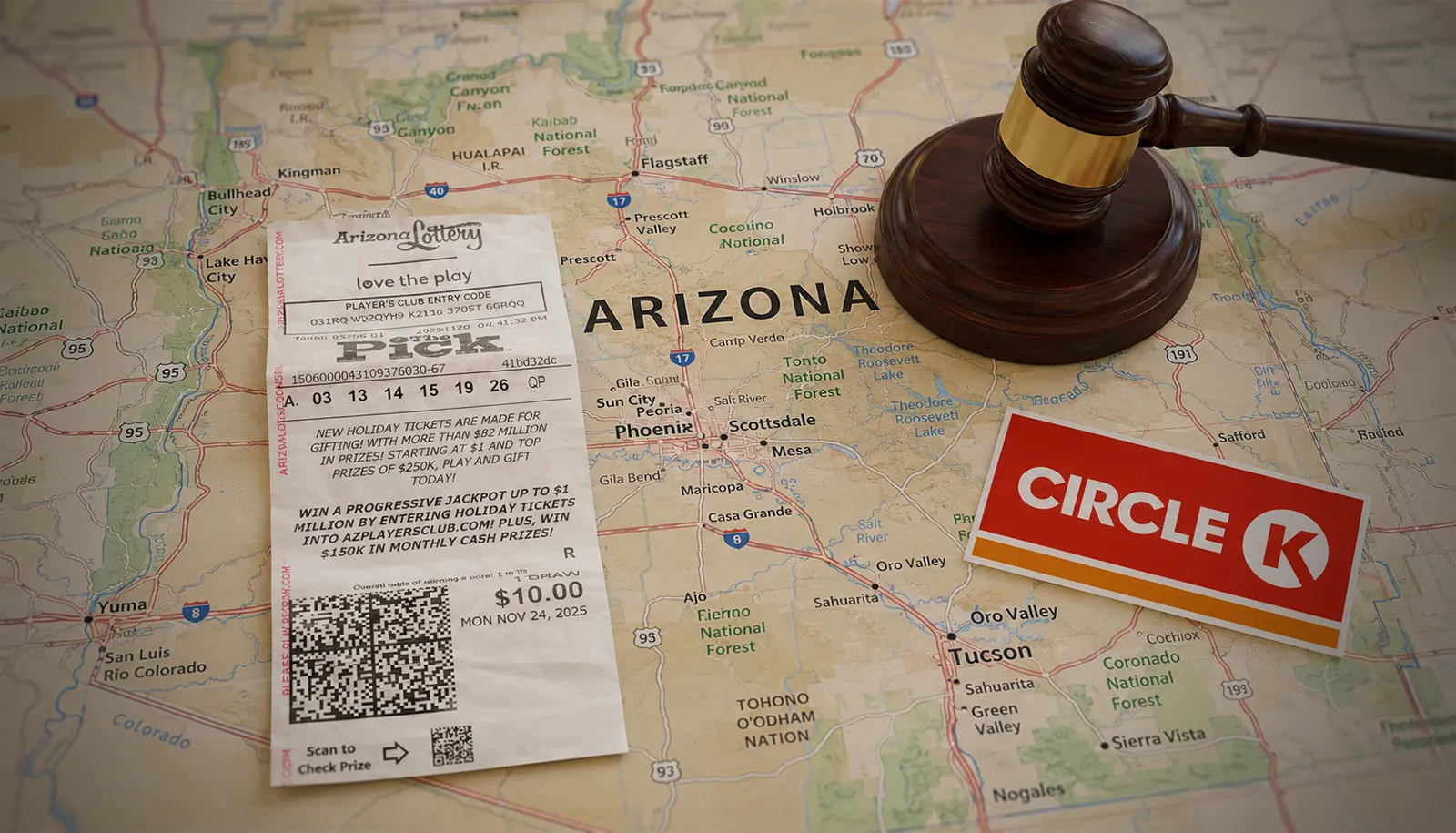
Our story begins last November at a Circle K store in Scottsdale, Arizona, where a customer comes in and requests $85 worth of $1 lottery tickets. However, $25 short, she only paid for part of the order, 60 tickets to be exact, leaving another 25 printed tickets behind at the counter.
The following day, store manager Robert Gawlitza allegedly discovered that one of the abandoned tickets had matched all six winning numbers (3, 13, 14, 15, 19 and 26) in Arizona’s The Pick lottery, making it worth $12.8 million.
According to court filings, Gawlitza finished his shift, changed out of his work uniform and purchased the remaining unpaid tickets himself, in line with company policy which requires employees to purchase any leftover lottery tickets. Till this day, Gawlitza has maintained that he avoided violating lottery regulations, followed unwritten company procedures and even checked with a supervisor before doing so. As his legal counsel explained to ABC 15:
So, if you accidentally print them out and they go unsold, it’s the industry practice for the person who prints them out to be responsible to pay for them. If not the person, then the store manager.
Circle K didn’t see it that way. The company terminated Gawlitza’s employment after 20 years with the company and filed a lawsuit in February, asking the court to determine who, if anyone, legally owns the winning ticket.
So Who Actually Owns the Circle K Ticket?
That’s the $12.8 million question.
Circle K is standing their ground, arguing that because the winning ticket was never paid for when it was originally printed, ownership never transferred to the customer. Under that interpretation, the ticket remains the retailer’s property until it is legally purchased.
The case became even more complicated when additional claims emerged. Another Circle K employee, the clerk who had printed the tickets, has also claimed entitlement after signing the back of the winning ticket and agreeing to split any winnings 50/50 with Gawlitza.
Rather than deciding the issue itself, the Arizona Lottery has held off paying the prize until the courts determine the rightful owner.
Why We’re Talking About This Case Beyond One Jackpot
A sum as high as $12.8 million is going to grab headlines all on its own, but the lawsuit that comes with it could have implications far beyond a single winning ticket.
The court may ultimately clarify when ownership of a lottery ticket legally changes hands, what rights retailers have over unpaid tickets and whether employees can purchase abandoned tickets without creating a conflict of interest.
Those questions rarely arise because most lottery transactions are straightforward. But this case falls into a legal grey area that could influence retailer policies and lottery procedures for years to come.
For now, the winning numbers have already been drawn — but the identity of the rightful winner remains very much undecided.

Popular News

Titi Poker Takes Over as Triton’s Online Poker Sponsor for Season 5
An $880K River and Three Other Remarkable Spin & Go Jackpots

Five ACR Poker Venom Mystery Bounty Heroes & Stories

BCPoker Makes Wednesday Golden With the $1,111 Golden $One Tonight
Latest News

Top Cash Game Players August 2026
Chris Klodnicki Wins GGMillion$ for the First Time in 147 Events ($406.5K)
CoinMillion Runs With an Overlay Again and an Unsuccessful Deal Attempt





Log in to join the discussion
Share your thoughts and see what others have to say.