
 EN
EN  DE
DE Surprise Shot Clock on 2026 WSOP: Main Event Structure Changed on the Fly

 PokerListings
-
 CoinPoker 150% up to $2000
18+ | Play Responsibly | T&C Apply
-
 Stake.US Poker $55 Stake Cash + 260,000 GC
18+ | Play Responsibly | T&C Apply
-
 Americas Cardroom 100% up to $2000
18+ | Play Responsibly | T&C Apply
-
 Betonline Poker 100% Up to $1,000
18+ | Play Responsibly | T&C Apply
-
 SportsBetting Poker 100% up to $1000
18+ | Play Responsibly | T&C Apply

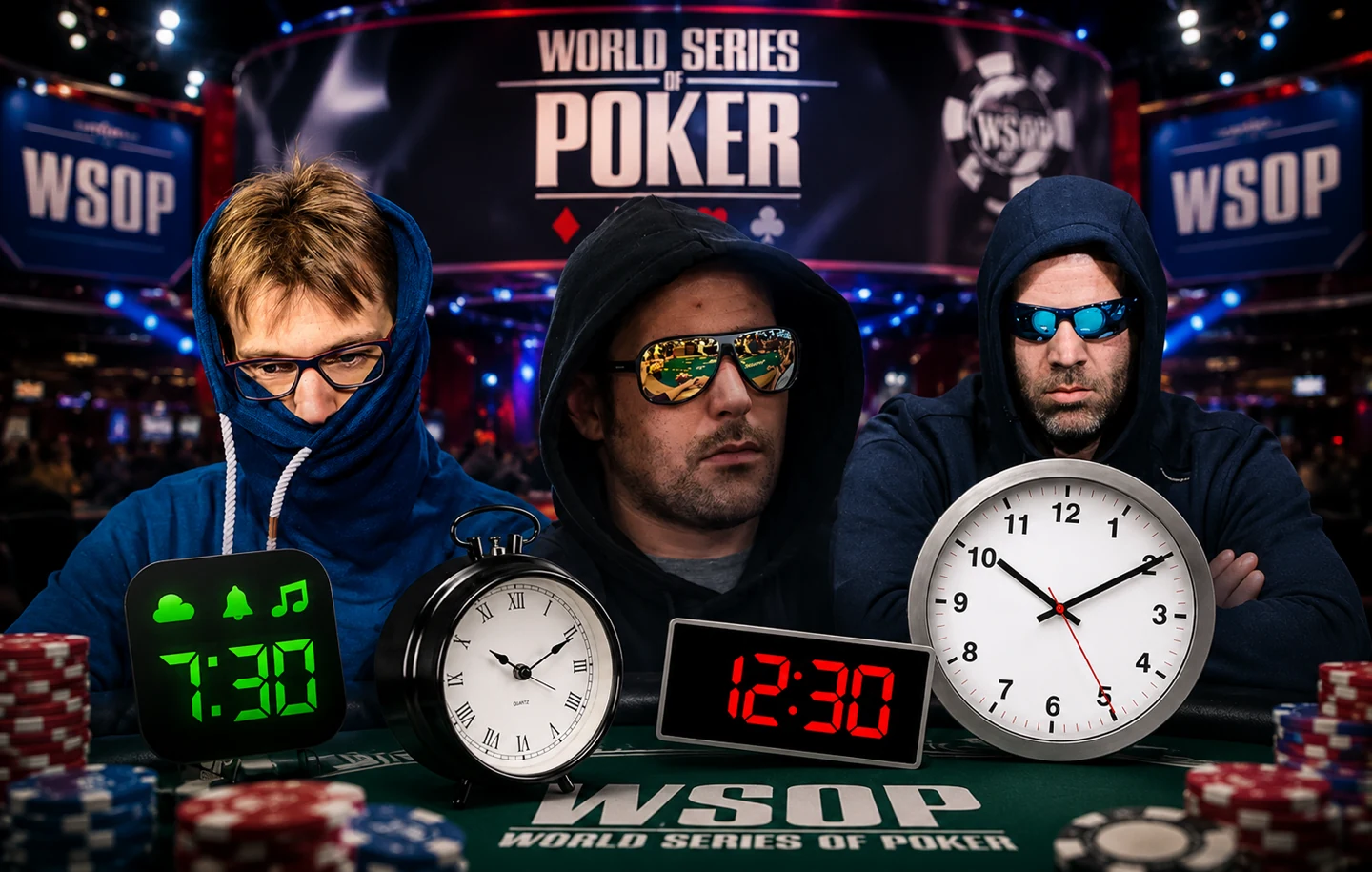
The 2026 WSOP is the gift that keeps on giving, even in the middle of the Main Event. For the first time in the history of the series, organizers unexpectedly decided to add a special shot clock on Day 7 of the Main Event, giving all remaining players just 20 seconds to decide their action pre-flop and only six time banks with 30 seconds each for post-flop.
While some players blame Loren Klein for this decision, who tanked on Day 6 for 15 minutes hoping to pay jump, others are criticizing the WSOP itself for a sudden change of structure showing more disrespect for the players than any time-wasting they themselves could have done. Let’s take a look at why the poker community reacted this way.
WSOP Rules Already Address the Tanking Issue
The time limit for everyone following a single tanking incident seems quite confusing to players when the 2026 WSOP rules already include Rule 80 Calling-for-clock, which describes the mechanism for activating the shot clock in different situations, including the following abuse of time:
Any Participant intentionally stalling the progress of the game may be placed on a clock for all decisions moving forward. Participants unnecessarily calling the clock or stalling, including purposely depleting time banks to ladder up in the payout, may be subject to a reduced clock or incur a penalty in accordance with Rules 40, 113, and 114.
However, applying a shot clock for the entire tournament is actually consistent with this same rule, as Daniel Negreanu pointed out in his video on this situation:
Host Properties, in its sole and absolute discretion, reserves the right at any time to implement an Event-wide “player shot-clock” into any tournament at any point in that tournament’s structure.
However, since the WSOP had never done anything like this before, and 15-minute-tanker Klein had already been eliminated from the event, some people saw other reasons behind the rule’s subsequent enforcement.
First, they did it to eliminate the hassle of activating the shot clock for floors during the remaining days of the Main Event, intimidating players with unexpected structure tightening.
Second, they wanted to speed up the action for a more dynamic game, making it easier to create entertaining content for TV.
After all, players have been tanking and stalling for as long as the WSOP has existed — but never before has a single instance of such behavior led to a time penalty for all remaining participants.
Considering that the latest WSOP changes around patches also appeared exactly the same year as the reunification with ESPN and new partnership with Warner Bros. Discovery, the theory about TV’s influence on speeding up the game after a single outrageous tank doesn’t seem so far-fetched — only time will tell whether it’s true.
Event-Wide Shot Clock Mostly Hits Amateur Players
While regulars are generally able to fit into the short decision-making period due to experience, for recreational players the new time limit often means even more pressure and stress in the deep run of an already difficult tournament where life-changing money is at stake. Especially if during the event the available time for thinking changes without prior notice.
At least, this is the opinion of a significant part of the poker community, although not everyone shares it.
Chris Brewer was among the first to publicly express dissatisfaction with the decision, criticizing the WSOP in several tweets:
Completely awful decision and insanely unfair to every recreational still in the field. Just giving an unbelievable amount of EV to guys who play high rollers who are still in and completely fucking everyone else. So incredibly anti changing the structure of this MTT in such a massive way. WSOP — this is legitimately a different structure MTT now. This is the same as turning the Chess World Championship from classical to blitz. I also don’t even think it’s good for TV. The long tanks in massive spots are part of the suspense.
When a couple of players stated that recreational players don’t need much time to think, Chris passionately countered:
Not remotely true, recs play way way way slower than pros in tournaments and are significantly more confused by the unique spots.
Andrew Lichtenberger supported him, calling this change “insane” and adding:
People unfamiliar with the format are going to be out of extensions in no time.
Jennifer Shahade joined the discussion, highlighting another issue of this limitation — a blow to tired people:
Everyone is so tired on Days 7-8! So huge edge for those whose C-game is good enough to sustain exhaustion AND shot clocks.
Even a few pro-shot-clock people, including Gallen Hall and Ryan Riess, were flabbergasted by the mid-event change of structure. As Gallen explained his thoughts in dialogue with Chris:
Seems crazy to hold them to the same standard as HRs (and again, doing this MID TOURNEY is nuts). I still like 20s pre, maybe 60s post, and then give them way more timebanks, maybe like 15.
Interestingly, Shaun Deeb publicly advocated for the introduction of shot clocks in this situation and emphasized that this measure is primarily aimed at regs:
The pros take way more time than recreationals. Very few recreational tank, it is way more the pros tank. So, I think this is better for the recreationals because pros can sit there for 7 minutes every turn and figure out: “Do I want 1.5x pot or do I hero call this guy? I actually think shot clocks are better for recs. I think that they are gonna be more impulsive, they’re gonna make their decisions quickly, they’re not gonna Hollywood as much. So, I think it’s way worse for pros. And I also think it’s a better experience for the recs.
Overall, after talking to people who are tired and frustrated by the wait at the tables due to someone else’s long deliberations, Shaun became confident that the introduction of shot clocks to the Main Event has only made it better for less-experienced players.
However, he also stated that for him personally, this WSOP decision is good because he can make decisions fast, so his opinion could very well be considered biased as a beneficiary. This is also indicated by his formulation that recreational players will play more impulsively under compressed time constraints, which can hardly be called a good thing for a lot of them.
Finally, in the comments, people pointed out to Shaun that the main problem with this change wasn’t the shot clocks themselves — they were already in place at the WSOP — nor the application of this rule but the sudden introduction of the new time structure without any warning. It was from this that the third reason for the community’s dissatisfaction arose.
Players Can No Longer Trust the Previously Stated Rules
While it’s common for businesses to leave a backdoor for potential rule changes at any time, in poker, and particularly at the WSOP, this never happened mid-event before. After all, poker players risk their money to play under certain conditions, trusting the operator to set them and ensure that all participants adhere to them.
Now, the WSOP is completely untrustworthy in this regard — and players expect literally anything from the series. They even started suggesting ideas for new rules and changes of structure that could be further introduced during the Main Event, starting with this gem from Isaac Haxton:
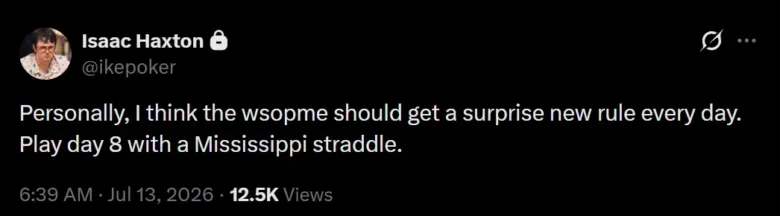
He opened discussion to highlight the absurdity of such changes — and others joined him.
- Scott Seiver: Announce on Day 8 that 13th place cashes for $0 now.
- Jerrod Ankenman: Maybe they could change the rules mid-hand, like roll a die on the turn to decide whether the card ranks are inverted, or all hands that contain a spade in the hole are dead.
- Jake Abdalla: Tag Team on Day 6, split back up 50/50 for Day 7.
- Randy Lew: Next year make WSOP Main Event have no pay jumps so people don’t stall aka winner take all. The bubble is when it’s heads up.
- DrKamikaze: New event format: floor comes up and changes the game AND the rules every level. No wait, just randomly whenever they get around to it.
- Finally, both Sam Greenwood and Steve O’Dwyer offered to add Decimator at the “10H FT”.
At the end of the day, the WSOP certainly has the right to change its own rules and tournament structures as it sees fit — it is, after all, a private business.
However, if this continues with mid-game surprises, the series’ reputation could be damaged enough to motivate poker players to choose playing under other operators that adhere to their publicly stated rules and announced structure — or at least warn players before changing anything.

Popular News

Titi Poker Takes Over as Triton’s Online Poker Sponsor for Season 5
An $880K River and Three Other Remarkable Spin & Go Jackpots

Five ACR Poker Venom Mystery Bounty Heroes & Stories

BCPoker Makes Wednesday Golden With the $1,111 Golden $One Tonight
Latest News
Top Cash Game Players August 2026
Chris Klodnicki Wins GGMillion$ for the First Time in 147 Events ($406.5K)
CoinMillion Runs With an Overlay Again and an Unsuccessful Deal Attempt






Log in to join the discussion
Share your thoughts and see what others have to say.