


The official rules of Texas Hold'em are actually very logical and simple and require just a few minutes to learn. Mastering Texas Hold'em, however, will take you a bit longer. Join us as we go through the rules and gameplay step-by-step.
Introduction to Texas Hold'em Poker
If you’re just getting started learning poker games and Texas Holdem Poker specifically, keep this guide handy for quick reference. If you ever get confused by the action, read below for some guidance. Each topic contains links to more in-depth articles on that specific aspect of Texas Holdem rules. When you feel you’ve got the hang of it and are ready to play, check out where you can play some real money online poker.

Before we get into describing the full Texas Hold'em rules and gameplay, here’s a quick glossary of terms you’ll encounter:
- Blinds: Short for “blind bets,” these are the forced bets made before the cards are dealt. In Hold'em, blinds take the place of the classic “ante.”
- Button: Nickname for the player acting as the dealer in current hand.
- Check: Similar to a call but no money is bet. If there is no raise preflop, the big blind may check.
- Flop: The first three community cards dealt.
- Fourth Street: See Turn.
- Fifth Street: See River.
- All-In: A player puts all of his or her remaining chips into the pot
- Preflop: Anything that occurs before the flop is dealt is preflop.
- River: The 5th and final community card dealt; also known as fifth street.
- Showdown: After the final round of betting when players reveal their hands to discover the pot’s winner.
- Turn: The fourth community card dealt; also known as fourth street
Read More:
Basic Texas Hold'em Poker Rules
Watch our How to Play Texas Holdem introductory video below. Then read on underneath for a more detailed look at all of unique Texas Holdem rules.
Texas Hold'em Poker is a community card poker game with game play focused as much on the betting as on the cards being played. Although the rules and game play are the same, the end goal is slightly different depending on if you’re playing a Holdem cash game or a Texas Holdem Poker tournament.
A Texas Hold'em tournament is the same as any other game of Hold'em with a few added rules and twists. Learn more about the unique rules of Texas Holdem poker tournaments. Meanwhile, a Holdem cash game is played on a single table with 2 to 10 players. The goal is simple: win as many chips as you can, one pot at a time. You win a pot by having the best hand after the final community card has been dealt, or by having all other players fold before the showdown. A full hand is made by combining your one or both your hole cards with the community cards.
A Texas Hold'em game can be broken up into three main parts:
- Setup
- Betting Rounds
- Showdown
Basic Video on Texas Hold'em Rules
You don't have much time? Our short video will teach you the basics of Texas Hold'em in just 2 minutes!
The Texas Hold'em Dealer Button

Once you have your players around the table the first thing you need to play poker is to have chips. Before you can figure out what kind of chips to give each player, you need to understand how the game works a little better, so we’ll get back to this. For now, assume all players have chips in front of them and everyone is ready to play poker.
The next step is picking the player who will start with the dealer button. Hold'em is played with what’s known as a rotating dealer, meaning a player will act as the dealer for one hand and then pass the role of dealer on to the player on their left when the hand is completed. To choose the dealer, either deal every player one card or spread the cards facedown on the table and have every player choose one. The player with the highest-valued card (aces are high for selecting a dealer) starts as the dealer.
The Button
If you’re in a live poker room or casino with a professional dealer (or someone volunteers to always physically deal the cards) the dealer button will still rotate around the table. Even though he or she is physically dealing the cards, for all intents and purposes the person with the button is viewed as being the dealer for the hand. Once the hand completes the player with the dealer button will pass it to the player on his or her left.
Texas Holdem Layout
Note that the Texas Holdem layout includes three flop boxes, one turn box and one river card box on the felt table. You may also have a play section marked on the table where your bets are made, away from your stack.

The Blinds in Texas Hold'em

Now that you have a dealer, you need to put out the blinds. There are two blinds in Texas Holdem Poker – a small blind and a big blind. These are forced bets required by two players to make sure there are some chips in the pot worth playing for. Without any money in the pot all players might be inclined to fold much more often, slowing down the action considerably.
The player directly to the left of the dealer puts out the small blind. The big blind (usually double that of the small blind) is then paid by the player to the left of the small blind. The size of the blinds will dictate the stakes of the game you’re about to play. Typically, you want players to buy in for no less than 100 times the size of the big blind. If you want to buy in for $20 you should play with blinds of 10¢/20¢. For convenience, most people will play 10¢/25¢.
In poker games at a live casino or poker room the maximum and minimum amounts a player can be in for will be in relation to the blinds. For example in a $1/$2 game the table minimum is usually $40 (20x the big blind) and the maximum is $200 (100x the big blind).
Related Reading:
- 14 Essential Tips for Your First Time Playing Poker in a Casino
- How to Beat Live $1/$2 No-Limit Hold'em Poker
Back to the chips: If you’re playing in a live casino or online your chips will be provided for you in increments that make sense for the stakes you’re playing.
If you’re playing at home, you’ll need to determine which chips to use and how to distribute them. Once the blinds are set we know what kind of chips we’ll need to play with. (In the above example we’d use 10¢ chips, 25¢ chips and maybe a few $1 chips.)
You want to give players enough chips in each denomination to allow the game to run smoothly. Typically a player will need only 10% of their total chips in the smallest denomination, as they are only ever used to pay the small blind. For the most part, all Texas Holdem betting will be done with chips larger than that of the small blind. Once you have the chips sorted out and the first blinds in the pot, you’re now ready to deal the first hand.
Related Reading:
Texas Hold'em Poker Betting Rules
The person dealing the cards deals to the left of the player with the dealer button first and rotates clockwise around the table. Each player gets one card at a time until each player has two cards, both face down. These are known as your hole cards and they are for your use alone when making your final 5-card poker hand.
When you play Texas Hold’em Poker, each round consists of a minimum of one and a maximum of four betting rounds. The first round of betting is when all players have got their two hole cards, also known as "Preflop". A hand ends when all players but one have folded or the fourth and final round of betting completes with multiple players still in the hand – whichever comes first.
At that point players enter into the showdown (to be explained in the next section) and the player with the highest hand, hole cards combined with the community cards takes the pot. If two players share the highest hand, the pot is split equally between them.
Example of a split pot:
Community cards are K Q J 10 3
Player 1 holds hole cards A Q making a straight using three community cards and his A Q from his hole cards
Player 2 holds hole cards A A making a straight using four community cards and one of the aces from his hole cards

Pre-Flop
(Note: The following betting rules apply to Limit Hold'em Poker. See more about No-Limit and Pot-Limit betting formats here.) When all players receive their hole cards you’re now in the pre-flop betting round. Each player looks at his or her cards and decides what action to take. In Hold'em only one player can act at a time. Preflop starts the first round of betting with the player to the left of the big blind. This player has three options:
- Fold: Pay nothing to the pot and throw away their hand, waiting for the next deal to play again.
- Call: Match the amount of the big blind (preflop this is also known as “limping in.”)
- Raise: Raise the bet by doubling the amount of the big blind. (Note: a player may raise more depending on the betting style being played, again see the rules for No-Limit and Pot-Limit above.)
Once a player has made their action the player to the left of them gets their turn to act. Each player is given the same options: fold, call the current bet (if the previous player raised, that is the amount you must call; if no one has bet it’s the big blind amount) or raise. In Limit Hold'em a raise is always the amount of one bet in addition to the amount of the previous bet. For example: if the big blind is 25¢ and the first player to act would like to raise they put in a total of 50¢ (the big blind + one additional bet).
If the next player would like to re-raise they would put in a total of 75¢ (the previous bet + one additional bet). Again, though, in No-Limit Hold'em a player can bet as much as the total amount of their chips on the table at any time. A Texas Hold'em betting round ends when two conditions are met:
- All players have had a chance to act.
- All players who haven’t folded have bet the same amount of money for the round.
Example of Two Betting Rounds
Example Betting Round 1
There are five players at the table:
- Player 1 – Button
- Player 2 – SB (10¢)
- Player 3 – BB (25¢)
- Player 4 – Under the Gun
- Player 5 – Cut-Off
Start of betting round
- Player 4 – Calls the big blind (25¢)
- Player 5 – folds
- Player 1 – Calls the big blind (25¢)
- Player 2 – Calls the big blind (since they already have 10¢ bet, they only have to add another 15¢, for a total of 25¢)
- Player 3 – Checks (since they already have the bet matched, they do not need to add more money to call; this is called checking)
End of betting round
When Player 2 calls the big blind all players now have the same amount of money in front of them. But Player 3 (the BB) has not had a chance to act so the round of betting is not over. Once Player 3 checks both conditions are met and the round of betting is over.
Example Betting Round 2
There are five players at the table:
- Player 1 – Button
- Player 2 – SB (10¢)
- Player 3 – BB (25¢)
- Player 4 – Under the Gun
- Player 5 – Cut-Off
Start of betting round
- Player 4 – Calls the big blind (25¢)
- Player 5 – Raises (50¢)
- Player 1 – Folds
- Player 2 – Folds
- Player 3 – Reraises (they already have 25¢ big blind in. They complete the bet of 50¢, and add one more bet for a 75¢ total)
- Player 4 – Folds ( previous call of 25¢ is now in the pot)
- Player 5 – Calls (matches Player 3's bet for a total of 75¢)
End of betting round
In this scenario all players had had a chance to act when Player 3 made the re-raise. But all players did not have the same amount of money bet. Once Player 4 folds, only Player 3 and Player 5 are left in the pot. When Player 5 calls, both conditions are met and the round of betting ends.

The Flop
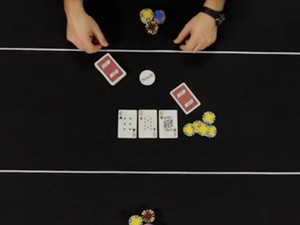
Once the preflop round ends, the flop is dealt and the second betting round starts. This is done by dealing the top card in the deck facedown on the table (called the “burn” card, it’s not in play), followed by three cards dealt face up in the middle of the table (see below). These are the first community cards, which all players can use to make their best 5-card poker hand.
Once the flop has been dealt the first post-flop betting round begins. The rules of post-flop betting rounds are the same as a pre-flop with two small exceptions:
- The first player to act is the next player with a hand to the left of the dealer
- The first player to act can check or bet; as there has been no bet made, calling is free.
A bet on the flop in Limit Holdem is the amount of the big blind. In No-Limit it has to be at least twice the size of the big blind but can be as much as all of a player’s chips. In our Limit Hold’em game as described above, a player must put out 25¢ to make a bet in the first post-flop betting round.
The Turn
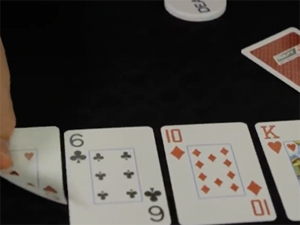
Once the betting round on the flop completes (meaning any players who want to see the next card have matched the value of any bets), the dealer again ‘burns” one card face-down out of play followed by the fourth community card dealt face up in the middle of the table beside the 3 flop cards (see image below). Once the turn has been dealt another found of betting begins, this is the third round of round of betting.
The third round of betting in Limit Hold'em is identical to the flop betting round with one single exception: The size of a bet for this round, and the final betting round, is doubled meaning that to make a bet in our game will now cost a player 50¢. In No-Limit Hold'em a player can again bet any amount of their chips as long as it’s at least twice the big blind or double that of any previous bet.
The River
Assuming more than one player is left having not folded on one of the previous streets, the fifth and final card, (the River), is now dealt. Dealing the river is identical as dealing the turn with one card being burned facedown followed by a single card dealt face up.
This is the final street and no more cards will be dealt in this hand. The final betting round is identical to the Texas Holdem round on the turn and players can their hole cards with the community cards to make the best possible hand. Remember not to reveal your hole cards before the last betting round is complete, this will in most cases "kill" your hand.
Showdown
Once all community cards have been dealt and the river betting round has been completed the players now enter into the showdown. At this point the best 5-card poker hand wins the pot. Here are the rules you need to know about a Hold'em showdown:
- The player who bet on the river is the default first player to reveal their hand. If any other players choose to show their hand first, that is OK.
- If no betting happened on the river (all players checked), the player closest to the left of the dealer must open their hand first, continuing clockwise around the table.
- If a player is holding a losing hand it is their option to reveal their cards or simply muck their hand and concede the pot.
For more on How to Determine the Winning Texas Hold'em Hand and Which Hand Wins, check the links below:
The Best 5-Card Hand in Texas Hold'em
In Texas Hold'em Poker you must make the best 5-card hand possible using any combination of your two hole cards and the five community cards on the table. You can use both, one or none of your own hole cards to make your best hand. Here are some rules about evaluating a winning poker hand:
- Remember the official poker hand rankings. There are no exceptions to this order: a flush always beats a straight; three of a kind always beats two pair, etc.
- There are no hands used in Hold'em other than the hands listed in this chart. For example having three pairs is actually only “two pair,” and the highest-valued two pair make up your final hand.
- Final poker hands must be exactly 5 cards and only those five cards are used to evaluate the winning hand.
Showdown Example
The board is 2 J Q K A Player 1 hole cards: 10 9 Player 2 hole cards: 10 2
Combined with the community cards, both players best hand has the same rank (a straight from ten to ace). This means the pot is split between the two players. The remaining cards and the fact Player 1 also has a pair means nothing – only the best five-card hand factors into deciding the winner.
If all remaining players have nothing (no pair or anything stronger), the winning hand is the hand with the highest-valued single card, meaning:
A
 A
3
A
3
 3
4
3
4
 4
6
4
6
 6
7
7
6
7
7
is a better hand than:
K
K
Q
Q
J
J
9
9
8
8
A
A
J
J
9
9
8
8
6
6
is a better hand than:
A
A
J
J
9
9
8
8
2
2
Suits are never used to evaluate the strength of a hand.
Once you determine the winning poker hand that player receives the pot. The dealer passes the dealer button to his or her left and the two players to the left of the new dealer put out their big and small blinds respectively.
Additional Texas Hold'em Rules
Raising
- A player must either declare their intent to raise verbally before making any actions or bring the amount of chips equal to the total amount of their raise into play at the same time. A player is not allowed to place chips, return to their stack and place more chips. This is known as a string bet.
- Solutions to any other random situation you come across can be found here.
Buying Chips
- The minimum number of chips a player is allowed to buy before their first hand dealt is determined by the house rules governing the game. Typically a minimum is 50-100 times the big blind.
- There is no maximum to the number of chips a player may buy at any time.
- In a cash game a player may reload, or add more chips to their stack, at any time between hands. Once a hand is started, a player may only use the chips they had in play at the beginning of the hand, during that hand. Any additional chips will not be “in play” until the next deal.
Play Texas Hold'em Online
Do you think you have what it takes to beat your opponents? Why not sign up at one of our many recommended online poker rooms below and test the waters? We have tested all big poker sites and those are the ones we can recommend:
Texas Hold'em Buy in Rules
A Texas Holdem buy in refers to how much it costs to enter a poker cash game or tournament. There are usually specific rules for Texas Holdem buy ins, which can also differ from one poker site to another. But here's the general gist of it. Most poker rooms will have minimum buy-ins of roughly 20 to 40 big blinds for cash games. Whereas the maximum buy-in would be capped at around 100 big blinds. In deep stack games, this can increase to 250 big blind stacks - and even more.
Occasionally you may get a choice of buy-in amount so you can choose to enter deep or short-stacked. It obviously costs less to enter short, but the downside is your implied odds decrease significantly post-flop. Meaning you your gameplay is limited, you'll see less flops and can win less chips. Also, you need to take rake into consideration - which is the % taken by the card room. This also makes a short stack less profitable.
However, you should still buy-in with what you a) can afford to lose; and/or b) are comfortable losing. Your buy-in amount may also reflect the skill level you're playing at and your bankroll. Even the best poker players have losing stretch and you should be able to cater that without affecting your life negatively. Remember: You should never take chips off the table - especially not pocket them to keep them 'safe'.
Practice Texas Hold'em Online Free
While the rules of Texas Hold'em might seem a bit complex in spots they really are quite easy to pick up in practice. And there’s nothing more important to learning the game than playing some actual Texas Holdem poker hands in real life. This can easily be done at home among friends (check out our full guide to running an amazing poker home game), at a real live casino or at online poker sites.
Playing Texas Hold'em Poker online might even be the easiest way to get comfortable with the Texas Hold'em rules as you can play hands at a much faster pace. You can choose to play for real money, of course, or you can start playing the free Texas Holdem games offered at every site. Check our page for the best places to play free Texas Holdem online here:
Related Reading:
More on How to Play Texas Holdem Poker
- Texas Holdem Tournament Rules
- No Limit Texas Holdem and Pot Limit Holdem Betting Rules
- How to Play Limit Hold'em Poker | Limit Holdem Rules
- Odd Texas Holdem Poker Rules and Situations
- How to Play Poker – The Ultimate Guide for Poker Beginners
- Best Online Poker Bonus Offers
- 10 Essential Texas Hold'em Moves: The Check-Raise
- Online Poker Tournament Series
Texas Holdem FAQs
-
What are the top Texas Holdem Official Rules?
1. BUY-IN - In a cash game, there is a minimum buy-in to enter, but you can reload or buy more chips at any point outside a hand. In a tournament you buy-in once, with the possibility of re-entering. Your starting stack is typically 100 big blinds or more.
2. DEALER BUTTON - This represents the 'rotating' dealer which moves after each hand. To choose the first dealer, each player picks a face-down card from the deck and the one with the highest value card is the dealer.
3. BLINDS - There are two 'blind' players after the button (clockwise) - Small and Big Blind. The big blind is the call price of the round and small blind is half of that. These are forced bets that the players in question need to put out to build a pot, irrelevant of their hand.
4. DEALING - You need to deal clockwise around the table, starting from the small blind. Each player gets one card at a time for a total of two hole cards. After a round of betting here, you deal 3 cards for the flop followed by another betting round. Then one more card for the turn, more betting, then one more river card and final betting. Before dealing each round, the dealer must 'burn' the card at the top of the deck
5. ACTIONS - Every time cards are dealt or turned on the board, there is an action. Choose to check (do nothing), bet (add chips to the pot), call (match someone's bet), raise (add even more chips than the bettor), or fold (discard their hand and exit the round). A bet must be at least worth two big blinds. Or if you raise, it must be at least double the previous bet. Each round is only over when all players have acted - either placed their chips, folded or checked around.
6. BETTING / RAISING RULES - You need to declare your intent to raise or the amount before making an action. Or bring their chip raise amount into play at the same time. You can't place chips gradually - This is known as a string bet and would be considered a call.
7. SHOWDOWN - Unless everyone folds to one player, the best hand at showdown (showing cards after last betting round post-river) wins the pot. The player who bet on the river should reveal their hand first. The other/s can show or muck/fold their hand and give up the pot.
8. THE BEST HAND - Poker hand rankings are as follows, with the best ranging from top to bottom:
Royal Flush
Straight Flush
Quads
Full House
Flush
Straight
Three of a Kind
Two Pairs
One Pair
High Card -
How many Texas Holdem betting rounds are there?
There are FOUR Texas Holdem betting rounds:
- pre-flop
- post-flop
- after the turn
- after the river (showdown) -
How should the Texas Holdem layout be?
Note that the Texas Holdem layout includes three flop boxes, one turn box and one river card box on the felt table. You may also have a play section marked on the table where your bets are made, away from your stack -
How many players for Texas Holdem?
A Texas Holdem cash game is played on a single table with 2 to 10 players. The goal in a cash game is to win as many chips as you can. A multi-table tournament will have a number of players divided into multiple tables with 9-10 players on each table. As players run out of chips and are eliminated, the number of tables reduces until the final table (9-10 players). Play continues until heads up (2 players) and then the final prize winner. -
How do blinds work in Texas Holdem?
There are two 'blind' players after the button (clockwise) - Small and Big Blind. The big blind is the call price of the round and small blind is half of that. These are forced bets that the players in question need to put out to build a pot, irrelevant of their hand. This is to induce more action from these players because they have the worst position. Otherwise they'd never play! -
How many cards do you get in Texas Holdem?
Texas Hold'em combines your two hole cards with the five community cards. The player with the best 5-card hand (out of 7) including BOTH hole cards wins the pot for that round. -
What's the most common winning hand in Texas Holdem?
The hand rankings are placed in that order for a reason. The more valuable cards are the ones that are harder to get. So by default, since High cards and single pairs fall at the bottom, these are the most common hands to hit. Therefore, Ace or King high cards, or pairs - most likely a pair of face cards since they're played more. -
What's the worst starting hand in Texas Holdem?
72 off-suit is mathematically the worst starting hand you can have in Texas Holdem. In fact, many home or cash games on TV have a bonus for winning with this hand to induce action. -
Do you shuffle after EVERY Texas Holdem hand?
It's called the Shuffle and Cut - and it's done after every hand. When a round is over and the pot is won and distributed, the deck must be shuffled. Live card rooms will alternate decks between hands. The deck must also be cut with minimum four cards with the bottoms of the decks hidden from players. Only then can dealer deal the next hand.













No limit cash game in state of Washington: I Raise under the Gun comes to Button who Goes All-in; I call I have more chips: In the Rules who suppose to Show 1st: I said he show 1st he’s the agressure & I paid to see his hand: Is this correct
self dealt texas holden tournament game. the turn card is exposed before everyone bet on the flop.. what do you do????
Hi, after the first hand is dealt, someone goes all in (say with their last chip) are they still in to see the rest of the cards? And play on them? Where if someone folds due to a raise, they do not get to play the rest of the hand.
Hi Josie,
A player that’s All-in can view the rest of the hand. Once the hand reaches the River the player can then show their cards.
The player that’s All-in must not show their cards until the remaining players in the hand have finished their moves.
Example Player A,B and C in the hand. Player A with the fewest chips goes All-in. He must then wait until players B and C have reached the end of the hand.
Player C can show their cards:
On the river when betting is over
or
Player B folds, leaving A in the pot with player C
or
Player C folds, leaving A in the pot with player B
If a player folds during the hand, then no they cannot continue to play the hand.
Should you need further assistance please let us know.
PokerListings Team
your down 2 2 players ,is the dealer little or big blind?
In heads up play the button is always on the small blind, who acts first pre-flop and last post-flop
Hallo can you continue to play in a hand if a player does not have any chips left after the first cards are dealt. Can you create a side pot to continue playing with the other players who do have chips left or not.
Hi Andriaan, Yes a side pot will be created for the remaining players with chips in the hand.
Manal
PokerListings
4 players with different amount of chips all go all-in.
Two of the players have the same winning hand
How is the chips distributed to the two winners?
@Mel: The two players with the same hand split the entire pot.
Hi .a player raises 2400 and dosnt realise another player is still in the hand and throws his hand in ..can he take his cards bacout from middle of table
Hey Aidan,
I mean, it’s an odd scenario if you raise and immediately throw your hand in after?
Most probably, this is not even allowed, and the dealer will tell you there is a player left to act.
If that other player behind re-raises and you throw your hand in by mistake, it really depends on the generosity of the floor man
– but most of the time this would be considered a fold from you.
If a player calls all in. Before players before him react those the call all in when it comes to him half to put all his chips in.
Blinds are 200/400. After the flop player A raises to 5000 player B goes all in for 5300 and player C calls 5300 but is not all in. can player C raise anymore?
Hey Duane,
if Player C just called 5300, then his action is complete.
Then it is up to Player A to call the remaining 300 (5300 – 5000), fold or raise again.
If Player A raises again, then Player C has the option to call, raise or fold.
if i bet afterthe river and get called am i allowed to see the callers hand when i show and he mucks?
@frank: Online: yes. You can always see mucked hands. Live: no. If a player mucks, he gives up any chance to win the pot, but you cannot see his cards.
@Warren: Hiding your big chips is frowned upon and can be seen as angle shooting and no player should be doing this. You’ll have to check with your local casino whether they have any specific rules against this in place as there is no general official rule.
Is there an official rule that your largest denomination chips must be in the front of your stack, or, is it just a common courtesy.
Question, in a tournament and the blinds are going up and it is also time to race off chips, can a player get knocked out of tournament if they only have one chip less than the amount to be chipped up
Some poker rooms would round it up, however this depends on where you’re playing.
Texas hold them, after the river Card a player makes a bag and then looked down to see he only has one card in the hole, what is they called? He did not mark his cars but one came up missing.
If my 3 of a kind beats the dealers 3 of a kind, I WIN, Right. I have three kings, dealer has 3 9’s.
Hey Bon,
Yes, but remember some cards on the board may play as well. If you have one King in your hand and two on the board – while dealer has a pair of 9s and one 9 on the board – then they have a full house and you have a set – so dealer would win. What was your situation?
Straight beats a pair, if that is what you are suggesting. Always, 5 cards make the hand, so if player 1 chooses to make their hand with their Q plus the community Q, they have a pair of queens and they lose. Assuming player 2 uses the AKQJ to complete a straight with their 10. Normally, player 1 would not make such a mistake and the pot is split as both players make their hand from the community cards.
Do you have a reference for this rule as we had the same issue,
Technically yes, as the verbal “raise” s binding so the table knows a raise is coming.
you are wrong.I Have since posting this found the correct answer. After the hand is wonwith ghe best hand, the person who comes second is he/she with the most chips.
Next best hand…
Not correct – for the hand to proceed, every player still in must have put the same value of chips into the pot. Every raise, must be called, folded on, or raised.
Just to make sure I’ve got this right…
If everybody in a round raises then the last player is putting in more money than anybody else – so more to lose? So in practice the last player would never do anything more than call, right?
I am not sure if this question is going to make sense but I hope it does We play friendly games of Texas hold’em. OK let’s see if I can make sense of this there was three people left on the table playing one person had maybe 40,000 in chips one person had 30,000 in chips and one person only had 8000. So the Dealer put in first because we were blinds she decided to go on and she only had 1000 so it was her 10,000 and then her 7000 after I had to go because I was a blind which I only had to go in Half if I want it was on sure what to do but I went with her the 8000 the other lady had to go when her 10,000 because she was the big line now she decided to go in all which the only other person that could i’ve matched her was me Which I ended up doing That money went to the side because the other person the dealer and no other money No the big blind person one so she got all the money no we always play first and second place and high hand if no one other than the winner has any chips does she get all first and second prize money I thought she did but they’re trying to say she didn’t so does anybody know the answer to this just so you know we play a friendly game of poker it’s a bunch of older ladies that are playing we do it for fun and we’ve always had first place second place high hand Thank you sorry so long of a piece here I just wanted to make sure I wrote everything in there to hopefully find out if somebody can give me the info on this for the next time if it ever happens again thank you again
They do deal to your Seat…. then they fold your cards….right
Dose the dealer still deal you in if you got money on the table and you take a break
obviously read the proper rules lol
If there are only 3 players and the all in is called, there should be a showdown. Player A and B shows their cards and the dealer deals the river.
The call bet is $100. A player on their turn says I’m going to raise. They then take $100 in chips and say here is the call and then goes back to their stack to get their raise. Is that legal?
Lol
Sorry this may sound stupid but had this situation last night and I would like to know the RULES.
Player A (p), B (w), and C (l) playing. A – check, B – all in, C – fold, A – call.
1) Who opens cards first if river still needs to be dealt. Dealer / A / B / Both Players
(My answer – Dealer)
2) MUST player A show his cards?
(My answer – No, his choice)
3) May player A muck his cards?
(My answer – Yes, his choice)
how do you gauge who comes second in a 4 way all in?the chip leader wins the hand.but is second place dertermined by the next best hand or who after the chip leader has the most chips?
Sure.. its called a premature turn. Basically, you will announce that action wasn’t complete on the flop and the turn card will come back. Complete the flop action, put the turn card to the side, then burn and turn the river. Complete the action on the river card, take the premature turn and shuffle it with the stub. Cut the deck stub, deal the new turn without burning a card
Hello there, i made a mistake when dealing the cards and we argued about it and could not find a solution. when the flop opened first player said check, 2nd player said check, 3rd player said check and i did not realise the fourth player and opened the fourth card and everybodys saw the card than the fourth player said i was gonna raise and what i did was get the fourth card back in to the deck shuffle and continued. is there a rule about this
thanks
It’s a 5-card game – you use any 5 cards from your own 2 and the 5 community cards on the table to make the best poker hand. In the first screen, the players split the pot because they both make the hand: pair of 5s + A K Q. In the second screen, yes, the bottom player has a pair of Q, but neither of them is a club. The top player has 9 of clubs which he can use with the four clubs on the table to make a flush. The second player has 8 of clubs so he also makes a flush, but with lower ranked cards so the top player has the best hand.
It’s a 5 card hand, so nr 2 has A A Q J 10, nr 3 has A A Q 10 8. This is why nr 2 wins.
Hello. I wanted to ask, shouldn’t have the hand Nr. 3 have won together with hand Nr. 2? The kicker is Q of spades, so J on hand Nr. 2 shouldn’t have helped, am I right?
Call me a donkey at the tables and it will be on and POPPING like Pop Corn!!
Yes!!! He knows nothing regarding the game!!
Seems odd. Should have been a miss deal. Or if the player hadn’t looked, the dealer could choose a random card out of the 3 and shuffle it back in the deck.
No. He only has to post if he has missed his blinds. Each casino has different rules, but taking 10mins for a toilet break etc is acceptable. Normally if they miss a few orbits, their chips will get locked up.
So card rooms like in London allow others on the list to play that seat until the player has returned.
Not too sure what you’re asking. The top image, no player can win at showdown. Both are “playing the board” with their Q, so its a split (tied) pot.
Second image, McAllister has a “Pocket Pair” of Queens. Watson has made a flush (4 clubs on the board) and nine in hand.
no
You have hand strength meter active and therefore you pay for it when you wiin. OK?
not necessarily…
Not necessarily. It might depend on the 10 and/or the Q. If it makes a royal, than royal wins, obviously, it might also depend on the 6 if it makes it a flush…
in 1st round he checks if he does not wish to raise
You should strike him on his forhead with a big giant dildo, because he is a dickhead…
no
put them back, reshuffle and go again
Can someone explain both hands to me, in 2nd image the third player holds pair of queens??
I have a question about Texas Holdem rules and the deal. Dealer deals the cards, preflop betting is done, flop comes, before betting is complete, dealer burns a card and turns the next card. the question is, some say that card should be shuffled back into the deck? then they say that the remainder of the deck is to be shuffled with the exposed card? This I find to be unfair to players who are betting their cards and the flop, to shuffle the deck would certainly be a disadvantage to them. Does shuffle that card actually mean to shuffle the remainder of the deck? The second part is, does the exposed card before betting is done just become dead? Thanks for anyone who does in fact know the ruling on this.
After you finish a game of texas holdem and you are going to play again, do you put all the used cards back into the deck or do you keep them out? Like what you do in blackjack
In a cash game. If the player leaves the table behind the dealer, say to visit the toilet. Then returns before it is his turn to post. On returning, does he have to post the blind before it came round to his turn, even though he missed out only on couple of hands?
at the state champs a situation occurred where a player was dealt 3 cards by accident,i thought it was a redeal but the tourney director said as there was no action ??the players hand was mucked and that hand resumed play???
is this right?
So is spelling.
really complacated I only read it because I have the game but never really played it…
sounds complucated
if three players are in a hand and two player show their cards, are both hands dead?
Yup, goose down is about as helpful as a donkey. Just read how much poker knowledge he shares in his responses here.
The rule for the dealer is… No you supposed to know the rule I’m not telling you
Yup they are big donkeys
My son in law says he knows the rules of Texas Hold’em but he does not know what the Flop is should I consider his version of the rules or read the proper ones I am new to this game…
The pot is split they both have a straight it is the best of 5 cards
Two questions about BB
First question:
What I’ve understood is that in Betting Round 1 BB can:
1. Check if others before him called or folded
2. Raise if any of others called
3. Re-raise if some one raised before him
and in the Betting Round 2 he can also Call if someone raised before him.
(Call in 1st betting round has not sense for BB, because he already did his bet)
Is this right?
Thanks!
both, both are using A K Q J and 5th card 10..
Q 8 obviously
u r screwed
all in
kicker..
four of a kind wins obviously
but this hand is in the community cards so both are winning in this case
both the players make their best possible 5 cards combination with obviously the 4 cards of 4 of a kind in it, the 5th card decides(kicker) if this 5th card is also taken from the community cards meaning this card is better than the 2 cards player 1 or 2 have, both share the pot..
if two players hold a house each and there is a four of a kind on the board how do you determine who wins ?
during a hand if a player wants to know how much another player has in front of him. What is the rule for the dealer
when a player does not have enough chips to post a blind what is he rule?
I play a little poker at home but haven’t tried a casino yet. I don’t know a couple of things. Can I see my cards before its my turn? Are you allowed to talk about what hand you might have? Why does the betting switch on the flop? Can you call other players donkeys?
If all 5 cards are on the table with a natural flush having an ace high. two players are also holding this suit in their hold cards, one has a king the other a ten. does the king constitutes a win or the ace rules over all cards creating a split?
If a player goes in but doesn’t no he has the winning hand in taxes holdem can somebody say if he won
what happen if i click back to lobby button when playing 3rd level shootout in a middle of a game?
if you go all in pre flop with another player and dealer flops cards that was mucked and flop was in the hand do you stop and start over
Q 8 against Q 7 on the is Q 9 5 3 2 who wins?
10 Q against 10 6 on table is A K Q J 4 Who wins ?
Every time I have money over 1 million or 500 thousand dollars it is taken away from my total. I DO NOT UNDERSTAND.
bPlaying pot limit hold em a player bet 120 the next player said raise and he called the 120 and only put a 100 in. Is that considered a raise
@shaun hand A2345…its a five high straight…well then ace is not higher in that hand…but if its A,k,Q,J,10 with diff suits…ACE IS HIGH because its a ace high straight…
Mike ..K/3 is the winning hand…though ader player has a pair of 10 in the board its porfitted by a higher pairs on the board aa
Jack..you can cash it Out if u decided not to play anymore…only it can be dead money if u bet it in the game….
Dick.. according to poker rules always wait for your turn to act…
Gloria…2 other players should put 1000 though all in player is shorts stock…there would be a side pot in the game
someone else should be able to play for them Jack and Gloria you’d have to put 8×4 in one pot which would be 3200 in one pot and one for the remainder would be 200 ea. would be 800 this is a side pot which would be if the remainder of the players want to bet into it. Bbank I would not fold I’d raise and give a convincing read it doesn’t matter on what cards you’re given just on how you choose to play them and how you utilize the tells that are given out.
if after the river the cards on table read AAQQ10 AND 1 PERSON HAS A 10/ 4 IN HIS HAND AND ANOTHER HAS K/3 DOES THE K3 WIN EVEN THOUGH 1 HAND WOULD HAVE AAQQ1010 BECAUSE YOU CAN ONLY USE 5 CARDS RIGHT AND THEN THE K WOULD BE THE HIGHEST KICKER?
WHAT ABOUT adding a printer friendly version
3 people in betting 1000.00 each on Flop, turn one player is all in with 800.00, do next 2 players only put in 800.00 each or should they put original bet of 1000.00 each
if you put chips over the line before it is your turn to act, is it a binding bet?
What if a player decides to “Quit” the game and has a substantial amount of chips, what happens to his chips? Are they dead or do the rest of the players at the table divide them up equally?
i got a question…suppose all the community cards are of the same suit(flush) and it also contains an ace,so will the pot be divide among remaining players or a player with a king of the same suit but not producing a straight/royal flush take the pot.
I am researching and studying about the poker, can you help me by giving you comment about the happening case:
If you are the third player, where “the first player had bet and the second player had fold”, will you call or fold ?
*** Condition: let forget about the value of the cards and the amount of the bet
Let just follow your instinct that “you call becuz you believe that you will have more chance to win” or “you fold becuz you think that the pot is not big enough to take a risk”, which one you think you could follow, please give me one choice
If the winning hand is in the hole cards being two pair who wins the pot one player has a smaller pair and the other two people only have high card
Here is what should be an ez one; are Aces always high card? Point of fact A, 2, 3, 4, 5
When blinds it’s 500/1000 and one player had 1800 all in and small blind call, can the big blind doing Reise?
lots of questions, zero answers…
how many chips do you start with
Can I flip up my hole cards before the better (to my left) to see and then continue to play?
i don’t mean to complain but would you know wut a hand its if u didn’t know anything about poker and how do you know how to make a combination.
how do I leave a game halfway through? Do I have to go all in?
what happens if a player picks up wrong cards
How many cards in a hand?
When a player says,”I see your bet and raise you” is that a legal form of betting. My friends don’t think its legal.
If player goes all in after a raise.but the amount is less than minimum raise. Can a player after him still raise or just can call ?
if the dealer turns up 4 of a kind, do the players still playing split the pot, or does the player with the highest 5th card win???
Does the Ace go both ways in Texas Holdem?
is Playing Donkey style Illegal or not
Where do I find the answer to my question
when two players end up heads up in a free roll game and one player bets out on the flop, turn and river to be called on the flop, and turn by the other player who then throws his cards face up onto the table with the mucked cards is the hand over or can this player still call the bet.I would think if a player throws his cards a way face up or down he is conceding that he is beaten,Is this the case, sure would like to know.ThanksKevy
If two players are left in the tournment a
nd the button is moved to the person that was just the small blind and the other person was just the big blind should the button be moved to the one that was just the big blind
If two players are left in the tournment a
nd the button is moved to the person that was just the small blind and the other person was just the big blind should the button be moved to the one that was just the big blind
in a live 9 handed no limit holdem cash game where does the action start if a player 2 seats after big blind puts out a “missisipi stradle” of over 4 times the big blind?.From the big blind missing the stradle player and then the other players on to the small blind and big blind then the stradle player or from the stradle player around in order back to the stradlle player or from the stradle player around to all the other players and then the small blind and big blind and finally back to the stradle player.Can i get clarification and where can i see this?
question:if I am in a game every one but 2 fold since we have bet are not the ones who folded required to show their cards ,since we paid to see them?
I had 4 aces and my opponent had a red 3 and a red 2. I win don’t I?
Unlucky man, I hate those casinos. 2 years ago my mate was caught cheating at roulette and the mafia boss cut his fingers off. It went to court but no evidence was found so no luck there but now he’s missing two fingers on his left hand.
@Mark….What you are thinking this could be is ‘collusion’ however in this case its not, its totally legal. You don’t have to answer if you don’t have to. its legal because hes in the hand, its heads up, hes only talking to you and not seeking advice/information from people that aren’t in the current hand. its part of the psychological battle in poker. sure the way he went about it is poor etiquette. and regardless of his acting, it still would have been hard to put him on the nuts. however to discuss live cards with others that have folded or are watching is ‘illegal’ but if he was like, I have the ace, you had to then decide whether or not he was lieing. if you believe him then its his disadvantage brought on by himself and not a 2nd or 3rd party. to manipulate (bit of a harsh word) but that’s part of the whole psychological side to poker, make you opponent think you have certain cards, or not (in simplistic form)
Table talk is a big issue at my weekly game. 3 Aces on board…with KQ hearts n my hand and had ace high flush hearts. Final bet i bet aggressive and opponent acted scared of calling and kept asking if i had the ace….i never respond to table talk and opponent decided to go all in….i made bad decision to call and lost to his 4 aces….is this fair or legal to manipulate and discuss cards on an open hand?
@neil sim….no you cant play on there behalf. there chips will still be left at the table though and will pay the blind set each time round.
@Eddie, it depends where he threw the cards. if he flips them over in front on him then its not a muck. if he throws them into the middle, or over that line that circles the table (he can put them over the line if he keeps his hand on them at all times before bringing them back over)
@confused poker player….yes you are correct, he should have shown both or just the aces. otherwise it says that hes playing the 6, so your 8 would win, its good practise to show both.
@igor both are split pots…..both will play the board as in both instances the community cards make a straight
@Anita player two wins…the best hand will look like this – K K Q Q J….player one loses the pot although he has a pair of fives, they are countered by the board pairing up twice…and then it comes down the kicker/high card which is the J
@Illyia Ace King wins the pot. would have been a split pot unless that ace came. AA88K vs AA8810…the king kicker takes the pot
@Shazza since its the dealer who isn’t active in the game then its not cheating unless someone who’s in the hand can see the cards that the dealer is looking at. if hes keeping them to himself its fine. its more ‘frowned’ upon, and depends on how strict you want the rules to be, if its pub poker or the likes, then get the organiser to clarify THERE rules, some may allow it, some may not. but outside of the social poker scene it is a no no. but inside the social poker scene then its fine, but like I said aslong as players in the hand cant see the cards that hes looking at, if they can, then its classed as cheating regardless of where you are playing the poker
If there is a sole dealer in the game with 4 players left and the dealer is looking at all the folded hands is that not considered cheating?? he said he is the sole dealer and can do whatever he wants.
ace king v ace 10 flop comes 884 turn 4 river ace who wins?
2 kings, 2 queens, five on the board
player 1 had 5,2
player 2 had J,3
who wins
if the board is 6 ♥ 7 ♣ 8 ♣ 9 ♠ T ♦ Player 1 holds A ♠ 7 ♣
Player 2 holds A ♣ Q ♣ who wins?
if the board is T ♥ J ♣ Q ♣ K ♠ A ♦ Player 1 holds T ♠ 7 ♣ Player 2 holds 8 ♣ 2 ♣ who wins?
don’t we split this hand ?
Any game if 2 players are left and the board has two 3s and three 4s a full house one player has K-8 other player has A-7 who wins the pot
First time playing
In the showdown can you only show one card or do you have to straight away show both? For example I was playing last night and my friend showed me that he had a pair of sixes(one six on hand and the other on the flop) and I had pair of eights so I went in to collect my money when he showed me suddenly that he also had pair of Aces. Should he showed me both of his cards right away or was he right by doin it this way?
was playing a home game when the player to my right announced a raise and i mucked straight away..2 players said i broke the rules by not waiting till the player said the size of the raise..did i break the rules????
I was in a cash game. after the river card was played I went all in, my opponent was deciding whether or not to call, while he was deciding he took his too cards, turned them over, and threw them on the table… he said he was not mucking. I said that was a muck…what is the rule?
If two players are left after the flop and one goes all in and the other player calls and has more chips, is it a rule that both players must reveal their cards and then the turn and river are shown? Thanks for any help
In texas hold them all, the dealer offers the deck to the player on the letft, who just taps the deck, can another player demand the deck to be cut by another player?
In a cash game is it okay to two one or both cards without actively mucking. And if I am in the hand can I talk about my hand.
@Leslie
its straight flush it must be split pot if any player had 10diamond he would take the pot.
Leslie it is a 3 way pot due to the fact that the board ha. A straight flush on it. In poker the top 5 cards win, now If it was another diamond other than the 7 not giving everyone a straight flush then the ace high flush would’ve won
(if there has been no raise before and turn gets to big blind, he raises) . does the round goes on. or what. pleas help.
when playing texas holdem knock out tournament if someone had to leave the game for whatever reason can someone take over and play on there behalf
hope you can help me
THANK YOU
Adoro poker
When playing texas hold em poker and i am closest to the dealer as first to check or bet but someone bets before me when its up to me first can i check and claim that it was a false bet??
IF YOU SAY ALL IN AND THEN YOU DONT PUT IT IN AN THEY TAKE THE MONEY DOES IT COUNT
when playing holdem can you tell your opponent what you have
Awesome! I was searching for these rules!
Who gets second place in the following situation in a tournament situation:
3 players left in a game, short stack goes all in, other players call pre-flop. Flop comes and the other two players go all-in. Big stack wins the hand, knocking out both the other players. The short stacks cards would have beat the other loser. Do the cards decide who is second, the relative chip stacks at the start of the hand or are they joint second?
In a timed game, what happens when a player goes all in? Does he set his chips aside from the pot? Does he count his chips, because other players have more chips than him? If he wins the hand, does he only win what is equal to his chips from the other bettors or does he win the entire pot? Do other players match his bet? Then what happens to the pot if he only gets his winnings out?
I am heads up in hold-em and my opponent shoves, I flip my cards over showing QJ whilst deciding but the dealer says that is a call by showing as it is similar to string bet… even though he is all-in…
@Vengie Sia In Texas Hold’em, both players tie, because the full house is the best combination of 5 cards for both players. If it had been 3 eights and 2 aces, then the player with the 8 could have played a 4 of a kind with his or her 8. Suits don’t have strength, so the 8 couldn’t be swapped to make it stronger in texas hold’em.
@Mary
In Texas Hold’em you take a combination of five cards out of seven available. Remaining two cards don’t matter. It’s always best 5 cards out of 7. So if common cards are e.g. 99977 (full house) and players have A6 & A3, then the best 5-card combination for both of them is 99977. It’s a tie.
It could be different if combination was e.g. 22266. In such case A6 guy wins coz his best combination is 22666 and the other guy still has 22266.
If a full house is dealt on the flop and two players have Ace high in their hand. One has an Ace, six and the other has an Ace three, do we split the pot? We had a huge arguement on this at our last poker game.
Hello we use to play poker and we encounter a problem last night we have two players, player 1 has K and 10 player 2 has 8 and 6 the community card on the table comes out as 3 Aces and 2 8ths so its a full house, we want your help to know who wins that game. Hope you could help us thanks.
If a player shows his hand to someone who is not in the hand or an outsider what is the outcome.
good game
If all four players have “FLUSH ” please explain to me from 1 to 4 who is weakest and who is strongest, thank you.
1…..Strongest ( which sign)
2…..Little weaker (which sign)
3…..More little weaker (which sign)
4……Weaker player (which sing)
Quiero saber donde puedo encontrar la totalidad de las normas del poker para torneos y para cash en español, las necesito para un poker room. muchas gracias…
Explain what is the kicker and when does it come into play
If someone mis-declares their hand on the showdown, does this count as cheating. What is the correct course of action if another player decides not to show their hand in the showdown due to a player’s mis-declaration but then discovers that the previous player mis-declared. i.e. one player declares they have a straight. Player 2 has a pair of kings, but says they won’t show as they believe they have lost. Player one is then called up as it is shown they do not have a straight. Has player 2 technically folded? Do they lose the hand, or is player 2, upon learning that player one mis-declared allowed to retract his decision given that you assume that at the showdown people will declare their hands honestly?
My personal opinion is that player 2 should be allowed to show their hand and win the game as player one technically cheated in the phase of the game where people are meant to be honest and declare only their real hands.
Hi my name is Anthony and I’m from Dublin, Ireland. I came across a situation whilst playing a game of poker in my local pub which caused a bit of a fight. Here’s the situation: There were four players left at the table. As it is a timed game it was known that the next hand would be the last of the night. 2 players had roughly the same amount of chips left with prize money going to first and second they were both guaranteed money. Player A looks to be in lead, with player B close behind. Players C and D have roughly the same short stack and can only get their money back by fighting for third. C and D are small and big blind, into player A who folds and is now out of the hand but happy in the fact he thinks he has first place. Player B then calls and Player C goes all in. Player D calls as he needs to beat C to get third. Player A has folded so into Player B. This is where the argument started. In order to decide whether or not it was worth her while to call the all in bet, Player B asked Player A to count his chips exactly before she decided to call. The argument then started that as Player A had folded he had nothing to do with this hand and was not required to count his chips for Player B. What is the official ruling here? Is Player A required to count his chips, even though this will give Player B an advantage to win more chips and essentially win first place? Thank you so much if you can answer this for me soon! Dia Dhuit from Ireland 😀
Love to play poker!
If after winning at one table I am assigned to go to another table, what deternmines who is the big blind at my new table?
@ sarfaraz, gary7, and others:You list different scenarios, but the same rule applies. In Texas Hold ‘Em each player plays the 5 best cards between the table and your hole cards. e.g. both players have a pair of kings, you then work down the “kickers”, if player A holds a J, player B holds a 5, and the other 4 community cards are Q 9 7 6, player A wins by virtue of second kicker. Repeat that with player A holding a 2 instead of the J, and the pot splits since the next 3 high cards are on the table.
Or let’s say that a straight runs the board, (5 6 7 8 9) with player A having A K and player B having Q Q. Player B’s pair is counterfeited by the straight on the board, and the pot is split. If player B has Q 10, he counts the 6 – 10 and wins the hand with the higher straight.
Whats the rule on a exposed card while dealing if all players has received 1 hole card
SHOWDOWN ON RIVER IF A PLAYER CALLS THE BET, IS IT MANDATORY
TO SHOW HIS HOLD CARDS
If there’s a 4 of a kind at the table ! Then what happenns who haves the higher card winns?
okay i have a question, lets say the five cards on the table are
J 6 3 10 10
and in my hand i have J and 6
then my opponent has J and 8
would i win because even though he has the highest card would i not win because i have to pairs in my hand
@ Matt: Dealers cannot kill a winning hand that was tabled and was obviously the winning hand. By any doubt, call a TD/floorman/supervisor.
in holdem, on a called hand do you have to show your hand if requested by a player?
Another player and I thought we had tied a hand so we split the pot. Before the chips were put into our piles and the cards had not been collected I realized that I out-kicked him. (The dealer should have caught it but he didn’t.) I told him that I had won but he felt that we had already called it a split pot and refused to give me his half. The chips had been split and pushed in front of us but they were still separate from our piles. What is the rule in this case?
-Thanks!
I would like to know if there are only 2 players left and they can raise three times right? If they are all done they should show cards; however, question is here now. Should they show both cards or only one card? Also is the player who raise the last have to show both card?
Quick question,
Can a player use an ace like this K,Q,A,2,3,4? My brother thinks he can while I dont believe so because your ace is being used as your lowest and highest card in the same run.
In a recent cash game a situation came up in reference to correcting a dealer mistake. The flop was on the table. The dealer missed the last player of to act. As the player was placing his bet on the table the dealer placed the turn card on the table. before the chips from the player betting hits the table the turn card is revealed. The dealer explains to the table that the bet would be allowed and the option to call was now available, but he would then have to remove the turn card from the table, burn a card and place the river card face down on the table put the turn card mistakenly produced back into the deck, shuffle and without burning a card because he had already burned the turn action place a new turn card out on the table and then return to bet action, then the river card would be revealed from its position on the table. 3people of the nine at the table agreed, but the host of the game expressed his discontent witht the corrective action the dealer had explained. The dealer explained that by doing it this way you preserve the true river card while allowing the mistaken turn card the be available to resurface in the deck and deal. The host made a ruling and stated that the dealer should just put the mistaken turn card back into the deck shuffle and provide a new turn card. As a result of the decision one player left the game immediately and the talk of the table for the next half hour was on the ruling. I feel the dealer was ccorrect in his assessment and explanation, but the host made the call. What do you think!?!?!?
one question; If I got AS, 2, 3, 4 5 Heart and some body else got for e.g 6, 10, J, 8 7 Heart.
Who won?
If you have 2 players in a hand with a #3000+ POT, and the dealer drops remaining cards out of her hand in floor, how is this dealt with? Is the hand “dead” or does floor person re-shuffle and then hand is continued? i would apprciate e-mail reply. Thanks
wiebe loves poker
If a player bets, in this case raises, before his turn what is the correct procedure to follow.
Need a ruling
2 players all in 2 players all in in side pot. p1 declares hand throws up cards beats second player for main pot rakes main pot 3rd player sits on cards does nothing 4th player throws cards up for cards read has set of tens. 3rd player shows cards to players not in hand one of them finds a winning hand and throws 2 crds up to show a straight. My objection is that this is a dead hand as soon as he passed it to another player not in the hand and did not call his hand or throw them all up for cards read I walked away in disgust what is the ruling on this type of play?
If the board included four spades one of which was an Ace and player 1 had an 8 of spades and player 2 held a 9 of spades, would this be a split pot as both players had Ace flushes? I was told I had lost that hand as I had the lowest card (8 spades)
i was playin a tournament the other day and this happened, there are 3 limpers into a pot flop comes down, SB shoves all in BB folds BTN tanks for a while and says “i have the nut flush draw and an overcard” is his hand dead as he told everyone what he had?
Question #1:
Please help answer this situation that I ran against someone. I am suggesting that its a split pot and the other person insists that Player ‘A’ wins.
Here is the situation:
Texas Holdem – In a straight situation where two players have the same high-end straight but one player (Player ‘A’) contributes two of his concealed cards in the straight and other player (player ‘B’) contributes one card from his concleaed cards. Is it still a split pot.
Question #2:
Please help answer this situation that I ran against someone. I am suggesting that player ‘A’ wins and the other person insists that its a split pot.
Texas Holdem – Can you please help determine if player A wins or is it a split pot.
Community Cards: K 3 8 8 4
Player A: K 6
Player B: K 2
While playing, if someone holds his cards as he intends to fold, lifts them in the air, extends his arm as to throw them, can then retrieve them back and continue the game? Or it’s considered as a fold?
When you are playing in a tournament, is it okay to show your cards to the people standing behind you?
@Oscar
In the interest of fairness you should always play “cards speak”. That means that the hand you show is the hand that counts, even if you declare your hand incorrectly.
A beginner player should be able to turn their hand over and have the dealer or other players make sure the correct winner is awarded the pot.
Last week during a game I had a 8 and 3 hand. The flop was an 8, 3, and a K. Then a 4 and another K fell. I called my buddies hand and I said that I had 8’s and 3’s with the pair of K’s slipping my mind for a second. He had a pair of 4’s and called the K’s. When I remembered the Ks I told him that I still had the winning hand but he tried to argue that since I didn’t call the K’s when I showed my cards that he won since did. We argued for a while. Who was right?? Does it matter what you call when you show your cards or do you always just go with the best hand?
@Paul
If the dealer exposes a card it becomes the first burn card. The player who received the exposed card gets what would have been the first burn card (instead of just giving that player the next card off the deck)
what is the rule if as the dealer is dealing he flips one of the cards face up. Is it a re deal or do you use it as the first burn card.
@rjsdusk
Hmm, we’re usually a little skeptical when something has “o” in the title instead of “of”. That said, we have heard of the raise needing to be just 50% of the minimum raise in order to open the betting.
Anyone else out there have some info on this?
PokerListings.com said: Since Player C’s all-in was not a full raise, the betting will be capped there. Other players have the option of calling but not raising.
But “Robert’s Rules o Poker” says: 4. Multiple all-in wagers, each of an amount too small to qualify as a raise,still act as a raise and reopen the betting if the resulting wager size to a player qualifies as a raise. Example: Player A bets $100 and Player B raises $100 more, making the total bet $200. If
Player C goes all in for less than $300 total (not a full $100 raise), and Player A calls, then Player B has no option to raise again, because he wasn’t fully raised. (Player A could have raised, because Player B raised.)
So, I think in my example player D has the option to raise.
Am I wrong?
@rjsdusk
Since Player C’s all-in was not a full raise, the betting will be capped there. Other players have the option of calling but not raising. If Player C’s all-in was 300 total, the next min-raise would have to be to 400.
@lost
Both players have two pair, sevens and fours with an ace kicker. Split pot.
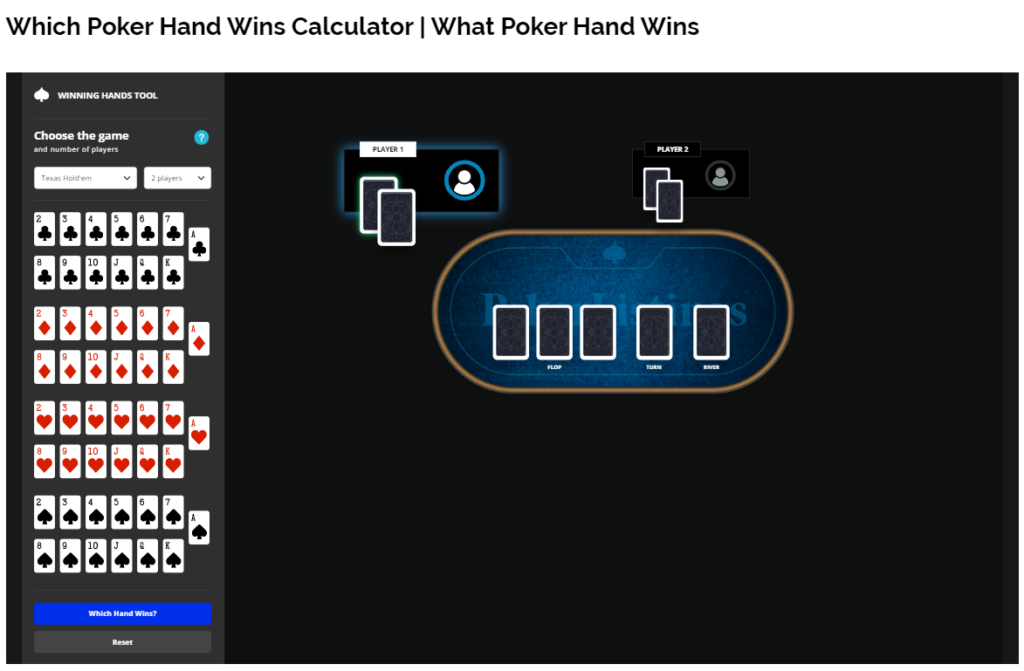
Check out our “Which Hand Wins Calculator” to solve these quickly!
http://www.pokerlistings.com/which-hand-wins-calculator
suppose in a “No Limit Holdem”
player A bets 100,
player B raises to 200 (100+100) and
player C goes all in for 250 (not a full raise).
If player D wants to raise (by 100) he
must raise to 300 (200+100) or to 350 (250+100)?
if two players have two pair one with
Q 7
744AK
J 7
WHO WINS
@Tim Dickens
The other players in the hand must call the amount of the big blind. The difference between the all-in bet and the big blind from each player goes into a side pot that the all-in player is not involved in.
@ Steve
This is a split pot. Both players have a full house jacks full of treys.
@ Bob P
If the hand is in the much then no one’s going to pull it out to show, since they can’t know if those were the actual cards.
The rule is that the player who gets called must show. So if Player A made the final bet and Player B called, Player A is obliged to show his hand first.
Sometimes when a player is bluffing on the river and gets called he will just insta-much his hand so he doesn’t have to show how bad it was. In this case the remaining player wins the pot and is not obliged to show their hole cards.
Two players have called the final bet. Player A shows the winning hand and player B mucks the losing hand. Player A demands to see Player B’s hand. Does player B hvae to show his hand once he has mucked his cards and conceded the hand?
Hi please can yo help with this matter.
player one has A♠5♣
Player two has 10♠6♣
The flop, turn and river are J♣J♠J♥3♥3♦
Am I wrong with thinking its a draw or is there a winner
Thanks with any help you can give
If a player goes all in with a bet that does not equal the big blind and there are more than one player remaining in the round is it necessary that those players equal the big blind to stay in the hand or can they just call the amount of the all in bet?
If a player goes all in with a bet that does not equal the big blind and there are more than one player remaining in the round is it necessary that those players equal the big blind to stay in the hand or can they just call the amount of the all in bet?
Thank you- yes, I did mean between hands. Thanks again.
@Jennifer
If by “between deals” you mean between each hand then yes. But don’t shuffle during a hand, like between the turn and river for instance.
Can someone answer this one please – should the deck be shuffled between deals??
@Watson
It’s up to the tournament staff to balance tables by moving players. Generally they will move the player who would be in the big blind on the next hand to keep people from overpaying blinds. Sometimes it works out that the moved player will pay double blinds. This seems to happen more often online when the moves are done by the poker software. Live, the intention is always to be fair to the players as far as the blinds.
in tournament play when moving a player to a different table, how do you know which player should move as this could affect the blinds. i understand you would not move a player that just was big blind into the position of small or big blind at another table, so how do you determine this move?
To Beko, player 1 wins. it is a 5 card game. both players have the 10 pair. play one also has a 5 pair which gives 1 a two pair vs. players 2’s one pair on the board.
I think that that rule only applies in big poker tornaments like WSOP.
Dylan
I saw once at TV and today it happened at our table – I want to know how to proced on the case below? The player wants to fold – but before that – he goes with the hand to the chips direction, take some – showing like he’s going to bet – but instead of that, he actually folds. At TV (World Series of Poker), the player was requested to bet anyway (it means pay the last call). Here everyone said I was wrong – but I do remember that case from ESPN. Is that a rule of the poker? Thank you for your help.
using the example:
“Example Betting Round 2
There are five players at the table:
Player 1 – Button
Player 2 – Small blind (10¢)
Player 3 – Big blind (25¢)
Start of betting round
Player 4 – Calls the big blind (25¢)
Player 5 – Raises (50¢)
Player 1 – Folds
Player 2 – Folds
Player 3 – Reraises (they already have 25¢ in as the big blind. They complete the bet of 50¢, and add one additional bet for a total of 75¢)
Player 4 – Folds (their previous call of 25¢ is now in the pot)
Player 5 – Calls (matches the bet of Player 3 for a total of 75¢)
End of betting round
In this scenario all players had had a chance to act when Player 3 made the reraise. But all players did not have the same amount of money bet.
Once Player 4 folds, only Player 3 and Player 5 are left in the pot. When Player 5 calls, both conditions are met, and the betting round ends.”
1- Can the player 5 do a re-raise over the player 3 at this point?
2- Can the player 5 do a re-raise at this point if the player 3 made a re-raise all-in of 75 and the player 4 call?
We have been having difficulties dealing with the following:
TABLE/COMMUNITY: 10 – 10 – 5 – 4 – 7
PLAYER 1 has: 5 – 2
PLAYER 2 has: A – 8
Who is the winner in this case? Although the first player has TWO PAIRS (i.e. 10-10 one from the table and 5-5 one from his hand) and the second player has only one pair (i.e. 10 – 10 from the table and none from his hand). Who is the winner in this case? Aren’t these two players chopping the pot because the pair of the 5 is smaller than the pair of 10 on the table and in this case the pair of 5 is falling?
Thanks for your help.
if a player says you win in a all in and the table then sees he has a straight but the player playing does not does he still win the hand?
How do you get an answer to these questions?
1. Two players after the river card, both call. Upon request by other player(s) no longer in the hand, do both players have to show their cards?
2. Same scenerio, does either player have to show their hand?
i have a prob.plz. tell me who wins this hand player 1 has a 2,8 off suite
player 2 has2,5 off suite-.the board has 6QQ7,9. NO FUSH AT ALL ON TABLE
tang ina
If I have a pair ok K in hand und the oder has a pair of J one in hand and one in the table. The pair of K wins?
@Dan – Hands are ranked on the best five cards only. Therefore, the person opposite you will win with a two pair, jack high (6,6,A,A,J) and you will lose with a two pair, five high (6,6,A,A,5). Because your pair of threes is worse than both 6,6, and A,A, it becomes redundant. Hope this helps.
you have 3,5 in your hand. the across from u has J, 8. on the board u have 6,6,3,A,A who wins?
what happens if you have Q 10 on hand, and anothr one has Q … the pot is Q 6 6 10 2 … whos the winner in this case???
here is the situation player a is the dealer player b calls all in player c folds before player a has a chance to call of fold player b mucks his cards should player a recieve those chips since they were part of the pot.
If there is 4 spades on the board and the 2 last players throw down lower cards than say an Ace can we both play ace high or does the higher card in the persons hand win
2 players left at the table, one player goes all in before the flop, the flop comes, the player who went all in has 2 kings the flop reveals a king,the player who called him goes to fold his hand the dealer stops him, is this allowed?
I haven’t been playing Texas Hold ‘Em for very long, but I’ve always played “5 best cards” – I’ve never heard of “natural pair”. can someone help me out.
On the Table – 10 – 10 – 9 – 9 – 3
My Hand – A – 5
Opponents Hand – A – 3
We both agreed that it was a split pot with 2 pair and A high. But others at the table said the 3 was part of the “natural hand” and so that wins. I’m confused. Does someone have the answer?
If only 2 players left in a hand. Player A bets on river and B calls. Player A throws his hand forward in frustration declaring 2 pr but both card land facedown at the elbow of dealer clear of any other cards. Player B insist that that A’s hand is a mucked hand and dead and proceeds to claim the pot. Is player A hand dead ????
2 players are all in preflop, is it a rule that their hands are turned up for the remainder of the hand?
what happens when in a tournament is started a person goes out on a hand. after half hour of play a player noticed that there are (2) 4 of diamonds in the deck. Is the person who went out a half hour ago allowed back into tournament.
What is the definition of Ace-Rag and is As8s a good hand to play with
ok i have some questions: i have Joker,5 and mi opponent had 4,6 ok the on the table was king, king, 4, 4, 7 who has the winning hand the joker,5 or 4,6 ? And why? ty.
my texas holdem poker has banned
please give back my poker
who wins ? player 1, 3h and 7s player 2 5d and 9h the board shows 4d,4h,ks,qc,ad
DOES THE BOAT BEAT THE STRAIGHT
Sean Lind,
Just started playing poker. Any suggestions on the best ways to improve? I’ve heard read books (like Little Green Book/Super system), heard playing online (fulltilt), play in free tourney’s, play w/ friends.
Any suggestions on what might help me the most? Thanks
hi
someone is in a hand but can’t bet because they have gone all in and there are other people still betting.
Everyone finishes betting and the last player to bet shows his hand
does the player who went all in have to show his hand in order or wait to find a winner of the split pot???
Thank you
question about raise and reraise. if i raise $200 and everybody called $200 except for one player behind me who went all in with $201, can i still re-raise? some said yes, but some said no because the person who went all-in has to double my initial bet for me to re-raise.
a dealer exposes the flop before prefolp betting round has finished.. what happens in this situation. also if river get premature exposed and the stub gets into the muck??
Sean,
Say you are playing with a buy in of $30 with blinds c15-c30.
A: Does Poker have a time limit – i.e x rotations of the players on the table or y amounts of rounds or z amount of hours? Is it ever played to the death?
B: Do blinds ever increase with time?
C: If say after the flop the round of betting ends on c60 being called by however many of players, does the betting after the turn have to start at a minimum of c60? Or could a bet of c15 be made?
D: If someone raises, must the reraise be a minimum of the value of the previous raise: i.e P1:c60. P2: $1c20. P3: $2c40?
Or could it go: P1: c60. P2: $1c20. P3 $1c80?
Thanks 🙂
this has came up a few times in our home game.
in a heads up situation player B CALLS ALL IN
before player A has even match the big blind.
we have decided that player A can call the big blind
but player B can not raise the pot at any time unless
player A act first.
please explain the rules. we play it as a tournement
86j93 all hearts.
Me- 5, 2
him- 6, 8 ( we don’t have any hearts in our hands. )
he said he has 8’s n 6’s. I said we both have flush so it’s split pot. Right?
Anibal,
You are correct. A flush is made up of five suited cards, and all five cards count towards the hand. This means:
Board (all spades): AKQJ6
You have: A (hearts) 9 (spades)
They have: K (diamonds) 4 (Spades)
You win, since AKQJ9 is better than AKQJ6.
PS. I used to answer questions daily, but that is no longer the case. I will answer questions again on Friday, but will probably be my last day.
Theresa,
This depends on the rule at the location you’re playing. Some people don’t allow you to show at all, some places allow you to show when heads up, others allow you to show anytime you like.
If you’re asking for your own rules at a home game, allow players to show when it’s heads-up only, that way there will be no arguments.
David,
The most important thing is that no player is forced to pay the big blind twice in a row and the blinds stay as intact as possible. In this scenario Player B was supposed to pay nothing next hand, Player A was supposed to be big blind.
So you are correct, Player B will be the button with the Small blind again.
Andrew N,
In Hold’em you have to make the best possible 5-card hand. Since you have the jack your flush is better than your opponents:
you: AKJ95
Them: AK953
You win
In a game at home, when it gets down to two players >> Is the dealer ALWAYS THE SMALL BLIND?
Iam new here, when does Sean Lind answer questions? thanks
In a flush on the table, do we need to beat the highest card or the lower card.My friend say is there is an A on the table is a split pot for all that are in. I say if some one has a biger card then the smallest on the table that one wins.
Player exposes his cards during a hand either to one person or to several.. In Cash game or in a tournament. What should then happen?
Game down to 3 A B AND C.A is the dealer B small blind C is big blind.C is knock out.Does B now the dealer have to put out small blind again?
The board is AK935 all diamonds, i have J diamonds and 6 hearts, the other player have 87 hearts, do both players use the flush on the board and split pot?
AMA,
Yes, both the blinds are allowed to call, fold/check or raise.
Question:is it possible for big blind to raise after some players called big blind and no one raised?and how about small?
Diane,
There are too many situations to give you every possible scenario, but the rule is this:
No player can miss a blind, and no player can be forced to pay a big or small blind twice in a row (excluding getting down to heads up)
Unless multiple people get knocked out in a hand, the button always moves one seat to the left, even if the player who should have been in that seat gets eliminated. This way the blinds stay intact.
It’s common for there to be only one blind in tournament play, I.E the player who should have been the small blind gets eliminated. In that case there will only be one big blind.
Next hand the button sits on the (now) empty seat, and the blinds are back to normal.
In tournament poker, what is the correct way to move the big, little and dealer chips as players drop out?
ian,
we’re going to need more information.
A-K-Q-J-10 is a straight, meaning three of a kind (JJJxx) would lose to it, unless the three jacks are with a pair (JJJ22) making a full house.
hi all just want to know why 3 j beat a,k,q,j,10
frank,
You can stop playing in a cash game whenever you like, there is no required period of stay.
And unless all players at the table agree to increase the blinds or stake, they will never go up.
hey… id like to know the rules for a cash game, like when its allowed to stop playing, do the antes go up?
Sammy,
You always deal from the dealers left, clockwise, one card at a time to every player until each player has two cards.
This is the same with heads up. The difference is the dealer is the small blind heads up, so they must act first pre-flop. The dealing never changes.
Would it be right to say:
One card each is dealt to the players in a clockwise direction starting from the player left to the Dealer till each player has two pocket cards
This would be true for both multiplayer and heads up table
Multiplayre – Player who posted small blind
Heads-Up player who posted Big Blind.
The above two get the Cards
One question:
multiplayer table: Dealing of cards starts from left of the Dealer(Small Blind)
Heads-up table: Dealing of cards does it start from player left of the Dealer (Big Blind) or from the Player who posted the small blind i.e. Dealer itself
Thanks in advance
Johan,
You need to make the best five card hand for each player. Other than player 1 all players are playing the board (the best hand they can make is a full house jacks over queens).
Player 1 though has a better hand, Queens full of Jacks
QQQJJ > JJJQQ
5 Players, 1. 9+Q, 2. K+7, 3. 2+6, 4. A+10, 5.K+5
Dealer. J+Q+J+J+Q
Who win??
Johan
Jiten,
Two players can agree to split a pot before the river if they choose (only in a cash game)… but why would you? You’re there to play poker, you can’t do that by giving someone their money back in a hand.
Either way, in a home-came you can do it. The board has to be dealt out regardless, but it’s not really against any rules. Although it will look very suspicious, making it seem like you and that player are working together.
Instead of this, the more common thing to do is agree to shoot it, meaning neither player bets, you just check it down, winner takes the pot.
Mike S,
I replied to this comment yesterday, but apparently it got lost in the webs.
Anyways the main goal is to not mess up the blinds. If you sit down in a situation which has the first live player on your left in the small blind (you’re not in that hand), you can’t be the button next hand, since that would force the blinds to remain the same, you have to wait until it passes.
When a player is moved from one table to another, they are supposed to be moved to the same position on the table as they were in on their other table (or as close as the tourney director can get it).
If it’s a broken table though it’s random, so you could end up anywhere.
Can the last two players agree to split the pot before the river card? or can the rest of the players force a showdown and say that the river card has to be dealt?
If you come in as small blind and have to wait until the button passes you then wouldn’t it be the same if you sat down at the table as the button(in tournament play). If you sat as small blind (not allowed to play) the next hand you would be the button, the blinds would be correct,but you still can’t come in the hand. then what is the difference if you sit down as the button? The blinds would sill be correct except you would have the best position.
The button is the best position to in and if you are moved to another table I was under the impression that you have to be seated as big blind or up to the button but not as the button so you are in the worst position.
Mike S,
In a tournament you can not come in between the blinds and the button. This means the player who sat down in the small blind needs to wait until the button passes him to play (he will not get to play as the button).
If you’re seated as the button though, you’re allowed to be dealt in that hand. The idea in a tournament is to keep the blinds as normal as possible.
In a cash game you can’t come in on the button because the button never sits on an empty seat, it would skip ahead with 3 blinds. In a tournament the button can sit on an empty seat, meaning if you’re seated there, you can get cards and play.
noe moran,
It’s a split pot for all three players. The best five card hand anyone can make there is AAA1010, the only way you could win the pot would be to have the case ace, or to have a pocket pair to give you a better under-pair on the full house, such as AAAJJ
In tournament play, if 2 players are moved to another table and sit down at the dealer button and small blind are they allowed to be dealt in that hand or do they have to wait until the button passes them. Also if you sit at a table as small blind are you allowed to come in as the dealer after that hand is complete.
I just have a question about this play it there is a full house on the board with A,A,A,10,10 we are three players, and the first player has 10,J and the second 10,5 and the third 3,5 it become a split pot for all or a split pot for the first and second who have a 10?
jesus,
I’m not exactly sure what you’re asking. If both players have pocket aces, they chop, since they have the same hand.
If it’s A2 verus A3 it’s still a chop, since they have the same 5-card hand (A,K,Q,9,8)
two players have A’s there is K,9,7,Q,8 and one has a 3 and the other have 2 on their hand with the pair of A’s who will win this pot
Paul,
A raise is always equal to: size of the current bet + the size of the previous bet or raise.
So, with a $1 big blind, the minimum bet post flop is always $1.
If someone bets four, the min raise is $8 ($4 (size of bet) + $4 (size of previous bet) = $8)
The reason I worded it like that is because it’s not simply a double. If I bet $2, you raise to $6, and I want to re-raise, my minimum raise is not $12, it’s
$6 (current bet) + $4 (The amount of the previous raise) = $10.
As for your second question, that doubling of the bet size is for Limit games only. If you’re playing No-Limit the minimum bet is always equal to the big blind.
Hi Sean, couple of questions if you don’t mind:
What is the minimum size of the raise? If the big blind is 1 $, after the flop, the first player must bet at least 1 $ (correct?). Let’s say he bets 4 $. The second player wants to raise, he puts 4 $ to make it even (call) and then raises. What is the minimum size of the raise in this situation? 1 $?
Another question: I read poker rules on this webpage and found something interesting here:
“The third betting round is identical to the flop betting round with one single exception: The size of a bet for this round, and the final betting round, is doubled, meaning that to make a bet in our game will now cost a player 50¢.”
In all home games I have been to, this rule is usually not applied, i.e. the bet on the turn and the river is the same as the bet on the flop, meaning it does not become double.
Thank you so much in advance for your perfect answers!
dawa,
The burn cards are used to help make cheating more difficult, and to reduce the number of misdeals, that’s it.
am an absolute beginner…the burn cards are never used as such…what exactly is their function ???
Karin,
You posted that question on the article “Other Odd Poker Rules and Exceptions”. I answered it for you over there on the 23rd:
Karin,
Unless the dealer sees the two cards the entire time, and can vouch 100% that nothing funny happened, the hand is dead.
Even if the dealer did see the two cards the entire time, chances are the hand is still dead. You are never allowed to remove your cards from the table, simple as that.
So basically, in a home game the hand can be live if the dealer saw it, at a casino, you lose the pot.
Hi Sean,
That was quick .. thanks a ton.. Will go through it and et back to you..
Thanks Again…
Cheers
Emailed you on 3-22-10 and asked if a hand is dead if a guy drops one of his cards below the table (whether it is on his lap or the floor.) Is the hand dead.
Tashi,
I was able to get those rules up today for you. You can find it in the rules section under “more poker rules”. Or head here:
http://www.pokerlistings.com/poker-rules-5-card-draw
Tashi,
Hmm, apparently we don’t… which is odd. I’ll fix that ASAP. Should be able to have them up within a few days, it’s a pretty simple game with very few rules really.
Hi Sean,
Do you have the rules for 5 Card draw published anywhere. I know there are very few sites offerign this Game Type but its an interesting game and I would love to play. It could be anoyther famous Poker game ..
Thanks
Jeff,
If someone gets advice from another player at the table, especially from someone who’s already folded a hand, both players get a warning and the player with cards has their hand killed.
The rule in question is known as coaching.
I understand the last question about showing your hand to someone after they have folded but this question goes just a bit further. The hands have been dealt and one person decides to fold. That person who is now out of the game helps out the player next to him giving him advice on what to do. Now my questions… I need to know if these are “rules” or “etiquette” #1 – can the folded person state, to the person he is helping, the obvious, like what other players might have for a hand without using “his” folded cards as knowledge? #2 – Can the person state to the guy he is helping the best way to go knowing what cards “he himself” has folded? #3 – Are there actual rules for “table talk”?
I understand there is table etiquette but it still means it CAN be done even though I feel it is not right. If I can get a “rule” that states it can’t be done we will be able to put this debate to rest.
Thanks.
Kimberly,
Technically, no. You are never allowed to show your hand to another person, unless you’re at the showdown.
But, if the other player isn’t in the hand, and they don’t give you any advice, the dealer will typically let it slide.
As long as you don’t ruin the integrity of the hand, it doesn’t matter all that much.
While in a hand, am I allowed to show my live hand to someone else at the table that has folded?
Tommy,
Anytime a card leaves the table (regardless of what happens after that point), that card is dead/exposed.
This does not automatically make it a misdeal. It will only be a misdeal if this was the first or second card dealt, or it was the second card exposed on the deal.
If just that one card is exposed, it’s shown to everyone, and used as the first burn card.
if a card leaves the table during the deal lands in players lap but not exposed is it a misdeal. players argued it is only a misdeal if card touches the floor.
sergij,
board: KKQ95
You: 9J
Friend: 93
Your best hand KK99Q
His best hand KK99Q
It’s a split pot.
I have a question, if in the middle there are five cards : 2 kings, queen, 9, 5. and i have a 9 and a J, and my friend has a 9 and a 3. Whos wins? me or do we split the pot????????
gaz.d
Because it’s post-flop, a player can just call the all-in. 2 chips is the only bet, so 2 chips is all you need to call. If you want to you can complete the bet to 10, but that’s not required.
If it was pre-flop, it would be different. Regardless of the amount of chips the big blind actually has, it’s assumed that the full big blind is the opening bet pre-flop, all players required to match it to remain in the hand.
3 ppl playing texas hold em tourny. blinds are 5/10. we all post blinds and see the flop. nxt player to bet only has 2 chips and goes all in. how many chips do the other 2 players have to put in if they want to carry on in the hand???
cheers
Maria,
Jasmeet answered it perfectly.
Maria,
Sorry I missed the Ace but still that doesn’t change the result
hands are
Your: 33A97
other: 99AK7
Other is the winner
if there was a 5 in your hand or in place of 7 or 9 on the table then it would have been a different story
your hand would have been A2345 that would have been a winner
Maria,
your hand: 33974
other player: 99k74
other player wins because of the pair of 9
i have a question
if i have a pair of 3’s in my hand and the other player has a king/9 and on the table there is 4 7 9 2 ace…who wins this hand???
Des,
Player 2 would win with the better second kicker:
P1: 555AJ
P2: 555AK
since player two’s fifth card (king) is better than the jack, he wins.
Hi,
who would win in the following scenario?
player 1:ace and jack
player 2:ace and king
table shows:55952
thank you for the help!
Gary,
This depends on the room really. In many places you’re not allowed to show you hand until all betting is complete. If you do it by accident, then it’s usually not a big deal, you’re just told not to do it again.
If you do it on purpose you hand can be killed (force folded).
In other places this is totally allowed, and in other other places this is only allowed heads up.
So ask the dealer before you start playing to know how they deal with this situation.
As far as I’m concerned it should always be allowed, but especially heads up. It bugs me that it’s not in some places.
I would like to know if a player who mistakenly exposes his hand before the final round of betting is complete is forced to fold his hand or does it remain in play as an advantage to other players.
Thank you man this help a lot!
John,
First, props for the Ascii suits.
And yes, the pot is split in this scenario since both players have the same 5-card hand 10-J-Q-K-A.
You have to make the best 5-card hand, all other cards don’t matter.
Sean,
Can u explain me this:
* if the board is 2♥ J♣ Q♣ K♠ A♦
* Player 1 holds T♠ 9♣
* Player 2 holds T♣ 2♣
Both players hold the very same hand (a straight from ten to ace). This means the pot is split between the two players. ???
Is there any rule how to know who is winner? Thank you for your answers.
John,
Example 1:
Player 1 wins, JJQT8
Example 2:
Player 1 wins, 88J74
All five cards count, in both questions it was a matter of kickers.
I have a question! Which hand is stronger?
Example 1
Player 1: J 8
Player 2: J 5
J T 7 6 Q
Example 2
Player 1: 8 J
Player 2: 8 9
2 3 7 8 4
Hey, just use your best judgment on this one. You need a few of the smallest chips to cover blinds, a lot of the next size up (most bets will be made with those), a couple larger ones, and one or two big ones.
You can reserve a color or two for chipping up when the blinds raise and stacks get deep. It’s best to use as few colors as possible while making it easy for players to make any bet they wish.
Next time you set up, write down what chips you gave out, and make notes about any problems (not enough small chips, too many… etc) then adjust for the next game.
Hi
Not sure if that my first question came through. If you were setting up a house game, are there any guidelines for how to divide up the chips in terms of values. I have 240 chips to split between 8 people, and the chips come in 6 colours. Obviously the smallest chip has to be the small blind value but any advice would be welcome.
Thanks
Ron
Brad,
No you can not. Straights are linear in Hold’em:
A-2-3-4-5-6-7-8-9-10-J-Q-K-A
To qualify it must be 5 sequential cards from left to right.
Can you use a wrapped or collard straight? Example…K,A,2,3,4,
James,
If Player A’s hand is mucked (it’s discarded and has touched the muck pile), player B wins the pot without having to show (since he has the only live hand.
But, if any player requests to see the hand, then the dealer will show it (you shouldn’t do that… ever). Some places will say that you need to show two cards to win a pot, but that’s just not true. They have to award the pot to someone, and once player A mucks, there is no one left to award it to other than player B.
hi.this situation came up during one of a cash game I was in.
On the river, Player A bets and is called by Player B. Player A goes on to muck his hand. Player B then mucks his hand as well and proceeds to take the pot. Some players insist that Player B has to show his hand even after Player A mucked, others insisting he doesn’t. Is there a rule concerning this? Must Player B show his hand, even if it may be a worser hand, to take down the pot?
Thanks in advance.
Jacques Dion,
How to build a side pot:
First, take the smallest stack, $200 from player 1. This (plus all money from other streets, blinds, etc) goes into the main pot.
Player 1 – all in main pot
Player 2 – $400 remaining
Player 3 – $800 remaining.
Now you build your first side pot (in this case, only side pot). The smallest stack is now $400, so you take that amount from each remaining player, making the side pot $800.
Player 3’s remaining $400 is then returned to him.
The winner between player 3 and player 2 wins the $800 side pot.
If that player beats player 1, they win the main pot ($600 + blinds and what-nots), otherwise it’s shipped to P1.
Situation;Three palyers are all in.fisrt player has 200$,second 600$ and third 1000$,The second player wins.How do we distribute the money?
Thanks
Jacques Dion
There is a show down player number one will make a bet player number two will raise. While player number one decides to call, fold or raise, player one turns over one card. Player number two beleives it is a fold without the verbal call of fold or forward motion of mucking cards. Is this a fold or what?
Bob,
In Hold’em it doesn’t matter where your cards come from. A straight on the board is the same as a straight made from cards in your hand.
Unless a player holds a 7 in their hand, they split the pot.
If there is a straight on the board, 2,3,4,5,6. and a player has a six in his hand. would this be a split pot or because the player with the hidden 6 high straight win?
Thank you,
Bob
Ross,
The player with the higher heart will win (assuming there are 4 hearts on board, or they have two in his hand)
In poker you have to make a 5-card hand, all five cards count.
win the best
Heads up play. Both players have 2 hearts. Table flops 3 hearts (Ace high). Is that a split pot or does the player with the higher heart in his hand win? This happened to me in a freeroll MTT and I lost the pot with a lower heart.