
 EN
EN  DE
DE GGPoker Has Tightened Its Policy on Third-Party Software

 PokerListings
-
 CoinPoker 150% up to $2000
18+ | Play Responsibly | T&C Apply
-
 Americas Cardroom 100% up to $2000
18+ | Play Responsibly | T&C Apply
-
 Ignition Poker 150% up to $1,500
18+ | Play Responsibly | T&C Apply
-
 Black Chip Poker 100% Welcome Bonus
18+ | Play Responsibly | T&C Apply
-
 Stake.US Poker $55 Stake Cash + 260,000 GC
18+ | Play Responsibly | T&C Apply

On October 15th, 2026, GGPoker announced five new security measures to protect players more efficiently. However, not everyone saw them as it was intended — and in this article we share with you what concerns the poker community.

More Security Checks & Information Sharing
Among GGPoker’s new security measures, most have been very well received by players because they are actually helpful for efficient protection of their accounts.
New Game Client Security Features
- Screen Guard to make your tables invisible for screenshotting and screen capture
- Connection Monitor to alert you about suspicious apps’ connection on your device
- Process Check to create a white list of trustworthy apps
- DNS Check to check your networks for signs of DNS hijacking
Win-Rate Anomaly Detection
A new internal system for reviewing hands to determine whether the frequency of players’ correct decisions made against cards they cannot see falls outside the range expected in a fair game.
It was tested on previously confirmed suspicious cases and is applied to every hand, in addition to algorithms that monitor hand histories for signs of collusion, ghosting, botting, and the use of real-time assistance tools.
End of Support for Legacy Operating Systems
In 2027, GGPoker will cease to support older versions of Windows and macOS.
This applies to Windows 7, 8, and 8.1, as well as macOS 11 (Big Sur) and any earlier versions.
Players are advised to update their operating systems to Windows 10 / macOS 12 (Monterey) or later versions as soon as possible.
Supporting the Victims and the Community
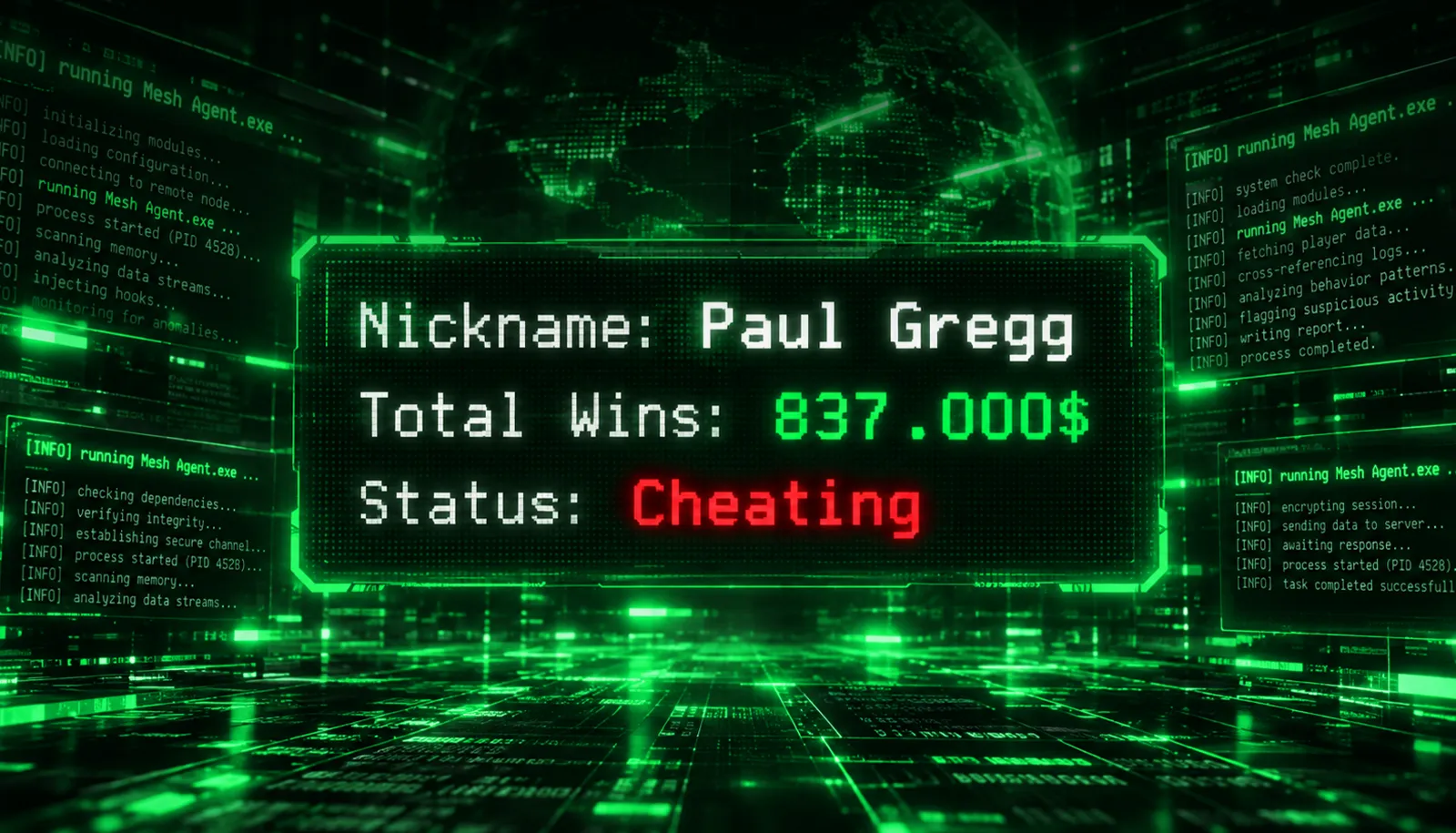
The Paul Gregg saga at GGPoker is not over yet: the poker room announced that it has not only tracked down the crypto wallets the fraudster used to transfer funds to Coinbase but has also notified the exchange and law enforcement authorities to facilitate recovery of the assets.
GGPoker intends to continue its efforts in this area and plans to share similar information in the future.
Third-Party Poker Software Ban
The most controversial update in the poker room concerned auxiliary software. Previously, GGPoker already prohibited the use of tracking software, solvers, and any other forms of real-time assistance — whether actual or potential — while playing on their platform. However, it was still possible to use tools like trackers and HUDs while playing simultaneously on other poker sites as well as management tools and scripts to help players tile their table and windows.
That is no longer an option; the site has explicitly stated its new prohibition as follows:
“Third-party tools running alongside the GGPoker client may access game data, interact with your tables, or automate actions on your computer. Each one handles your information in ways we cannot see or control, and each one is another point where your information can be exposed.
Previously, we permitted certain third-party tools that did not affect gameplay. However, following the recent incident, we are tightening this policy to better protect our players and reduce the risk of a similar incident.
Prohibited tools include, but are not limited to:
- Jurojin
- PokerTracker 4
- Hand2Note
- Holdem Manager 3
- StarsCaption
- DriveHUD 2
- Intuitive Tables
- Lobbyze
- Equilab
- AutoHotkey
- Other third-party poker software and automation tools
Please fully close these applications before launching GGPoker.”
It is hardly surprising that the incompleteness of the list — which theoretically increases the risk of receiving a warning, account suspension, or a ban for using any software — along with the GGPoker’s “interference” in what a player can use (and how they can use it) at other rooms has triggered a sharp reaction from the poker community.
Team of Jurojin Poker Isn’t Happy
Developers of Jurojin Poker, which was used by Paul Gregg and co. to cheat without their knowledge, were unpleasantly surprised by GGPoker’s decision and shared an official statement criticizing the poker room for tightening restrictions:
“Security should bring the poker ecosystem together, not tear it apart.
Following the recent security incident, we understand why GGPoker is taking action. Player safety must always come first, and incidents like these are a wake-up call for everyone involved, including us as software developers, to review and strengthen our own security practices.
But there’s a difference between addressing security threats and treating an entire ecosystem of third-party software as the threat itself.
For years, independent developers have built tools that improve the online poker experience, while players have incorporated those tools into their daily routines. Disrupting all of that through blanket restrictions, regardless of what each tool actually does, is not a security strategy we believe the industry should embrace.
Cyberattacks have happened before, and they may happen again. The answer cannot be to isolate everyone, point fingers, and dismantle years of work every time something goes wrong.
The answer is cooperation. Clear security standards. Open communication. Shared responsibility.
We fully support GGPoker’s efforts to protect its players. But protecting players and working with legitimate software developers should not be mutually exclusive.
A safer poker ecosystem is built by working together, not by turning its participants against each other.
We hope GGPoker reconsiders this approach and opens a constructive dialogue with the developers and players affected by this decision.”
Some players pointed out to them that their own software had been used for cheating — which, in turn, led to stricter rules — so they would be better off not drawing unnecessary attention to themselves. Others, however, expressed similar sentiments.
Regs Share Mixed Feelings
Juan Pardo supported Jurojin’s position, publicly denouncing GGPoker:
“Agree with all. Banning these types of programs that help with multitabling is ridiculous”
Niall Farrell chose even more straightforward style to express his disapproval:
“Rather play some cunt that can see my cards than manually tile my tables tbh”
Aaron “abarone68” Barone was much milder in his opinion, sharing sadness about not being able to effectively manage tables during his sessions anymore:
“Not saying I agree with it, but I can certainly understand the decision to remove HUDs, especially when one is built into the client.
The biggest issue on my end, however, involves other third-party software. I just want to be able to organize my tables in a coherent manner and share them with the audience on stream. Seems like these changes make those things a lot more difficult and for some, borderline impossible.
I’m all for safety too, but it doesn’t have to come at the expense at giving — not just streamers, but all players — the ability to multi table more efficiently.”
Ian Simpson expressed concern that banning “legal” software might push people toward using illicit tools that is harder to detect:
“I think the reason 3rd party tools weren’t banned earlier in pokers lifetime was because you can only ban legal 3rd party tools. And detecting the illegal ones is going to be insanely difficult in today’s game.”
He was supported by MTT Database Review:
“Instead of HUDs being available to anyone paying a small subscription fee it will now be much more of an advantage to anyone willing to have illegal ones. And I don’t mean other trackers, just bypass the current ones with HDMI capture card and few scripts from your friendly LLM and remote desktop operate it via browser window to avoid processes detection.”
Finally, Sergi Reixach shared frustration about uncertainty of new rules description, asking GGPoker to at least clarify what are the risks for people:
“Is this a recommendation or are you actually going to ban people? GGPoker more info on this please. Prohibited tools include:
- Jurojin
- PokerTracker 4
- Hand2Note
- Other third-party poker software
Please fully close these applications before launching GGPoker.
Many people play other sites such as PokerStars, ACR, iPoker etc that need to use third party tools so it is very very important to be very specific about this topic.”
However, at the time of the article’s publication, GGPoker had provided no clarification, leaving players with no choice but to contact customer support before launching any software — if only to be on the safe side.
But Aren’t These Measures Good For Recs?
It depends on what kind of recreational players we are talking about.
For occasional hobby players who play a small number of tables only at GGPoker and never use any types of third-party poker software, the situation became slightly more enjoyable because “predators” of the field now have more inconvenience during their sessions. The same is fair for less-experienced professionals.
First, professional players will now have to perform more actions to manage tables from different poker sites when multi-tabling, which will inevitably affect the speed and quality of their play. As a result, some may reduce their volume, while others might simply choose to leave GGPoker altogether.
Second, those who continue to play on GGPoker will now have to factor in the additional risks associated with running third-party software — used for playing on other sites — alongside the GGPoker client. This, in turn, could impact their activity and efficiency on those other platforms.
All of this works to the advantage of casual, laid-back recreational players.
However, for other types of recreational players, the situation has also become less convenient. Those who work during the week and settle in for a serious, enjoyable session on the weekend — often multi-tabling across several different poker sites — will find their experience degraded. They will now have to resort to workarounds, such as using Windows’ built-in window management features, to organize their tables. Even then, they need to be cautious: since the list of prohibited tools is not fixed, any program — even the most innocuous window manager — could theoretically cause issues when playing on GGPoker.
The same problem will affect those who play a few tables from different sites while working; they will now be forced to manually reposition their poker tables, whereas previously, these could be easily arranged alongside other open windows.
In this situation, one cannot help but ask: for whom, exactly, did GGPoker introduce all these restrictive measures, given that they cause discomfort for a significant portion of the poker community — including its primary source of real-money capital?

Popular News
Third Time’s a Charm: ACR Poker Handles Yet Another RTA Controversy

The One: Millionaire Maker by CoinPoker
Scandal! Paul Gregg Sees Opponents’ Cards for Months, Wins Hundreds of Thousands of Dollars

Who Wins the Most at Triton Jeju II
Latest News

Malta Poker Festival Brings Mizrachi and Millions to the Mediterranean

Calling is Underrated & Gives You a Lot of Info: thejericho2’s AMA on Reddit

CoinPoker Makes Substantial Changes to Cash Game Rake






Log in to join the discussion
Share your thoughts and see what others have to say.