EN
EN  DE
DE When I Play Poker, I Forget Almost Everything I Just Learned: Help!

 PokerListings
-
 CoinPoker 150% up to $2000
+18 | T & C apply | Play responsible
-
 Stake.US Poker $55 Stake Cash + 260,000 GC
18+ | Play Responsibly | T&C Apply
-
 Americas Cardroom 100% up to $2000
18+ | Play Responsibly | T&C Apply
-
 Betonline Poker 100% Up to $1,000
18+ | Play Responsibly | T&C Apply
-
 SportsBetting Poker 100% up to $1000

Have you ever found yourself in a situation after studying for hours — solving spots, watching VODs or reading books — that you sit down to play poker and realize that you can’t remember anything you just learned? It’s actually a widespread issue in the poker community. That said, there’s no need to panic: science has already done a lot to fix it — and this article will tell you how.
Reasons for Forgetting Information
According to ‘The Biology of Forgetting – A Perspective’, there are five main reasons for your brain to forget things you’ve learned, even if they are pretty important to you.
Informational Overload
When you consume too much information in a short time period or this information is too complicated to comprehend quickly, your brain needs more time and resources to process and “write down” everything you’ve learned.
Since the brain always prioritizes data that is most important for your survival, when you consume too much information too quickly, your brain can’t absorb it in full, discarding a significant portion if it requires too many resources to process and is not needed at the moment to solve current problems.
Divided Focus of Attention
Our brain is smart but it’s also lazy: it always seeks a way to work more efficiently without spending extra resources. Maintaining focus requires the brain to expend resources — and the more data you try to take in, the more resources you need.
Your brain won’t agree to this — it’s in its interests to reduce resource waste, so it simply won’t register some of the information you are trying to pay attention to. It will also choose which data sources are most important to you at the moment and will ignore other streams or allocate minimal resources to them, resulting in you only capturing the information superficially.
Lack of Sleep
Your brain uses sleep to repair and heal but it also uses it to sort everything you’ve learned during the day. It is similar to how workers maintain the conveyor belt but instead of physical products your brain sorts and stores data.
The things you already know — those that evoke a stable memory response through fixed associations — are sorted quickly, the brain simply sends them to the same address and moves on to the next locus.
However, completely new information first requires analysis to determine its significance and “storage” place. Usually, the brain does this during sleep, when a lot of resources are freed up because you’re not walking around and learning this and that.
So, if you don’t get enough sleep, your brain simply can’t do its job properly — it doesn’t have enough time to sort through all the new stuff, so some of it inevitably leaks out.
Stress Level
When stressed, the brain activates mechanisms that primarily ensure your survival, then stress reduction, and only after that everything else. Memorizing anything in this state isn’t a priority for the brain, so it shifts resources from memory to more important things. This is why, by the way, people often remember little about truly stressful periods in their lives, even if their body responds to related sensory triggers.
Genetics and Body Quirks
Because genes determine the synthesis of certain proteins involved in the process of memorizing data, they play a significant role in how good our default memory is. This is also true for individual characteristics of the nervous system, which are often described by syndromes or disorders — among them, autism, obsessiveness, compulsivity, and ADHD are particularly noteworthy.
Why Do We Forget Things?
In the 1880s, Hermann Ebbinghaus put forward the theory of the forgetting curve, which has been tested and confirmed many times since. It shows that even healthy people inevitably forget things if they stop deliberately using their memories.
The forgetting curve roughly depicts how much time is needed for memories to fade without repetition:
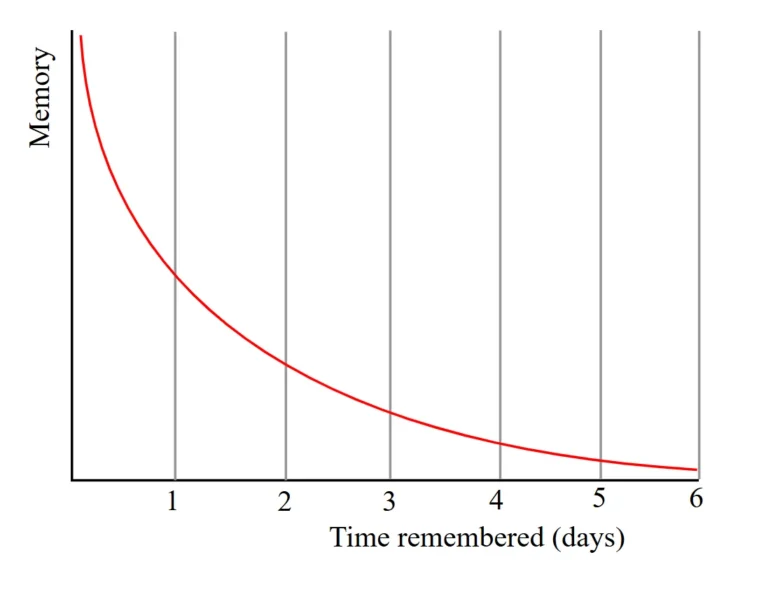
The less often a person activates their memory pathways, the weaker neural connections that ensure its storage and targeted retrieval become. And when data ceases to be regularly recalled, repeated, and used, the brain simply stops spending resources on storing it and maintaining access paths to it.
However, many core memories that once formed the basis of the brain’s associative apparatus for processing new information are not forgotten even decades after they were formed — even if you don’t deliberately recall them. The brain simply can’t erase them because without it, the rest of the system won’t function correctly — and that’s ineffective, something the brain really “dislikes”.
How to Better Remember What You’ve Learned
In her article for Psychology Today, doctor Ruth Gotian offers four methods for improving information memorization, combining classic and modern approaches. We added even more information about them from various studies and some extra tips to help you even more:
- Study the information one piece at a time. Every time you study, choose one topic and devote your full attention to it. Don’t get distracted while studying. Don’t move on to the next topic until you’ve mastered this one — this will make it easier for your brain to retain the information. Study poker as if it were a song or a poem, where memorization occurs gradually — one verse at a time.
- Write down key information by hand. Scientists still agree that writing information down on paper or even a tablet helps the brain better remember and process new knowledge, consolidating it not only at the level of vision and hearing, but also motor skills.
- Reflect on what you’ve learned before moving on to the next cluster. Help your brain create strong associations between what you already know and what you’ve just learned. Ask yourself: What surprised me? How does this connect to what I already know? When might I use this? How might I use this? — and write down the answers. It also will help you to sort and summarize new information, highlight key points and review it more conveniently in the future.
- Repeat, rest and apply. The human brain remembers information best when theory is followed by practice. So, your poker knowledge will more likely be retained if you learn a chunk of information, give the brain time to digest it, repeat and then apply immediately via drills or directly in-game.
- Use modern technology to reinforce learning. While AI dependency appears to impair people’s ability to learn, using this tool correctly can actually help you retain information better. Don’t let AI learn for you: use it as a summarizer and quiz generator to test your knowledge. Keep in mind that AI at this stage of its development is primarily a validation tool designed to satisfy your requests rather than provide correct answers, so be careful with it.
Finally, sleep well and do not ever stop learning new things. By learning something new, you use old neural connections and create new ones. This simultaneously strengthens your existing memories and allows new knowledge to more easily settle into your associative system. Don’t overload your brain but don’t let it become idle either — then your memory is less likely to deteriorate over time.