
 EN
EN  DE
DE AI Behavior Analyzer: Useful Product, Nonsense, or a New Threat to Poker?

 PokerListings
-
 CoinPoker 150% up to $2000
18+ | Play Responsibly | T&C Apply
-
 Americas Cardroom 100% up to $2000
18+ | Play Responsibly | T&C Apply
-
 Ignition Poker 150% up to $1,500
18+ | Play Responsibly | T&C Apply
-
 Black Chip Poker 100% Welcome Bonus
18+ | Play Responsibly | T&C Apply
-
 Stake.US Poker $55 Stake Cash + 260,000 GC
18+ | Play Responsibly | T&C Apply

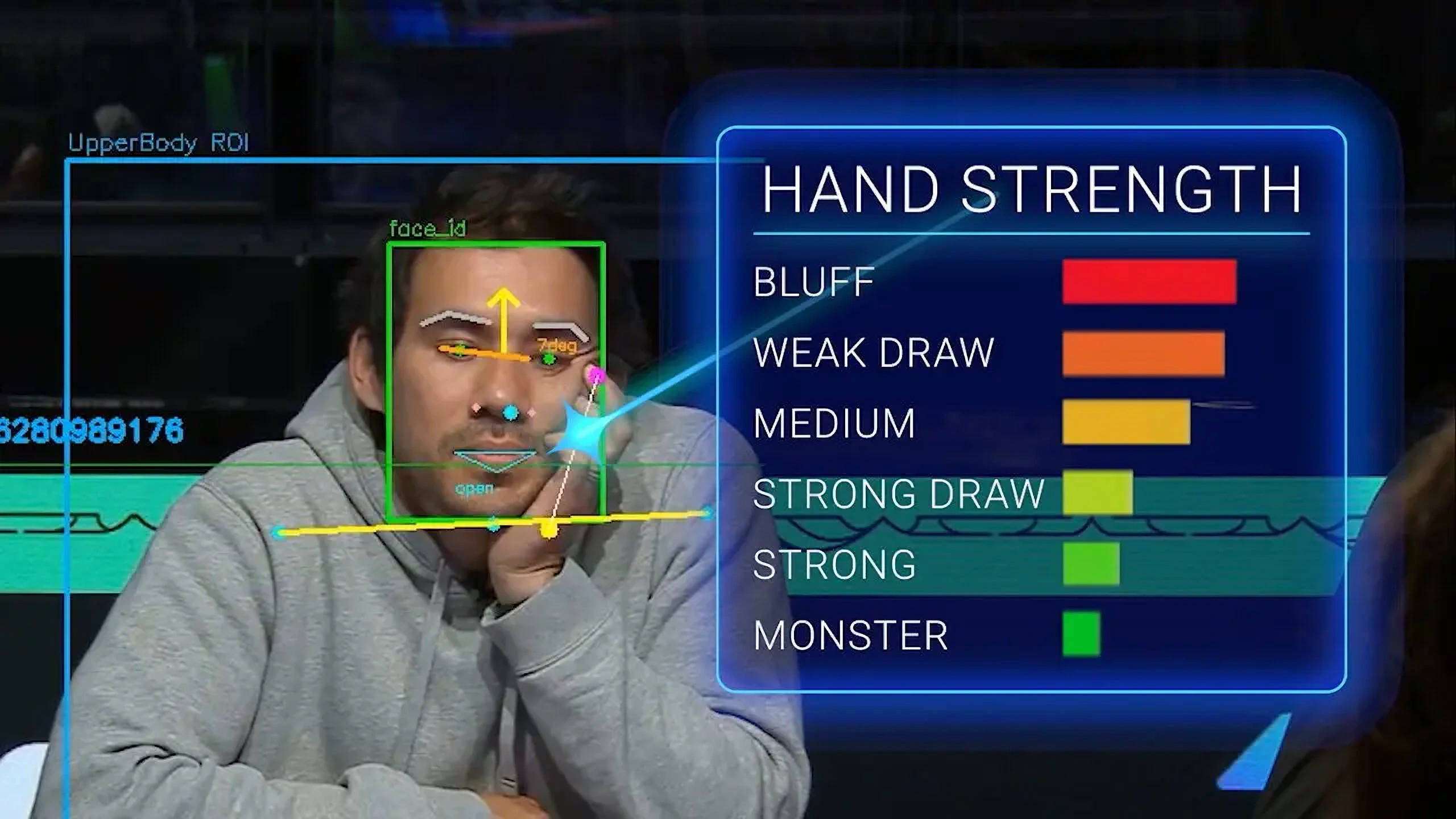
As soon as the WSOP returned to ESPN, instead of records and amazing experiences, the poker community was treated to yet another AI-fueled controversy. And while, fortunately, this time there were no fake quotes, the new tool from independent engineer Luke Geel divided the poker community in its own way.
What’s All the Fuss About?
The screenshot below shows an infographic from the AI tool that Omaha Productions uses for its TV coverage of the WSOP on ESPN.
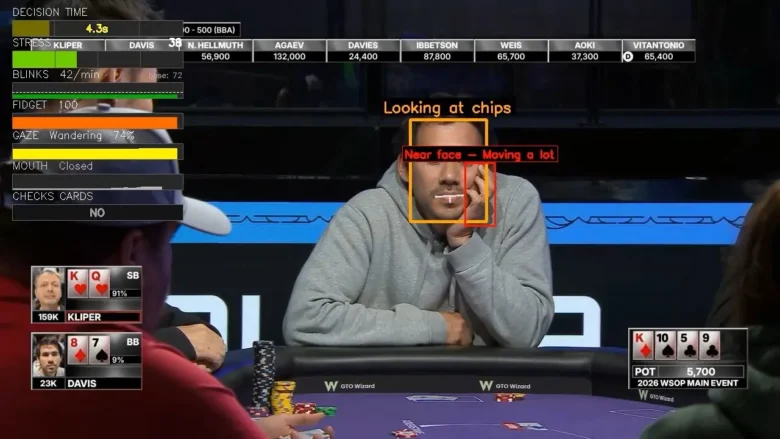
Jacob Feldman‘s article for Sportico reveals that the tool’s developer, Luke Geel, spent six months working on it — and it wasn’t easy:
It was significantly more difficult than I had initially hoped. I can’t just, like, upload a YouTube URL and say, ‘find their tells. […] Some people have asked [me online], like, ‘Hey, why don’t you run this on a top professional poker player, like Daniel Negreanu?’ He’s not going to have any tells. He’s probably worked hard to remove them. I just don’t see any reason to do that yet. Maybe in the future, when AI becomes even better.
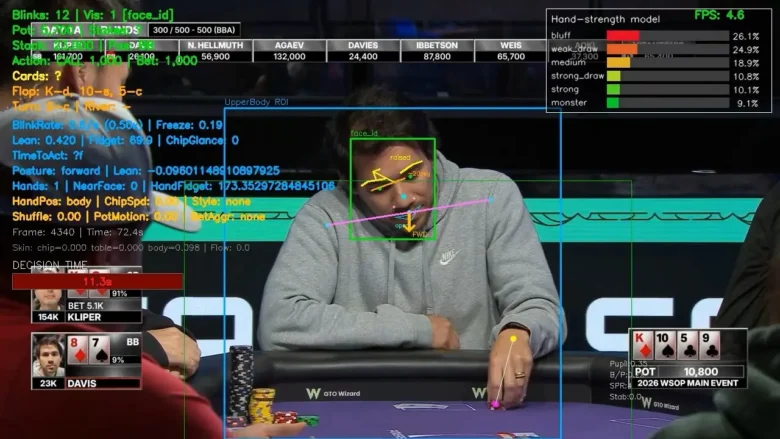
In its analysis, AI takes into account a wide variety of factors — the number of blinks, the frequency of checking one’s cards, the position of a person’s mouth, their gaze, the movement of a player’s hands, and so on. And based on these factors, the AI estimates the potential strength of a person’s hand.
For ethical and safety reasons, Omaha Productions only uses the tool to evaluate the behavior of a player who has already been eliminated from a broadcast tournament.
Why the Poker Community Isn’t Enthusiastic About This AI Tool
Both professional poker players and ordinary spectators received the news about this AI tool with irony and fear.
First of all, of course, because the stream is with the cards up — and when you see the cards, all those wow-pow flashes from the AI analyzer seem incredibly out of place. The AI says a player is bluffing with an N% probability — but you see their cards and the table at that moment and can figure it out without the AI’s excessive analysis.
Secondly, the creation of such a tool, and even its public display, looks like a threat to poker from three sides at once:
- The leap from on-screen AI analysis to AI glasses is short — it is a security risk that also can pose an inconvenience for players who wear glasses in live casinos to protect their eyes from the casino’s dreadful lighting. Especially at the feature tables.
- Such analysis could impact the overall skill level and preparedness of the field, making the game even more challenging. At the same time, there’s a high risk that wealthy players will be less likely to risk their money in the game due to the expectation that they’ll be monitored not just by human eyes, but by an AI analyzer.
- Publicly displaying other people’s tells in this format could not only raise privacy issues but also reduce the already sagging appeal of poker broadcasts, as people will tighten their poker face, try to suppress their emotions, shield themselves from the cameras, and so on. As a bonus, this could increase pressure on players, who will be worried about the risk of not just revealing their tells to their opponents, but also exposing them to the world.
Thirdly, an AI analyzer of this format could prove to be a professional disinformer if targeted at specific individuals — those with nervous tics, Tourette’s syndrome, a tendency toward stemming, or even chronic illnesses that cause pain or discomfort. As a result, people could easily accept a superficial, unreliable AI analysis as truth, play it in a live poker game, and lose all their money relying on AI tells. And then they will go with a complaint not to themselves, not to the AI, and not even to the developer — but to the one who advertised it to them on the broadcast.
To illustrate all these and other reasons why the poker community isn’t applauding the developer and Omaha Productions in this story, we’ve selected a few comments from prominent poker players.
Ian Simpson: There’s so much complaining about “euro regs” being robotic at the tables. Now everyone’s going to be forced to be as immobile as possible so that AI can’t learn their facial tendencies? If this tech is indeed accurate, the scope for abuse off of the feature table is scary.
Sam Greenwood: The guy who built this model needs some natural intelligence to aid his AI. After reading this article it seems like this model is likely over or under fit and not very good. Could a model like this be great in the future? Possibly. Is it a total embarrassment from a privacy, game integrity and broadcast quality perspective that ESPN is using this? Yes.
Alex Theologis: What a way to grow the game. “Come play the main event where AI software can immediately figure out if you’re bluffing based on your blink/min and hand fidgeting”.
Rob Kuhn: Pretty insane. Petition to ban sun glasses in future tourneys before someone uses this to cheat
Mike McDonald: I think it’s now fine that we all finally admit it- poker is a much better game when played poorly than when played well.
Liv Boeree: Not sure if real, but either way I fucking hate it […] I hate the direction it means poker (and the wider world) is heading.
Could This Behavioral Analyzer Be Useful for Poker Players?
Luke said in an interview that after publishing the tool online, people approached him with questions about whether it could be used to study their own tells and those of their opponents.
As his words above suggest, at this particular moment and in its current state, his tool will not be a good assistant for those who want to analyze professional players.
However, in theory, such models could be used primarily to identify and eliminate one’s own tells.
Players have done this before, by watching recordings of their own play — and in the early days of the game, by honing their poker face in front of a mirror or working with other players. Some even hired professional acting coaches to master theatrical poker face techniques.
AI could potentially help with all of this in the future, but not without a number of issues that follow its widespread use.
It’s also important to understand that tells are highly individual. All these stories about universal signs of deception are simply marketing ploys by scammers selling their services. According to the work of psychologist and behaviorist Paul Ekman, only seven emotions — happiness, surprise, sadness, fright (fear), disgust, contempt, and anger — are universally reflected across genders, nations, and cultures.
To recognize all the others, you need to simultaneously know the baseline of a person’s behavior — their normal facial expressions, gestures, and posture when they don’t feel threatened — and extract information from behavior clusters as they change.
Our brain does a lot of this work on its own, based on accumulated life experience, observation, and the ability to empathetically interpret the complexities of external signals. Also, we should not discount the evolution of the mechanism of recognizing facial expressions, which is much older than speech. All of this varies between people, and AI simply cannot have it because it is incapable of empathic perception.
Finally, it is worth remembering that AI behavior analysis tools are largely useless for online players — unless they learn to analyze a player’s type based on their country of residence, choice of avatar, nickname and emojis in the room.
What Might ESPN Try for Future Poker Broadcasts?
Analyzing players is very interesting — that’s why this AI tool has found some positive feedback among viewers.
However, perhaps ESPN and Omaha Productions should remember that poker is a competition of people and their minds. And use these minds to create entertaining content. We’ve even come up with a couple of ideas for you that are similar to this AI model:
- Invite psychics into the commentary booth and conduct part of the broadcast without showing cards until showdown or the end of the hand. Let the psychics explain what cards people are holding in their opinion, whether they’re bluffing or not — and then the viewers can see how good their abilities are.
- Hire behavioral psychology experts like Chase Hughes, professional magicians like Bedros “Spidey” Akkelian, or former FBI agents from Quantico to analyze poker players and share professional insights. This could be either an entertaining show, an educational program, or even a combination of both. “How to spot a liar” videos are extremely popular on YouTube and TikTok — embracing this approach in poker and the game of deception could be a great solution for anyone.
- Organize a competition between professional poker players and psychics to determine whether an unknown player is bluffing. You can even turn this into a Psychic Tag Team Show by incorporating psychics into the Tag Team Event, allowing them to play with 200% instinct and psychic abilities, and during breaks, share their observations and impressions.
- If you like using AI so much, put it against behavioral psychology professionals and psychics. This way, you can create a competition right in the commentary booth, where all participants can entertain viewers with their different approaches to analyzing players and their actions.
Inviting experts who actually understand human behavior and listening to their insights may be far more interesting and useful for both viewers and players than looking at AI infographics and conclusions based on dubious data and assumptions.
PokerListings 





Log in to join the discussion
Share your thoughts and see what others have to say.