
 EN
EN  DE
DE ICM vs Bounties – Two Opposite Forces in PKO Strategy


 PokerListings
-
 CoinPoker 150% up to $2000
18+ | Play Responsibly | T&C Apply
-
 Ignition Poker 150% up to $1,500
18+ | Play Responsibly | T&C Apply
-
 Stake.US Poker $55 Stake Cash + 260,000 GC
18+ | Play Responsibly | T&C Apply
-
 Americas Cardroom 100% up to $2000
18+ | Play Responsibly | T&C Apply
-
 Betonline Poker 100% Up to $1,000
18+ | Play Responsibly | T&C Apply
Even before ICM (the Independent Chip Model) became widely understood through solvers, players intuitively knew that the tournament payout structure — especially the bubble and pay jumps — mattered. But we didn’t know exactly how much or how they mattered.
ICM and solvers showed us the true value of survival: busting hurts our EV (expected value) much more than doubling helps, which is why correct tournament play sometimes becomes extremely tight when real money is at stake. While some players thrive in this environment, others miss the old days of looser tournament play.
Enter PKOs.
In progressive knockout tournaments, ICM has — to some degree — found its match. Extremely tight, survival-focused play is no longer always optimal. In standard PKOs, half of the total prize pool sits in bounties, and ignoring that equity is a major mistake.
At every stage of the tournament, progressive bounties pull toward chip accumulation and confrontation, creating a more dynamic, looser — as well as more complex — strategic environment.
The key question is how to balance ICM, survival, and the power of the bounty.
In this article, we’ll look at how ICM and bounties interact. We’ll use the concept of the risk premium to better understand how these two powerful opposing forces affect our strategy at different stages of the tournament, and what that means for the decisions we face in practice.
What ICM Wants
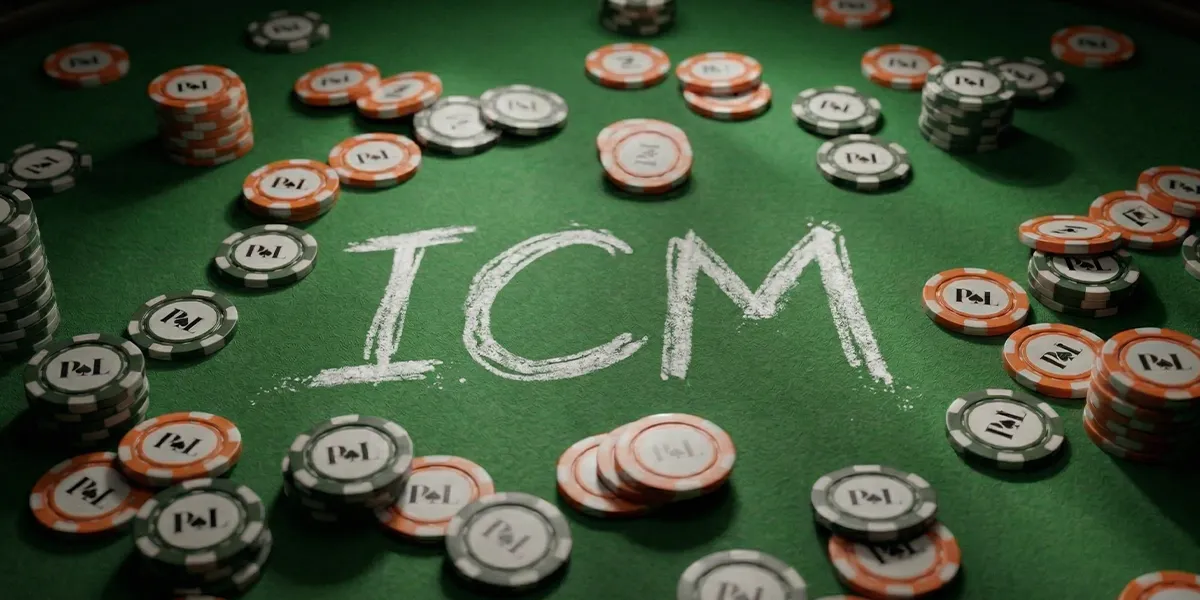
Speaking broadly and in practical terms, ICM often prioritizes survival and chip preservation over chip-accumulation.
Not all chips are of equal value according to ICM:
- Losing chips hurts more than gaining the same amount of chips helps.
- This means we need more equity than chip EV to make certain plays.
- Risking chips near the bubble or a big pay jump has the biggest downside, especially when another player – or several – are likely to be eliminated before us.
A useful concept that helps explain the additional equity we need in ICM spots is called the risk premium.
The Risk Premium
In a cash game, decisions are governed purely by pot odds. If a player is getting 40% pot odds, 40% equity is enough to call all in. There is no additional cost to losing all (or most) of the chips in front of you, because you can always rebuy and, more importantly, the next hand will be worth exactly as much as the previous one.
In tournaments, that symmetry is gone.
The risk premium describes the extra equity a player needs in a tournament spot compared to a pure chip-EV situation.
For example, instead of needing 40% equity in a spot, a player might need 47% because of tournament payouts/ICM pressure. The difference — 7 percentage points — is their risk premium in that situation, which directly influences decisions like finding good bluffing spots or making thin calls.
The risk premium is not fixed – it is highly dynamic. It is different against every player at the table (depending on how our stacks relate to one another) and changes with the proximity of pay jumps.
In PKOs, this risk premium does not disappear — but it does get distorted.
What Bounties Want

In a regular tournament, winning chips only slightly increases future payout potential. In a Progressive Knockout tournament, eliminating a player has immediate monetary value, which offsets the downside of risking your chips.
A big stack also improves our odds at future bounties, improving our EV in relation to the bounty prize pool, giving us extra incentive for calculated risk and chip accumulation.
In other words – bounties move incentives towards action.
The impact and value of the bounties is the highest at the start of the tournament. Even though the bounties are the lowest in an absolute sense, their relative impact on our EV is the highest at the very beginning.
For more details about how the value of the bounty changes throughout the tournament and how to calculate it, check out this guide on bounty value.
How ICM and Bounties Collide
Let’s now take a look at how strong ICM and bounty forces are and what they mean for our strategy at five different moments of the tournament.
The Start of the Tournament
At the very start of a regular tournament, all players already experience a small risk premium, around 1.7–1.8% – we need about 1.8% extra equity in comparison to chip EV/cash game to justify calling an all-in (for example, 51.8% instead of 50%).
This means ICM pressure is present from the start, but we usually neglect it because it is low.
Start of the Tournament (Even Stacks):
| Tournament Type | Risk Premium |
|---|---|
| Classic MTT (non-PKO) | 1.7% |
| PKO | -4.8% |
In a PKO, on the other hand, the risk premium is negative (-4.8% in our example), which means we have more incentive to gamble than in chip EV.
Negative risk premiums only ever happen in PKOs.
Risk premiums are different for covered versus covering players in a PKO. The benefit of the bounty only goes to the covering player.
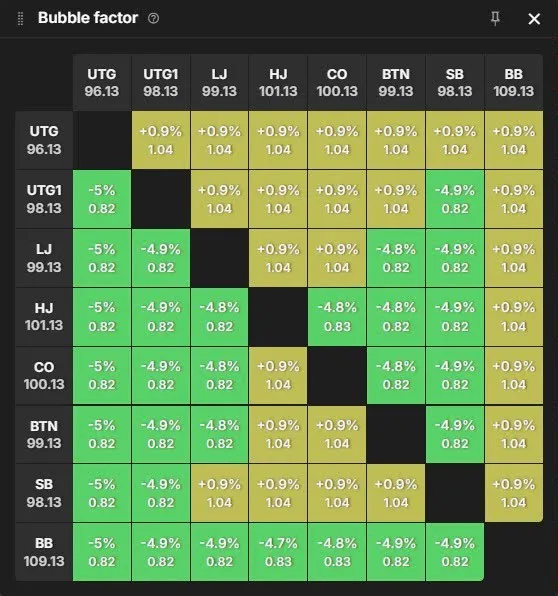
However, even covered players experience a slightly lower risk premium in a PKO. This is because bounties encourage opponents to play more loosely, improving the covered player’s odds against the covering player’s (looser) range. We see this phenomenon throughout the tournament.
Risk premiums are only a part of the story, but they clearly show how bounties trigger a much looser environment and encourage early confrontation across the board.
50% of the Field Remaining
With 50 % of players remaining and greater stack asymmetry, ICM pressure increases slightly, but it is still not overwhelming.
Classic MTTs:
- The initial risk premium (1.7% in regular tournaments) stays about the same for short stacks (and for medium stacks facing short stacks).
- Medium and bigger stacks begin to experience significant risk premium jumps against other big stacks. A 5% risk premium is not uncommon, showing the value of survival whenever there are shorter stacks in the tournament.
PKOs:
- Risk premiums for covered stacks grow only slightly – around 1-3% for fairly low ICM pressure.
- Covering stacks maintain a negative risk premium versus short stacks.
- The size of the covered stack matters the most – the shorter the stack, the bigger the incentive to chase the bounty.
- There is less open-shoving in comparison to a classic MTT. Short stacks have to shove a much tighter range because their bounty invites more calls (they have much less fold equity).
When going for bounties, the covered player’s stack size is more important than the size of the bounty. The smaller the covered stack, the bigger our incentive to play them.
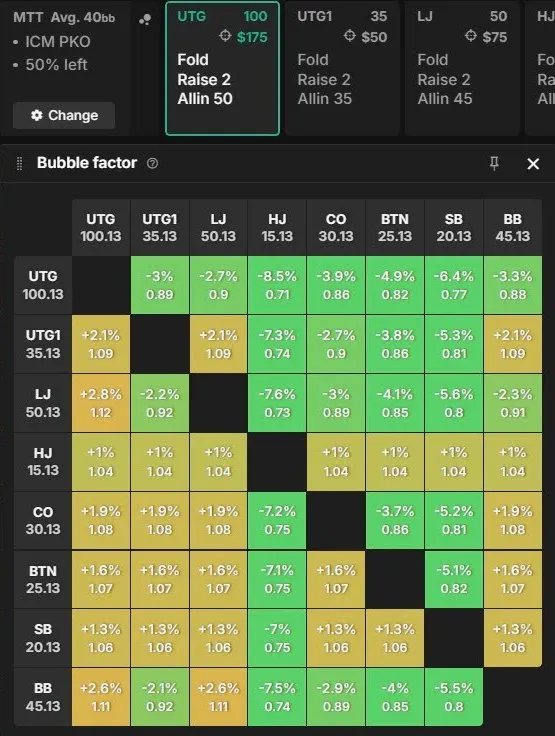
In this example, the chip leader (UTG, 100.13 bb) has by far the biggest incentive to play against the hijack with the shortest stack (15.13 bb) and the starting bounty of $50 – the risk premium is -8.5%. The lojack has a bigger bounty, but also a bigger stack (half of the chip leader’s stack) – the negative risk premium for the chip leader is only -2.7%.
Near the Bubble
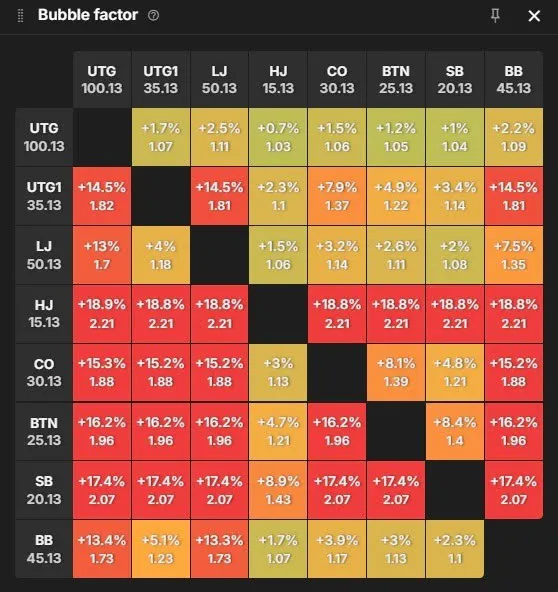
In the example below, we compare a regular tournament and a PKO with 40 bb average stack, at the same stage (near bubble) and with the same stack distribution.
Classic MTT
PKO
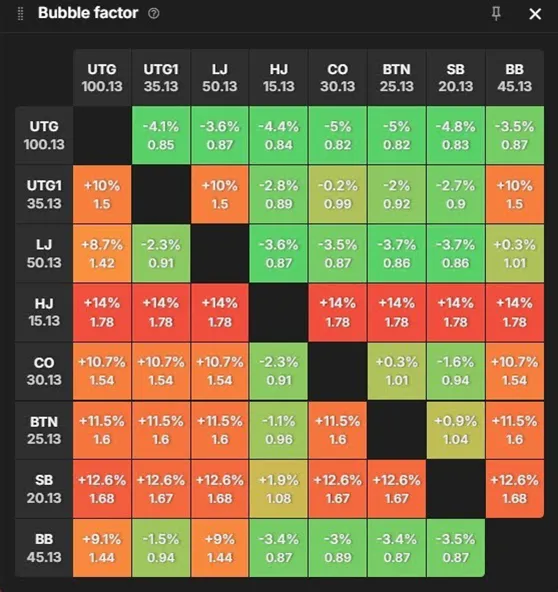
GTO Wizard Bubble factors, ICM Regular vs PKO, near bubble, 40 bb average stack.
Close to the bubble, risk premiums go through the roof and are very diverse and dynamic.
Classic MTTs:
- Medium and low stacks experience big risk premiums on the money bubble – easily as high as 15-20%.
- Big stacks maintain a lower risk premium if their stack advantage is big. If stacks are close together, everyone’s risk premiums are high.
- The bubble is usually the biggest ICM moment in the tournament (although some final table spots can exceed it).
The common ICM wisdom says that the pressure is the greatest on medium stacks, not the short stacks. While this is true the vast majority of the time, the money bubble can be the exception.
On the money bubble of a medium or large-field tournament, the absolute size of our chip stack matters more than our relative position at the table. Stacks around 10–18 big blinds often experience the highest ICM pressure on the bubble.
This is because the stack is still very playable, meaning we can often survive a few orbits by folding, outlasting players at our or other tables. The difference in equity between making the money and busting is huge for this stack. Doubling a 15 bb stack achieves very little, while busting is devastating – requiring extremely tight play.
PKOs:
- Bigger stacks feel ICM pressure, but often keep negative risk premiums versus most players.
- Risk premiums for covered players are high, but also lower than in a regular tournament (around 10-15% risk premium is common). Again, this is because covering players play so much more aggressively, making short stacks defend a bit wider.
The key to remember is that all risk premiums of 10-20% are very high. They mean we must have 55% – 65% equity to call all in a spot that would normally require only 45% (for example).
Late Stages
As the bubble bursts, ICM pressure drops significantly. Risk premiums instantly drop by as much as 15% for the most pressured players (short and medium stacks).
Classic MTTs:
- Risk premiums even out more – about 1-5% for all stack sizes.
- Covering an opponent’s stack matters much less in a classic MTT – we have increased risk premiums against all players who can seriously hurt our stack.
- Players should stay active, but big pots should be avoided, especially calling substantial all-ins as a medium or large stack.
- Approaching pay jumps, the pressure on medium stacks quickly increases – (the very late stages are much worse for them than short and big stacks).
PKOs:
- Covering opponents remains important, but big pots become increasingly less desirable, even with bounties and short-stacked opponents. The value of preserving chips/ICM is getting strong even for big stacks.
- The effect of ICM on medium stacks is intense – unlike on the money bubble they experience significant (positive) risk premiums even against stacks they cover.
Broadly speaking, bounties are losing a lot of their power as we get to the very end of the tournament. They still matter, but stack interactions and bounty size have very dynamic effects – we have to pick our spots more carefully.
The Final Table
The ICM pressure ramps up even more at the final table.
Classic MTTs:
- Medium stacks can face enormous survival (ICM) pressure, and risk premiums in some confrontations can reach — or sometimes even exceed — bubble levels.
- ICM pressure is very dynamic and depends on the presence of (very) short stacks at the table. The shorter the short stacks are, the more pressure on the medium stacks to survive.
PKOs:
- Risk premiums remain lower in PKOs in comparison to classic, but they do increase significantly.
- On the bubble, a medium stack covering a similar stack would usually keep a low (even negative) risk premium. This is not the case at the final table.
- Even for the biggest stack, the pressure to avoid big confrontations is strong in PKOs. When we only slightly cover our opponent, the bounty no longer makes up for ICM considerations. Preserving chips and playing strong ranges becomes increasingly more important (until very short-handed).
- Short stacks play fewer all-ins in a PKO than a classic MTT, opting for raises and calls instead. This is because opponents have more incentive to call the all in.
Final Thought About Raise First-In (RFI) Ranges
Raise first-in ranges in PKOs and Classic MTTs are very similar at the final table.
This is not the case for most of the tournament, where big stacks usually open wider and short stacks tighter because of bounty incentives.
The reason this changes late is the PKO payout structure. The regular prize pool payouts are flatter in a PKO ( the top two places paying similar amounts), which would actually increase risk premiums if bounties did not exist. This is because without a large first-place prize, the upside of building a very big stack is smaller, so ranges tighten.
Bounties offset this effect, but only partially — the result is that opening ranges in PKOs end up very close to those in Classic MTTs.
Conclusion
PKOs don’t change the fundamentals of tournament poker — but they do change the balance and reward more active play.
ICM is still the framework that governs tournament decisions. But in PKOs, that framework is constantly being pushed and stretched by bounty incentives. The result is a very dynamic tournament format where many spots sit right on the edge between caution and aggression.
The correct adjustment is rarely obvious, and the strategy is complex. But for most players, the biggest mistake is either applying regular MTT intuition too rigidly or playing too loose because of bounties. The first steps to real edge comes from understanding the basic impact of bounties throughout the tournament and recognizing when to adjust – based on stack sizes, ICM pressure and the relative value of bounties at play.
Hopefully, the key takeaways of this guide have made you feel a step closer to navigating PKO endgames correctly.
PokerListings 


Log in to join the discussion
Share your thoughts and see what others have to say.