
 EN
EN  DE
DE Calculating Bounty Value in PKO Tournaments – A Practical PKO Model


 PokerListings
-
 CoinPoker 150% up to $2000
18+ | Play Responsibly | T&C Apply
-
 Ignition Poker 150% up to $1,500
18+ | Play Responsibly | T&C Apply
-
 Stake.US Poker $55 Stake Cash + 260,000 GC
18+ | Play Responsibly | T&C Apply
-
 Americas Cardroom 100% up to $2000
18+ | Play Responsibly | T&C Apply
-
 Betonline Poker 100% Up to $1,000
18+ | Play Responsibly | T&C Apply

Progressive Knockout Tournaments (PKOs) are the new normal. In 2026, there are as many PKOs as traditional online MTTs, perhaps even more.
Many players transition to progressive knockouts with the same mindset they use in classic tournaments. This is a mistake. Bounties fundamentally change the dynamics and EV calculations, making PKO strategy distinct: more fluid, looser and more complex.
In PKO tournaments, we are constantly confronted with one additional question: Should I preserve my chips — or go after the bounty?
To answer that question in a practical way, we need a method to compare the value of survival and the bounty on the same scale.
Why You Need to Know Bounty Value
Bounty value is the foundation of PKO strategy – the first step toward understanding how much winning the bounty is worth compared to the downside of losing chips.
The bounty value model in this guide focuses on two things:
- converting the bounty into chips, and
- making simple pot odds calculations that include that bounty value.
Once you do this, many decisions become straightforward pot odds calculations rather than guesswork.
You may also hear the term bounty power used as a synonym, but bounty power more commonly refers to bounty value expressed in big blinds. In this guide, we’ll focus on the value of the bounty in chips.
PKO Essentials
Before we begin, let’s have a quick refresher on the basics of progressive knockout tournaments. Here is what matters:
- There is a regular prize pool, and a bounty prize pool – usually, half of the money goes to each.
- The bounty prize pool starts being paid out right away – with every elimination, a bounty is paid.
- The progressive nature of the bounty means that individual bounties grow with each knockout – when you eliminate another player, you win half of their bounty, while the other half is added to your own bounty.
PKO Strategy Basics
In terms of PKO strategy, we have to consider two opposing motivations throughout the poker tournament:
- Survival and chip preservation – avoiding risk to maintain our tournament equity and position, so that we can reach (classic) prize money.
- Going for chips and bounties – this has immediate monetary gain and also gives us a better chance at future bounties.
Strategy is heavily impacted by:
- different stack sizes at the table and their relative positions,
- the size of bounties (including our own), and
- the proximity of payout jumps (ICM considerations).
If all of this sounds a bit complicated, it’s because it is. PKOs have made playing the correct poker strategy even harder. However, there is also great news in that: with a short dive into a few simplified strategies, you can learn things most players don’t take the time to understand – and that can give you a notable edge in PKO tournaments.
Now let’s dive in.
Understanding Bounty Value
When we talk about bounty value in this guide, we don’t mean its direct monetary value (which is clear from the number next to the $ sign). Instead, we mean its value converted into tournament chips.
Why Do We Convert Bounties into Chips?
We do this because it allows us to compare all components of our tournament equity on the same scale. Once everything is expressed in chips, many decisions involving bounties become straightforward pot-odds calculations.
How Do We Convert the Bounty into Chips?
We want to know how many tournament chips represent 1$ of the prize pool, which we get using this formula:
Chips per $1 = All Chips in Play / Remaining Prize Pool
Example (start of tournament):
- Buy in: $20 ($10 + $10 progressive bounty)
- Entries: 150 players
- Starting stack: 10,000 chips
We have a prize pool of $3,000 (150 entries x $20) and 1,500,000 chips in play.
Chips per $1 = 1,500,000 chips /$3,000 = 500 chips per 1$
The immediate bounty (50% of the progressive bounty) is $5, which amounts to 5 x 500 = 2,500 chips.
Remember, in a PKO, only half of the bounty is paid out immediately – we will call this the direct bounty – this is the amount that matters in hand-to-hand decisions.
Here is another way to look at it.
In a standard PKO tournament:
- half of the buy-in, in our case $10, goes to the regular prize pool,
- the other $10 to the bounty prize pool.
- $5 is the direct bounty, while the other $5 will be progressively added to opponents who eliminate players.
The immediate bounty represents a quarter of our buy-in and is therefore represented by a quarter of our starting stack – in this case, 2,500 chips.
In a non-standard PKO, this could be a different percentage of the starting stack. The key to remember is this: bounty value always corresponds to the percentage of the buy-in that goes to the direct bounty.
How Bounty Value Changes Throughout the Tournament
As players get eliminated, the remaining (bounty) prize pool shrinks, while the number of chips in play stays the same.
This means that bounty value will grow in absolute terms as the tournament progresses (but this is not true for its relative value, see next chapter).
Here is an example of a model showing how bounty value changes throughout the tournament:
| Players Remaining | Starting Bounty Value (Example)* | Bounty Value (% of Starting stack*) | Bounty Value (% of the Average Stack*) |
|---|---|---|---|
| 100 % | 2,500 | 25 | 25 |
| 80 % | 2,639 | 26.4 | 21.1 |
| 50 % | 2,929 | 29.3 | 14.6 |
| 40 % | 3,063 | 30.6 | 12.3 |
| 30 % | 3,231 | 32.3 | 9.7 |
| 20 % | 3,455 | 34.6 | 6.9 |
| 10 % | 3,799 | 38 | 3.8 |
| 7% | 3,954 | 39.5 | 2.77 |
| 5% | 4,086 | 40.9 | 2.04 |
| 1% | 4,545 | 45.45 | 0.45 |
This is just an approximation, because it is impossible to know exactly how much prize pool is remaining in any tournament (it depends on what kind of bounties have been paid out). However, it is very close and very useful.
Knowing this already improves your understanding of bounty value above most of your competition.
What Does the Bounty Value Model Teach Us
- Bounties are worth the most in the early stages.
While bounty value grows in absolute terms (it is worth more and more chips) – this growth is relatively slow. The average stack and blinds grow much faster than bounty value, making the bounty a smaller and smaller fraction of the pots, reducing its importance.
For example, once 50% of the player-field is eliminated, the average stack increases by 100 %, while bounty value increases only by 17%. Overall, the bounty represents only about 14-15% of the average stack at this point (down from 25 % at the start of the tournament).
When 10% of the field remains, this becomes only 3-4% of the average stack, and so on.
- The relative value of the bounty quickly decreases as the tournament progresses.
If we look at it in terms of big blinds – the starting bounty is typically worth 25 BB at the beginning, but this falls steeply – in the late stages, it may become just a fraction of a big blind.
- Starting bounty value can never exceed 50% of the starting stack.
This is important to know because we can see that there is a clear ceiling to the (starting) bounty value growth – the starting bounty value is the key number, and the rest are just limited adjustments.
- Big progressive bounties stay relevant.
In a regular bounty tournament (non-PKO), bounties are nearly irrelevant in the late stages. But in a PKO, bounties also grow progressively – this keeps them relevant.
In every calculation, we must remember to multiply the bounty value with the correct multiplier when the opponent’s bounty is larger than the starting bounty.
While the value of the starting bounty goes down, it would also be a mistake to think they have no impact in the late stages of a PKO. The effect of the bounty in late stages is very situational – it depends on the size of the bounty, the size of the covered player’s stack, as well as ICM.
Calculating Pot Odds with Bounty Value: A Practical Example
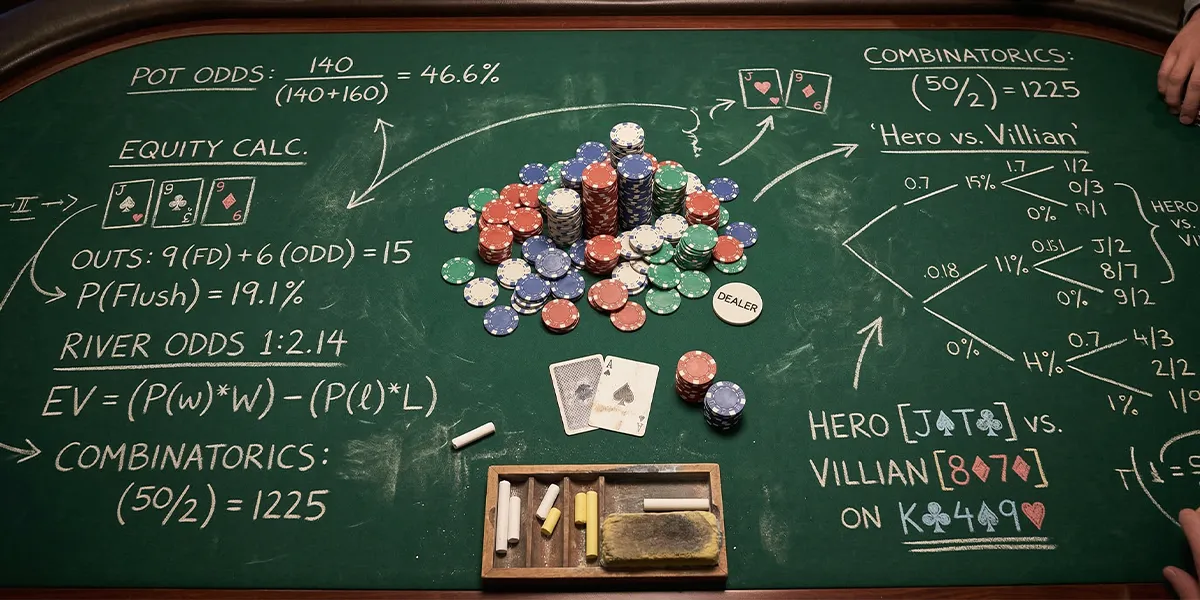
Step two of using bounty value is adding its value to the pot when necessary.
Let’s take a look at an example where we are deciding whether to call an all-in by a short-stacked opponent with a starting bounty.
Example
- Blinds: 100/200 (200 BB ante)
- Hero (BB): 11,500 chips
- Villain (Button): 2,800 chips
- 80% of the field remains (minimal ICM)
- Button goes all-in for 2,800 chips (14 BB) and we assume his range is ~23–25% (close to GTO). Everyone else has folded.
- Hero holds Jh9h in the big blind.
Without the bounty
- If there were no bounty, we would need around 44% equity to call.
- Equity = Our Call/(Our Call + All-In Stack + Blinds) = 2600/(2600+2800+500) = 44%
- In this scenario, Jh9h wouldn’t make the cut according to typical solver ranges.
With the bounty
- We know that the bounty value is 2,640 chips (taken from table above). We add this to the pot:
- Total chips to win: 2800 (all in) + 500 (blinds, antes) + 2640 (bounty value) = 5940 chips.
- Equity = 2600/(2600+5940) = 30.4%
With the bounty in play, the required equity drops dramatically. Jh9h becomes a clear call — in fact, hands as low as J7s or even 97s could be justified to call according to solvers.
In our example, the bounty value represents a large share of the pot/equity, because the opponent is quite short stacked for this early stage of the tournament (when relative bounty value is also still high).
The shorter the all-in stack, the more important the bounty.
Looking at our situation: if the button shoved for just 7 big blinds instead of 14 bb (all other factors the same), we might already be correct to call with any two cards.
How to Use the PKO Bounty-Value Model
Here is how to get the most out of this PKO bounty value model, step by step.
Remember that bounty value correlates to the percentage of the buy-in that goes to the direct bounty. If this is a regular PKO, it will be 25% of the starting stack.
The first step is to remember the corresponding chip amount (bounty value) for our tournament.
Most players remember a few key milestones – for example, what happens to bounty value when 50%, 10% or 5% of the field remains.
Since bounty value actually grows relatively slowly, it is also completely acceptable to pick a rough number for bounty value and use it for most of the tournament. For example, we could choose 25-30% of the starting stack for the first part of the tournament, and adjust to 40% when less than 5% of players remain.
If an opponent has a larger-than-starting bounty, multiply the value by the appropriate factor.
When making a decision, consider the potential additional value of the bounty in chips.
When facing an all-in by a short-stack opponent, calculate your equity including the value of the bounty.
Limitations of the Bounty Value Model
Understanding and calculating bounty value is a strong starting point for a solid PKO strategy. It is crucial when facing all-ins from players whose stack we cover, and useful whenever such an all-in is likely (for example, when an opponent is very short).
However, the bounty value model does not address:
- non–all-in decisions and ranges in PKOs (raises first-in, calling preflop raises, 3-betting, etc.),
- tricky multi-way situations, where multiple players behind us may also chase the bounty, and
- the effects of ICM.
ICM, in particular, is an important element of PKO strategy that must be studied separately. Bounties add value to the pot and encourage looser play, but in high-pressure ICM spots even the added EV of the bounty may not be enough to justify a call.
To go beyond simplified bounty math, dedicated PKO tools are the logical next step. Programs such as ICMIZER (PKO mode), HoldemResources Calculator (HRC), and GTO Wizard allow you to:
- practice and analyze PKO push/fold ranges with bounty values included,
- calculate adjusted pot odds in PKO spots,
- study how ICM and bounty EV interact across different tournament stages, and
- explore multi-way and complex situations that simple bounty calculations cannot capture.
To learn more about how ICM and bounties interact at different stages of a PKO tournament, you can also check out our guide on ICM vs. Bounties: Two Opposite Forces in PKO Strategy.
Conclusion
We have covered the simple conversion of the bounty into chips and begun to uncover the real strategic weight of bounty EV – and how that value evolves throughout a tournament.
By learning to translate bounty value into chips, you build a clearer framework for your all-in spots, getting closer to understanding when the bounty meaningfully shifts the decision – and when it does not.
Use the bounty model as your foundation, then layer in ICM awareness and deeper range work as your next step.
Good luck at the tables — go knock them out.
PokerListings 


Log in to join the discussion
Share your thoughts and see what others have to say.