
 EN
EN  DE
DE What Is Rummy in Blackjack: The Complete Guide to This Side Bet

 PokerListings
-
18+ | Play Responsibly | T&C Apply
-
 ZumbaCards Casino 5 Free Cards
21+ | Play Responsibly | T&C Apply
-
 A1 Social Casino 1,000,000 GC
18+ | Play Responsibly | T&C Apply
-
 CrashDuel Casino 100% up to 200,000 GC + 50 SC
18+ | Play Responsibly | T&C Apply
-
 UpUp Casino 1,000,000 GC + 2SC
21+ | Play Responsibly | T&C Apply


The rummy side bet is an optional wager available at select blackjack tables that pays out when a player’s first two cards and the dealer’s upcard form a specific three-card combination. Before going further, one clarification: the word “rummy” carries two distinct meanings at a blackjack table – most commonly it refers to this side bet, but it can also describe a blackjack game variant popular in certain international markets. Both are covered below.
Rummy the Card Game vs. Rummy in Blackjack
The rummy card game and the rummy side bet share vocabulary (pairs, runs, sets) but they are entirely different things. Classic rummy is a multi-round matching game where players draw and discard to build melds over several turns. The rummy side bet, by contrast, is a single-hand wager settled in seconds within a standard blackjack game; no drawing, no discarding, no separate game structure. The shared name creates genuine confusion, but the mechanics have almost nothing in common.
How the Rummy Side Bet in Blackjack Works
Here is how the rummy side bet plays out in a standard blackjack hand, step by step. Note that the exact mechanics can vary by casino, so verifying the specific table’s rules before wagering is always the right move.
Qualifying Rummy Hand Combinations
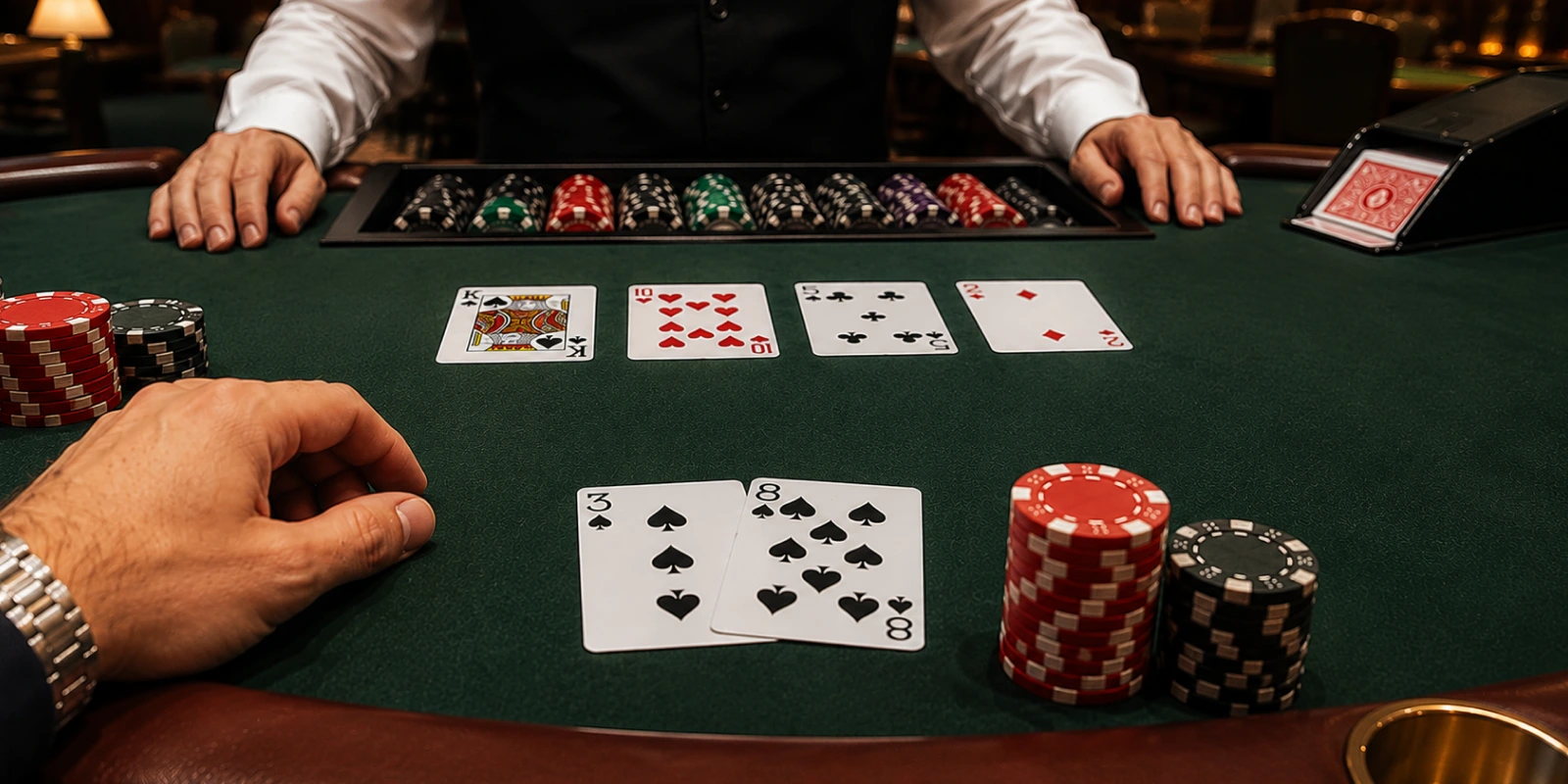
The rummy side bet wins when the three-card combination formed by a player’s first two cards and the dealer’s upcard matches one of the qualifying hand types. Standard qualifying combinations across most implementations include the following:
| Rummy Hand Type | What It Means | Example | Note |
|---|---|---|---|
| Flush | Three cards of the same suit |
3
 3
8
8
K
K
3
8
8
K
K
| Standard qualifying hand |
| Straight | Three consecutive-rank cards in mixed suits |
5
5
6
 6
7
6
7
 7
7
| Standard qualifying hand |
| Three-of-a-kind | Three cards of the same rank |
9
9
9
9
9
9
| Standard qualifying hand |
| Straight flush | Three consecutive-rank cards all of the same suit |
4
4
5
5
6
6
| Available at some casinos only |
| Suited three-of-a-kind | Three cards of the same rank and the same suit |
Q
Q
| Available at some casinos only |
Players must verify which combinations qualify at their specific table before placing any wager – casino house rules determine this, and not every property offers the full premium tier structure.
Examples of Winning Rummy Hands
Four concrete hand scenarios illustrate how the rummy side bet resolves in practice:
Mixed straight
Player holds 7 8 ; dealer shows 9 . The three cards form a 7-8-9 straight. Side bet wins at 4:1. Main hand total of 15 against the dealer’s 9 is a weak position – the player still faces a difficult main-game decision regardless of the side bet outcome.
Flush
Player holds 2 J ; dealer shows 6 . Three hearts form a flush. Side bet wins at 4:1. The main hand value of 12 remains unchanged.
Three-of-a-kind
Player holds K K ; dealer shows K . Three kings form a three-of-a-kind. Side bet wins at 9:1. Main hand contains a pair of kings – a strong 20 – so the player also stands in a favorable main-game position.
Winning side bet on a losing main hand
Player holds 4 5 ; dealer shows 6 . A suited straight flush – side bet wins at 20:1 or higher. However, the main hand total of 9 is weak, and the player may ultimately lose the main wager. This scenario underlines the key attribute of the rummy side bet: it is independent of the main blackjack hand outcome.
Timing and Resolution of the Rummy Bet
A common misconception is that the rummy side bet outcome depends on whether the player wins or loses the main hand – it does not. The two wagers are completely independent. Here is the resolution sequence:
- Place the main blackjack wager and the rummy side bet simultaneously before cards are dealt.
- The dealer distributes cards: two to the player, one face-up to the dealer.
- The rummy combination is evaluated immediately using those three cards.
- The side bet is paid out or collected at once, before main-hand action begins.
- The main hand continues as normal (hitting, standing, doubling, or splitting) entirely unaffected by the side bet result.
Rummy Side Bet Payout Table
The table below presents a representative payout structure for the rummy side bet. Payouts are not universal – casino house rules determine the exact pay table at each property, so always check before playing.
| Hand Type | Example Hand | Typical Payout Range |
|---|---|---|
| Flush | 3 8 K | 4:1 |
| Straight | 5 6 7 | 4:1 |
| Three-of-a-kind | 9 9 9 | 9:1 |
| Straight Flush | 4 5 6 | 20:1–25:1 |
| Suited Three-of-a-kind | Q Q Q | 30:1+ |
On a $10 bet, a three-of-a-kind at 9:1 returns $90. A suited three-of-a-kind at 30:1 on that same $10 stake returns $300. However, casinos offering simplified pay tables push the house edge above 5%, making the bet considerably less attractive.
Rummy Side Bet vs. Other Popular Blackjack Side Bets
The rummy side bet occupies a specific position among the optional wagers available at blackjack tables. Comparing it directly against four common alternatives helps clarify where it fits and for whom.
| Side Bet | Cards Used | Combination Types | Typical House Edge | Payout Frequency | Best Suited For |
|---|---|---|---|---|---|
| Rummy | Player 2 + Dealer upcard | Flush, straight, three-of-a-kind | 3.7%–4.38% | Moderate | Recreational players seeking frequent small wins |
| 21+3 | Player 2 + Dealer upcard | Poker-style (multiple tiers) | 3.2%–13.4% (varies) | Moderate | Players familiar with poker hand rankings |
| Perfect Pairs | Player 2 only | Pairs only | 2%–11% (varies) | Moderate-low | Players wanting a simple two-card bet |
| Insurance | Dealer upcard (Ace trigger) | Dealer blackjack protection | ~7.5% | Situational | Generally not recommended |
| Lucky Ladies / Super Sevens | Player cards | Specific value combinations | 17%–25%+ | Low | High-variance players chasing jackpot moments |
Rummy Side Bet vs. 21+3
Both the rummy side bet and the 21+3 side bet use the same three-card structure – the player’s first two cards plus the dealer’s upcard – and both reward poker-style combinations. The key differences: 21+3 offers more qualifying tiers (including five-card poker hand logic in some versions), higher top-end payouts, and broader availability across major casino floors. The rummy side bet is simpler and more standardized. House edge on both sits in an elevated range, making neither a particularly friendly wager for the mathematically focused player.
Rummy Side Bet vs. Perfect Pairs
Perfect Pairs resolves entirely on the player’s first two cards – no dealer upcard required. Rummy requires that third card, which means it opens winning scenarios (flushes, straights) that Perfect Pairs cannot produce. Perfect Pairs covers only pair combinations: mixed pair, colored pair, and perfect pair. That narrower scope means fewer winning outcomes per hand, though Perfect Pairs is more widely available at standard tables worldwide.
Rummy Side Bet vs. Insurance
Insurance and rummy serve entirely different purposes. Insurance is a defensive wager – it protects against dealer blackjack and pays 2:1 if the dealer’s hole card completes a natural 21. The rummy side bet is an offensive wager rewarding favorable card combinations independent of the dealer’s final hand. The two bets serve different strategic functions, and strategy-focused analysis consistently advises against insurance in most situations due to its unfavorable long-run return.
Rummy Side Bet vs. Lucky Ladies and Super Sevens
Lucky Ladies and Super Sevens are high-variance, low-frequency bets built around rare, jackpot-level moments – the kind of hit that happens occasionally across a long session. The rummy side bet produces more modest wins more often. For recreational players who want ongoing engagement rather than an occasional large spike, the rummy side bet is a more practical fit. Lucky Ladies and Super Sevens appeal to players chasing maximum excitement from a single outcome.
The House Edge on the Rummy Side Bet – What the Numbers Show
The rummy side bet carries a house edge of approximately 3.7%–4.38% under standard pay tables. Compared to blackjack played with optimal basic strategy – where the house edge falls to roughly 0.5% – the gap is significant. Over a 100-hand session at $10 per side bet, a 4% edge translates to an expected loss of around $40 on side bet wagers alone, before accounting for main hand results.
For perspective: the 21+3 side bet’s house edge ranges from approximately 3.2% to over 13% depending on pay table and number of decks. Perfect Pairs sits between 2% and 11%. American Roulette carries a fixed house edge of 5.26%. The rummy side bet is neither the worst-performing nor the best-performing option in this group – but it is materially worse than the main blackjack game. Casino house rules are the controlling variable: simplified pay tables that eliminate premium tiers (straight flush, suited three-of-a-kind) push the edge above 5%, at which point the bet becomes harder to justify even for recreational purposes. Players who prioritize minimizing edge should note this data carefully.
Should Players Place the Rummy Bet?

The rummy side bet is not recommended for strategy-focused players. The elevated house edge relative to the main game makes it a net-negative wager over any significant volume of play. For recreational players operating with a defined side bet budget, however, it is a defensible choice under the right table conditions. The following three subsections break down the genuine benefits, the situations where the bet holds up, and the situations where it should be skipped.
The Genuine Benefits of the Rummy Side Bet
There are real, honest reasons why some players find the rummy side bet worthwhile. They are not about beating the house – they are about the specific value it offers for a certain type of player.
- Higher hit frequency than many side bets. Flush, straight, and three-of-a-kind combinations appear often enough to produce wins at a reasonable rate across a session.
- Easy to understand. No poker expertise or complex hand-ranking knowledge is required. The qualifying combinations are simple and quickly learned.
- Immediate payout gratification. The side bet settles before main-hand action begins, delivering a fast win that adds a distinct moment of excitement to each round.
- Accessible to new players. No strategic knowledge is needed to place the bet – it requires zero input after the initial wager.
- Compatible with low minimum stakes. Most rummy-enabled tables allow side bet minimums well below the main wager minimum, making participation possible at low cost.
Situations Where the Rummy Bet Is a Defensible Choice
Certain player profiles and table conditions make placing the rummy side bet a reasonable decision:
- Recreational players playing for entertainment value, not to optimize long-run returns.
- Players with a discrete side bet budget – a specific amount set aside for optional wagers before the session begins, kept separate from main hand bankroll.
- Tables offering favorable casino house rules pay tables, particularly those including the straight flush and suited three-of-a-kind tiers, which keep the house edge in the lower part of the 3.7%–4.38% range.
- Players seeking added engagement without committing to aggressive main-hand betting increases.
- Side bet stakes kept to 5–10% of the main wager – for instance, a $1–$2 side bet on a $20 main hand – to prevent the additional variance from distorting overall bankroll performance.
Situations Where the Rummy Bet Should Be Avoided
Strategy-focused players (those applying optimal basic strategy with the goal of minimizing house advantage) should skip the rummy side bet. The 3.7%–4.38% edge directly contradicts the logic of playing blackjack correctly. Card counters and advanced players have even stronger reasons to avoid it: no counting system meaningfully shifts the edge on this particular wager. At tables where casino house rules produce a simplified pay table the house edge climbs above 5%, which removes any residual case for the bet.
Players on tight session bankrolls should also avoid it; adding a side bet wager on every hand materially increases variance and accelerates bankroll depletion during a cold streak. The tips section below outlines how to manage this wager responsibly if the decision to play has already been made.
Common Mistakes Players Make with the Rummy Side Bet
Five recurring, avoidable errors show up at rummy-enabled tables with notable regularity. Each has a direct corrective fix.
- Betting more on the rummy side bet than the position warrants relative to the main wager. Fix: Cap the side bet at 5–10% of the main wager – if the main bet is $20, the side bet should not exceed $2.
- Placing the bet without first checking the pay table. Fix: Always ask the dealer or check the posted pay table before the first hand – casino house rules vary, and the pay table determines the actual house edge being accepted.
- Assuming that qualifying hand combinations are the same at every casino. Fix: Confirm which combinations qualify at the specific table. Some properties exclude straight flush or suited three-of-a-kind; others use different payout multipliers for identical hands.
- Chasing side bet losses by increasing stake size after a losing run. Fix: Treat each side bet as an independent, fixed-cost entertainment decision – not a position to be recovered through escalation.
- Allowing the side bet result to distract from correct blackjack main game decisions. Fix: The side bet settles before main-hand action; once it resolves, focus returns entirely to optimal main-hand strategy. A winning side bet on a 16 against a dealer 10 does not change the correct play.
To illustrate the bankroll impact: a player betting $25 on both the main hand and the rummy side bet in a $300 session budget faces a realistic scenario where a cold streak – losing both wagers on consecutive hands – depletes that session bankroll in under 20 minutes. Proportionate staking is the only reliable protection against that outcome.
What Is Rummy Blackjack? The Game Variant Explained
Up until this point, the focus has been on rummy as a side bet. However, some players – particularly those in international markets or regulated online environments – encounter “rummy blackjack” as a distinct game variant rather than an add-on wager. This variant carries meaningfully different rules from standard blackjack, and understanding the difference matters for any player who might come across it.
Where the Rummy Blackjack Game Variant Is Found
In the United States, “rummy” at a blackjack table almost universally refers to the side bet. The game variant is rare in American casinos. Outside the US, the Rummy Blackjack variant has been documented most consistently in regulated markets and it appears occasionally in regulated online environments targeting international players. Regional gambling regulations, governed by local casino house rules, determine whether the variant is available in any given market.
Key Rule Differences in the Rummy Blackjack Variant
Rummy Blackjack operates under a distinct set of rules that separate it from standard blackjack. Key differences include:
- Aces always valued at 11: No option to count an Ace as 1 – player impact: unfavorable in some scenarios, favorable in others depending on hand composition.
- No premium payout for a natural blackjack: A natural 21 pays even money rather than the standard 3:2 – player impact: unfavorable.
- More liberal doubling rules: Players can double down on a wider range of hand totals – player impact: favorable.
- Unlimited splitting including Aces: Pairs of any rank, including Aces, can be split without restriction – player impact: favorable.
- Early surrender available: Players may surrender before the dealer checks for blackjack – player impact: favorable.
- Dealer stands on soft 17: The dealer does not hit a soft 17 – player impact: favorable for the player.
- Rummy Bonus feature: Three-card combinations within the main game earn bonus payouts, integrating the rummy concept directly into the core game mechanics rather than as a separate wager – player impact: adds winning opportunities.
The net picture is mixed. Some rules favor the player substantially; others, particularly the removal of the 3:2 natural payout, work against them. The overall house edge in any specific implementation depends on which combination of rules a given casino applies.
Where to Find Blackjack Games with a Rummy Side Bet

Availability of the rummy side bet varies considerably by region and platform. Casino house rules govern whether the bet appears at any given property, and availability changes – tables are added and removed based on player demand and floor management decisions. Verification with the specific casino before visiting is always advisable.
- Las Vegas Strip and Downtown Las Vegas: Select major properties offer the rummy side bet; availability shifts seasonally.
- East Coast / Atlantic City: Found at some Atlantic City properties; less common than on the Las Vegas Strip.
- Pennsylvania and Tribal casinos: Occasionally offered; varies by property and gaming compact terms.
- European casinos: Available at select properties, particularly in markets with established blackjack variant menus.
- Online casinos: Search the blackjack lobby using filters for “side bets” or “blackjack variants”; software providers including Evolution Gaming and Playtech have offered three-card side bet structures compatible with rummy-style mechanics.
- Live dealer platforms: Some live dealer blackjack tables include side bets matching the rummy structure – check the table information panel before sitting.
When selecting an online platform, verify that the operator holds a current license from a recognized regulatory authority and displays responsible gambling tools before depositing.
Players comparing blackjack tables online can also use BestOnlineCasino as a starting point for finding regulated platforms with clear game rules and visible side bet information.
Rummy in Blackjack: Final Verdict
Armed with a clear understanding of the mechanics, payouts, house edge, and strategic implications covered in this guide, any player can make an informed, deliberate decision about whether this wager belongs in their game. For further reading, exploring blackjack basic strategy guides and side bet probability analysis will sharpen that decision-making framework further.
Frequently Asked Questions
Is rummy in blackjack the same as the rummy card game?
No. The rummy card game is a multi-turn matching game played independently. The rummy side bet is a single-hand optional wager placed within a standard blackjack game, settled in seconds based on a three-card combination. The two share vocabulary but operate under entirely different mechanics with no structural overlap.
Does the rummy side bet affect the main hand in any way?
The rummy side bet is completely independent of the main blackjack hand. It is evaluated and settled before main-hand action begins. A player can win the side bet while losing the main hand, or vice versa. The side bet outcome has no bearing on correct main-hand strategy decisions.
What is the house edge on the rummy side bet?
Under standard pay tables that include flush, straight, three-of-a-kind, straight flush, and suited three-of-a-kind tiers, the house edge runs approximately 3.7%–4.38%. At tables using simplified pay tables that remove premium tiers, the edge can exceed 5%. Casino house rules determine the specific figure at any given table.
Can a player win the rummy side bet even after losing the main blackjack hand?
Yes. Because the rummy side bet and the main blackjack hand are independent wagers, a player can receive a side bet payout on a three-card combination and then lose the main hand through normal play. The fourth hand example earlier in this article illustrates exactly this scenario.
Why is the side bet in blackjack called “rummy”?
The name comes from the rummy card game, which rewards players for forming specific card combinations – runs (consecutive ranks) and sets (matching ranks). The blackjack side bet borrows that concept, awarding payouts for analogous three-card formations.
PokerListings 
Log in to join the discussion
Share your thoughts and see what others have to say.