
 EN
EN  DE
DE How to Play Craps at a Casino for Beginners


 PokerListings
-
18+ | Play Responsibly | T&C Apply
-
 Acebet.cc Social Casino 200% up to 10 SC
18+ | Play Responsibly | T&C Apply
-
 A1 Social Casino 1,000,000 GC
18+ | Play Responsibly | T&C Apply
-
 CrashDuel Casino 100% up to 200,000 GC + 50 SC
18+ | Play Responsibly | T&C Apply
-
 UpUp Casino 1,000,000 GC + 5 SC
21+ | Play Responsibly | T&C Apply


The noise hits you first. A craps table in full swing is easily the loudest corner of any casino floor. Strangers cheer in unison, the stickman calls out results in rapid-fire shorthand, and piles of chips slide across a complex layout covered in confusing numbers and betting zones.
Stepping up to this table can feel overwhelming to a newcomer. However, beneath the surface layer of casino theater lies a deeply logical game. Once you look past the flashing lights and center-table distractions, you will discover that craps offers some of the best player odds on the entire gaming floor.
What Is Craps?
Craps is a fast-paced live casino game played with two standard six-sided dice. The core foundation is remarkably simple. One player, designated as the shooter, physically throws the dice down the table. Everyone else standing around the layout bets on what numbers those dice will show.
Think of it as a communal activity built around a single physical motion. The shooter acts, and the results immediately ripple through every active wager on the felt.
Why Craps Favors New Players
The visual layout of a craps table is intentionally intimidating, but the underlying mathematics favor a disciplined player. The Pass Line wager, which serves as the foundational bet for every beginner, carries a modest house edge of 1.41%.
To understand why craps is highly competitive, compare its structural house edge against other popular casino options:
- Blackjack (With Perfect Basic Strategy): ~0.5% (Requires memorizing complex matrix charts)
- Baccarat (Banker Wager): 1.06%
- Craps (Pass Line Wager): 1.41%
- American Roulette: 5.26%
- Standard Slot Machines: 10% to 15%
Beyond the baseline mathematics, craps allows access to the Free Odds wager. This supplemental bet carries a house edge of exactly 0%. No other gaming option in a regulated casino offers true mathematical payouts without a built-in house markup.
The game also introduces a unique social element. Unlike blackjack or slots where you play isolated sessions against the house, craps players typically ride the same waves of variance together. This shared environment creates an electric atmosphere that cannot be replicated anywhere else on the floor.
The 6 Basic Steps of a Craps Round
A single round of craps unfolds in a highly predictable sequence. Use this step-by-step breakdown as your tactical map before buying into a live game:
- You place a baseline Pass Line wager on the layout before the new round begins.
- The stickman presents five dice to the active shooter, who selects two and returns the rest.
- The shooter delivers the opening throw, formally known as the Come-Out Roll.
- If the Come-Out Roll lands on a 4, 5, 6, 8, 9, or 10, that specific number becomes the established point. The dealer tracks this by placing a physical marker on the table.
- The shooter continues to throw the dice continuously. The objective shifts to hitting that exact point number a second time.
- The round terminates when the shooter repeats the point number for a win, or rolls a 7 first for a loss.
Understanding the Craps Table Layout
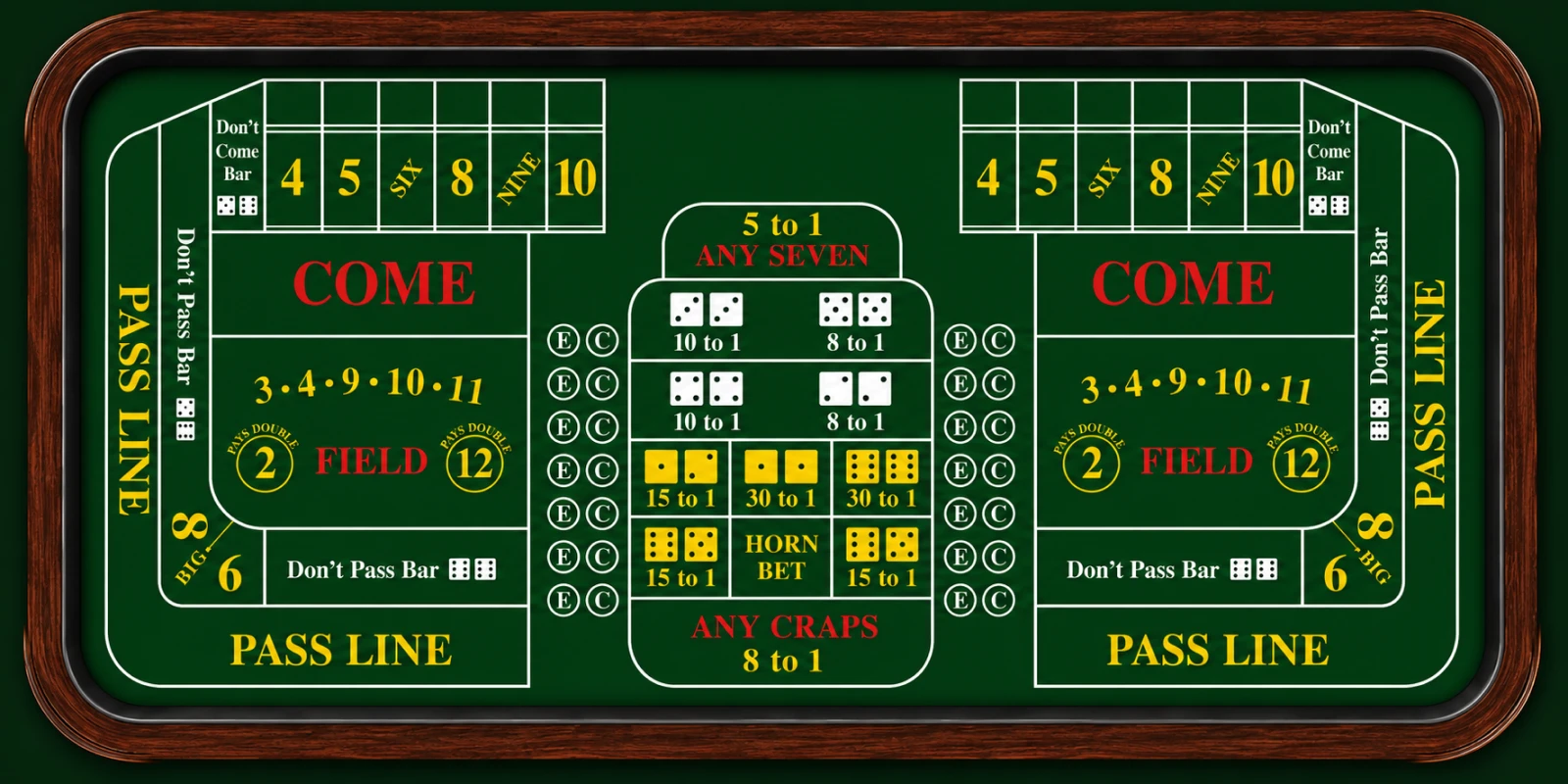
The symmetrical design of a craps table is meant to maximize casino space, meaning the two long outer sides are exact mirror images of each other. This layout choice immediately cuts the apparent complexity of the felt in half.
Each outer side section is dominated by the Pass Line, the Don’t Pass bar, the large Come zone, and the numbered point boxes. The shared center section of the table houses the Proposition and Hardway bets. This center neighborhood carries the highest house advantages on the floor. As a beginner, you must train your eyes to ignore this zone completely.
The Key Betting Areas for Your First Session
You only need to recognize five specific zones on the felt to play a disciplined, low-variance session:
- Pass Line: The long, curved boundary running along the outer edge of the layout where you will place your primary wagers.
- Don’t Pass Bar: Located directly parallel to the Pass Line, this zone is designated for players who prefer wagering against the shooter.
- Come Area: The expansive central zone on each side that functions identically to a Pass Line wager but activates after a point has been established.
- Field Bet Area: A single row of numbers situated in front of the Come zone that acts as a high-margin, single-roll wager.
- Point Boxes (4, 5, 6, 8, 9, 10): The large numbered squares running across the top of the layout where the dealer places the tracking puck.
The highly lucrative Free Odds wager has no physical markings on the table layout. To place it, you simply stack your additional chips directly behind your original Pass Line bet after the point is set.
Meet the Craps Table Crew
Four distinct casino employees manage a live craps game. Knowing their responsibilities helps eliminate table confusion during your first public session.
- Two Base Dealers: Positioned on opposite sides of the table, these employees manage all chip placements, collect losing wagers, and issue payouts for their respective halves of the layout. They are your primary points of contact.
- The Stickman: Standing at the center of the player side, this dealer utilizes a long wooden stick to retrieve and push the dice to the shooter. The stickman controls the game pace and announces the results of every throw. Because his announcements rely heavily on traditional craps terminology, mastering these shorthand terms is essential to following the live table action without hesitation.
- The Boxman: Seated directly between the two base dealers, the boxman acts as the table supervisor. This employee monitors chip security, watches for human errors, and holds final authority over any table disputes.
How a Game of Craps Works: The Two Phases
Every standard round of craps moves through two distinct operational phases: the Come-Out Roll and the Point Phase. The Pass Line wager ties your chips to the shooter’s ability to navigate both cycles.
Selecting the Shooter
When a new round begins, the stickman offers five dice to the next eligible player. To qualify as a shooter, you must hold an active wager on either the Pass Line or the Don’t Pass Line.
Taking the dice is completely optional. If you prefer to focus entirely on betting without throwing, simply say “pass” when the stickman slides the dice your way. The crew will move them clockwise to the next player without hesitation.
Phase 1: The Come-Out Roll
The Come-Out Roll is the opening throw of a fresh round. For a beginner holding a standard Pass Line wager, this roll triggers three immediate paths:
- Rolling a 7 or 11: An instant automatic win. Pass Line wagers receive an immediate 1:1 even-money payout, and the round ends.
- Rolling a 2, 3, or 12: An instant automatic loss known as “crapping out.” Your Pass Line chips are collected by the dealer, and the round ends.
- Rolling a 4, 5, 6, 8, 9, or 10: The rolled number becomes the official point for the table. The round advances directly into Phase Two.
Phase 2: The Point Phase
Once a point number is established, the base dealer flips a physical, double-sided disc from its black “OFF” side to its white “ON” side, placing it directly inside the corresponding point box.
The objective of the entire table now changes. The shooter must roll that exact point number again before throwing a 7. All other numbers on the dice become mathematically irrelevant to your Pass Line wager.
If the shooter hits the point number, your Pass Line chips win an even-money payout. If the shooter throws a 7 first, it is called a “seven out.” This losing outcome terminates the round, wipes out the table’s active line bets, and passes the dice clockwise to the next shooter.
A 7 is only your enemy during this second phase. On the opening Come-Out roll, it is your best friend.
The Best Bets for Craps Beginners
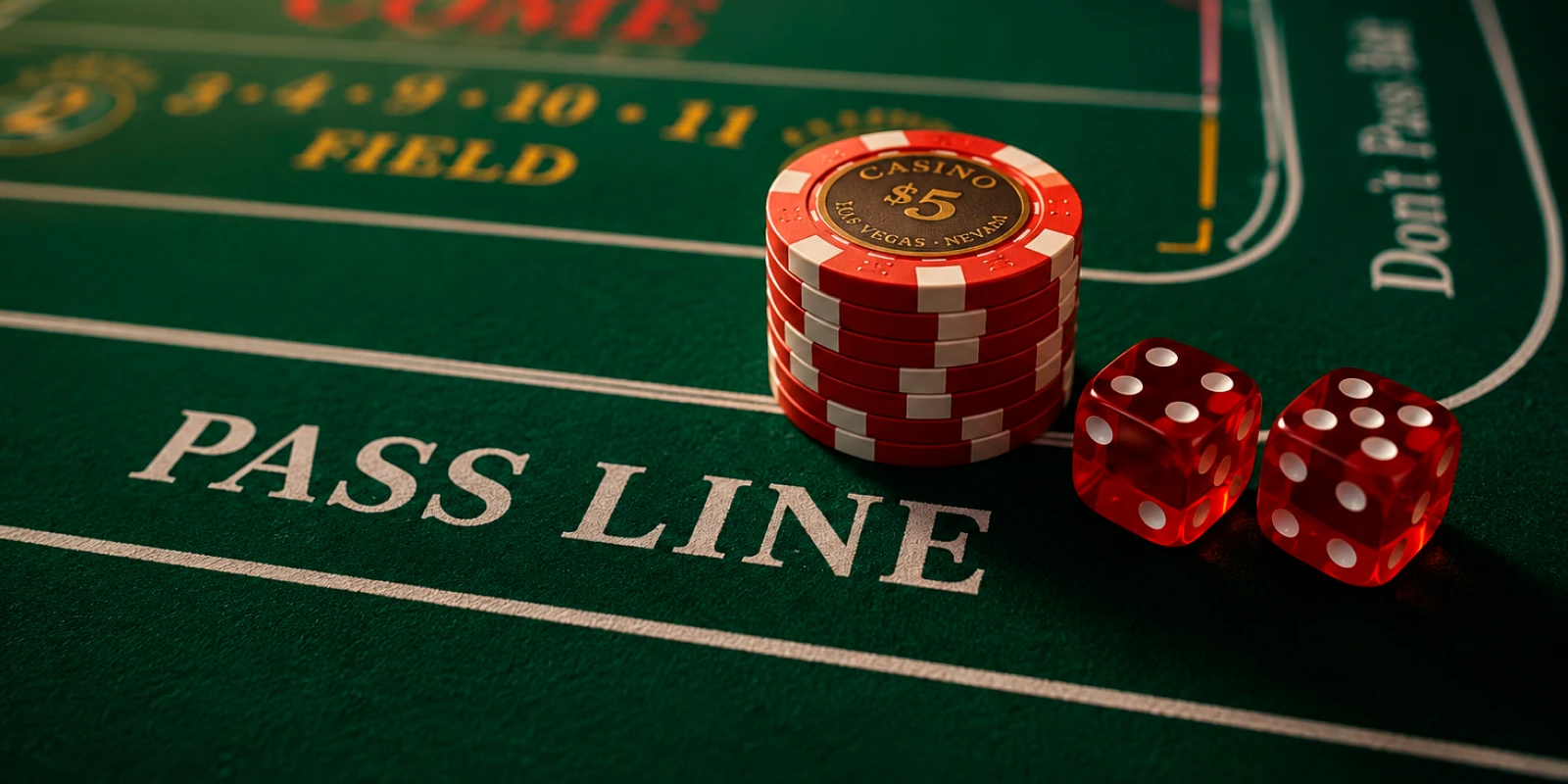
Defeating the casino’s structural advantage requires strict betting discipline. You must focus your entire bankroll on three core options and treat the rest of the layout as background noise.
The Pass Line Bet
This is your foundational wager. You place your chips on the outer Pass Line strip before the shooter’s opening throw. It pays even money (1:1) and carries a 1.41% house edge. Once placed, you cannot remove or lower a Pass Line bet until it resolves.
The Don’t Pass Bet
The Don’t Pass wager is the structural inverse of the Pass Line, meaning you are betting that the shooter will fail. On the Come-Out roll, a 2 or 3 wins, a 7 or 11 loses, and a 12 results in a push (a tie) to preserve the house advantage. During the Point phase, you win if a 7 appears before the shooter repeats the point.
While the house edge is slightly lower at 1.36%, betting the Don’t Pass line alters the social dynamic. You will be winning your wagers at the exact moment the rest of the table loses theirs.
The Free Odds Bet
This is the single most lucrative wager available on a casino floor. Because it carries a 0% house edge, the casino prints no markings for it on the table felt.
You activate this bet by stacking your chips directly behind your active Pass Line wager after a point number is established. The casino pays out true mathematical odds based on the difficulty of hitting the point:
- Points of 4 or 10: Pays 2:1
- Points of 5 or 9: Pays 3:2
- Points of 6 or 8: Pays 6:5
Casinos limit the size of your Odds wager based on a multiplier of your original Pass Line bet.
Understanding the 3-4-5x Odds Multiplier
Most modern casino floors utilize a standardized 3-4-5x odds structure to simplify table payouts for the dealers:
- On a Point of 4 or 10: You can bet up to 3x your Pass Line wager in Free Odds.
- On a Point of 5 or 9: You can bet up to 4x your Pass Line wager in Free Odds.
- On a Point of 6 or 8: You can bet up to 5x your Pass Line wager in Free Odds.
This specific cap ensures that a maximum Odds wager always nets a profit equal to exactly six times your original Pass Line bet, regardless of the established point number. Always maximize your Free Odds wager when your session bankroll permits, as it dilutes the overall house edge of your combined chips.
Come Bets
Come wagers allow you to jump into the action after a point has already been set. Once placed in the large Come zone, the very next dice throw acts as a personal Come-Out roll for those chips. A 7 or 11 wins immediately, a 2, 3, or 12 loses, and any other number moves your chips into that specific point box. You can then back your Come bet with Free Odds just like a Pass Line wager.
Place Bets on 6 and 8
If you want immediate action on the most frequent numbers without waiting for line transitions, ask the dealer for a Place bet on the 6 or 8. Mathematically, these are the most common outcomes outside of a 7.
Place wagers on the 6 and 8 carry a tight house edge of 1.52% and pay out at 7:6 odds. Because of this payout ratio, you must always wager in multiples of $6. A $6 wager secures a $7 profit. Do not place these chips yourself; slide them to the dealer and vocally state your target numbers.
High-Risk Bets to Avoid
The flashy, theatrical center of the craps table is designed to extract maximum profits for the house. The stickman will vocally promote these options between rolls, but the mathematics behind them are indefensible for a beginner.
Proposition Bets
Center-table proposition bets resolve on a single roll of the dice, carrying aggressive house advantages:
- Any 7: 16.67% house edge
- Any Craps (2, 3, or 12): 11.11% house edge
- Hardways (4, 6, 8, or 10 as matching pairs): 9.09% to 11.11% house edge
Treat the center of the table as background noise. The excitement generated around these wagers is an intentional casino design feature meant to disrupt your discipline.
Big 6 and Big 8
Avoid the large red 6 and 8 boxes printed on the corners of older layouts. These zones function identically to a standard Place bet on the 6 or 8 but issue a lower 1:1 even-money payout instead of the correct 7:6 ratio. You are taking the exact same physical risk for an inferior financial reward.
The 3-Bet Tactical Strategy Plan
To maintain the lowest possible house advantage while enjoying multi-number action, implement a structured approach known as the 3-Point Molly.
- Step 1: Place a table-minimum wager on the Pass Line before the Come-Out Roll.
- Step 2: Once the point is set, immediately back your Pass Line chips with the maximum allowable Free Odds.
- Step 3: Place a table-minimum wager in the Come zone. On the next throw, this moves to a second point number. Back this Come bet with full Free Odds as well.
This loop keeps your active chips backed by zero-house-edge odds, dropping the combined theoretical house advantage across your active session down to approximately 0.5% to 0.6%.
Beginner Strategy Pipeline:
[Pass Line Bet] -> [Establish Point] -> [Add Max Free Odds] -> [Deploy Come Bet]
Bankroll Management
Craps tables experience rapid short-term variance. To protect your bankroll from a cold streak, your starting buy-in must reflect the table limits.
At a $5 minimum table, bring a session bankroll of at least $100 to $150 (representing 20 to 30 minimum line units). For a $10 table, scale your cash up to $200 to $300. Set a strict stop-loss boundary before laying your money down, and exit the game the moment you reach it.
Essential Craps Table Etiquette

The primary barrier for new players is often social anxiety rather than table rules. Mastering a few basic table protocols will ensure you fit in with experienced players from your very first roll.
Handling and Throwing the Dice
If you choose to act as the shooter, you must follow strict security protocols:
- One Hand Only: You must pick up, shake, and handle the dice using a single hand at all times. Switching hands is a security violation.
- Hit the Back Wall: Your throw must travel the entire length of the layout and visibly bounce off the opposite diamond-textured rubber wall to count as a legal roll.
- Keep Dice Above the Rail: Never bring the dice inside your body line or drop them below the table’s wooden rail. They must remain visible to the dealers at all times.
Table Protocols
Always wait for a clear pause between rounds before buying into the game. Lay your cash flat on the layout felt; dealers are legally barred from taking money directly from your hand.
Once the shooter receives the dice from the stickman, keep your hands completely clear of the table interior. Late chip placement can result in a voided roll or a vocal warning from the boxman.
If you wish to tip the crew, the standard cultural method is placing a small Pass Line wager “for the dealers” directly alongside your own chips, allowing them to ride your winning streaks.
Online Craps vs. Live Casino Craps
Both options deliver the exact same mathematical parameters, but the playing environments serve entirely different learning styles.
| Feature | Online Craps | Live Craps |
|---|---|---|
| Pace of Play | Completely self-directed with zero time pressure | Fast and dynamic, controlled by the crew |
| Social Experience | Solo session with no external distractions | Intense communal energy and shared outcomes |
| Practice Options | Free-play and demo modes widely available | Real-money wagering only |
| Atmosphere | Quiet, pressure-free learning environment | Loud, energetic, and highly stimulating |
For pure structural practice, free digital software is unmatched. Once you memorize the betting transitions, transition to a live table to experience the authentic version of the game.
Step-by-Step Walkthrough of Your First Live Round
Follow this exact sequence of actions when you approach a live casino table for the first time:
- Observe the Table First: Stand at the outer rail for a few minutes. Check if the tracking puck reads “OFF” (black) or “ON” (white) to determine the active game phase.
- Buy In During a Pause: Slide your cash onto the felt between rounds. The dealer will verify the amount and push your chips over.
- Place the Pass Line: Wait for the puck to turn “OFF.” Place your baseline chips on the Pass Line boundary before the shooter receives the dice.
- Watch the Come-Out Roll: If the shooter lands a 7 or 11, collect your profit. If they land a 2, 3, or 12, place a fresh minimum bet. If they land any other number, watch where the puck moves.
- Deploy Your Free Odds: Stack your additional odds chips directly behind your original Pass Line bet.
- Track the Point Phase: Watch the subsequent throws until the shooter either repeats the point number for a table win or throws a 7 to reset the line.
Frequently Asked Questions
Is “Snake Eyes” good or bad in craps?
Snake eyes (rolling a 1 on each die for a total of 2) is an automatic loss for Pass Line bettors on the initial Come-Out Roll. It belongs to the “craps” number group (2, 3, and 12) that triggers an immediate line defeat. However, for Don’t Pass bettors, rolling a 2 on the opening throw counts as an instant win.
How much money do I need to play craps at a casino?
To survive normal short-term variance, bring a bankroll equal to 20 to 30 minimum table bets. For a standard $5 table, a buy-in of $100 to $150 is optimal. For a $10 table, aim for $200 to $300.
What is the minimum bet at a casino craps table?
Wagering requirements vary based on the casino location and the time of day. Most major commercial floors offer $5 or $10 baseline minimums during quiet weekday afternoons. These limits routinely jump to $15, $25, or higher during busy weekend evenings to manage heavy floor traffic.
What do terms like “yo” and “boxcars” mean in craps?
“Yo” is the standard stickman shorthand for the number 11, utilized to prevent phonetic confusion with the word “seven” over a loud casino floor. “Boxcars” refers to a roll of 12, showing a pair of sixes on the dice.
PokerListings 
Log in to join the discussion
Share your thoughts and see what others have to say.