Using AI To Help Your Poker Game – A Look At Microsoft Copilot


 PokerListings
-
 CoinPoker 150% up to $2000
+18 | T & C apply | Play responsible
-
 Stake.US Poker $55 Stake Cash + 260,000 GC
18+ | Play Responsibly | T&C Apply
-
 Americas Cardroom 100% up to $2000
18+ | Play Responsibly | T&C Apply
-
 Betonline Poker 100% up to $1000
18+ | Play Responsibly | T&C Apply
-
 SportsBetting Poker 100% up to $1000

As AI tightens its grip on humanity, here is a look at how low-stakes poker players can utilize our new robot overlords to refine their games on the virtual and the physical felt. In this article, we will examine a strategy guide generated by Microsoft Copilot AI, focusing on strategies, exploits, and tips within the $5-$15 price range.
The Prompt
Like all interactions with AI, it all starts with a prompt. For this experiment, as we examine other AIs to compare them, the following prompt will be used. It will remain consistent throughout: “I am an online poker MTT player who plays an average of buy-ins between $5-$15. Help me become a super pro crusher like Adrian Mateos. Use range charts, bet sizing information across a range of stack sizes to make a tight, solid, aggressive strategy that will help me run deep in tournaments.”
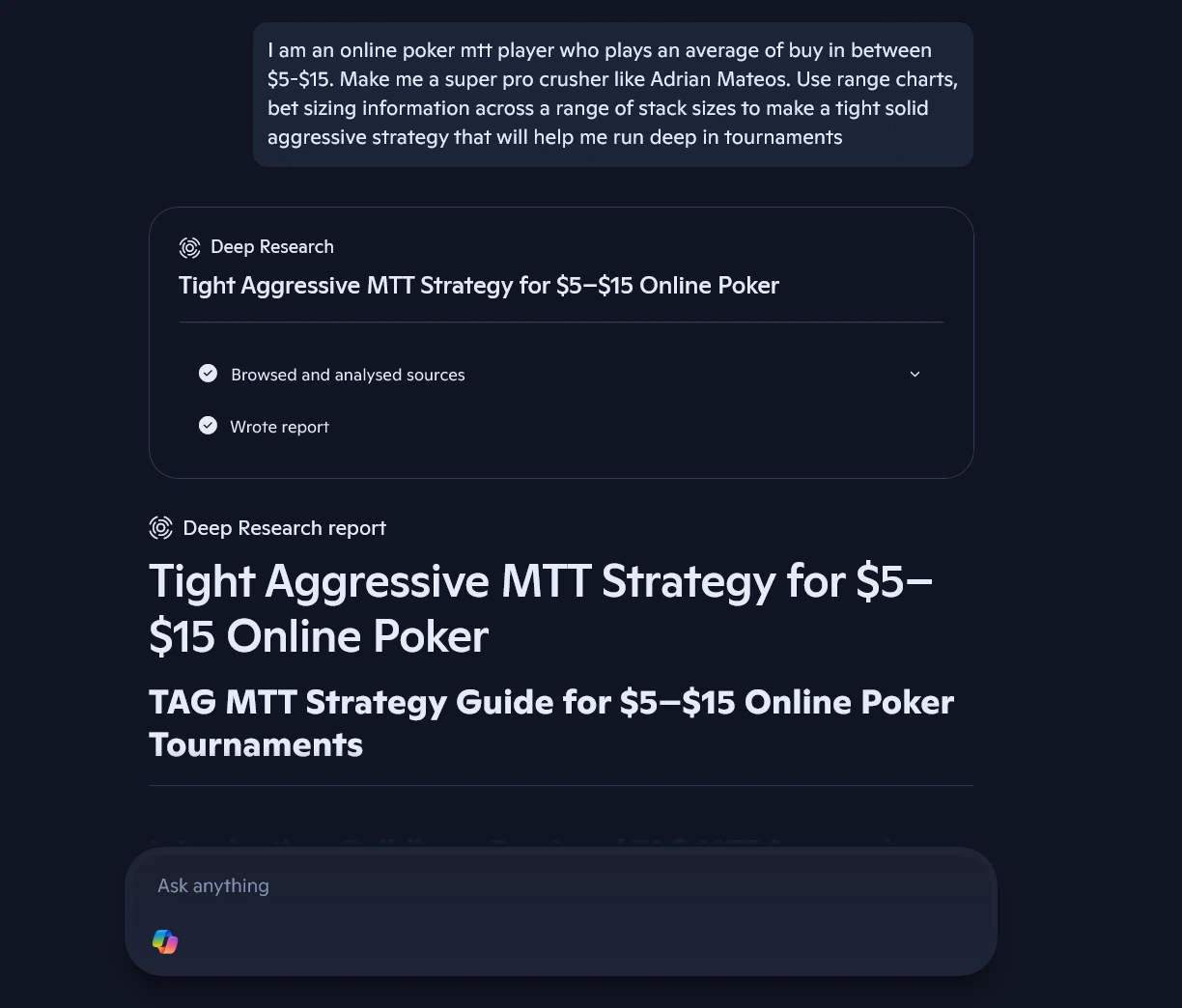
To make this guide, I used the Deep Research option to ensure it is as detailed as possible. When using prompts, you must be specific in your requirements for the AI service.
First Glance At the Outcome
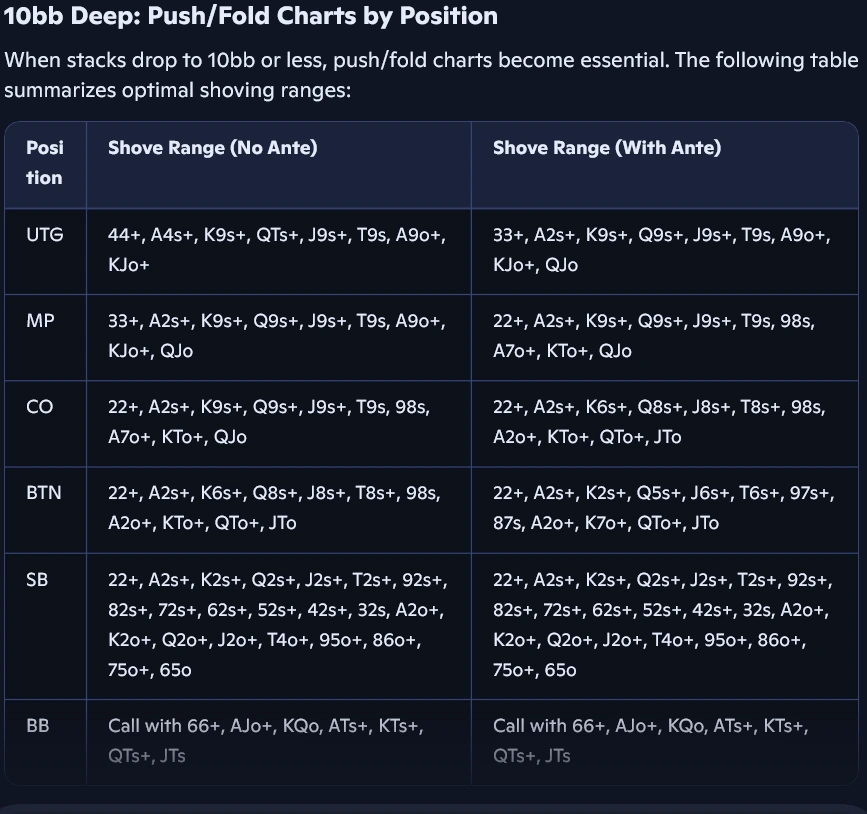
It took Copilot around five minutes to generate the report, and it went into remarkable detail considering the time it took. It covered everything mentioned in the prompt in great detail, and included range charts for a range of stake sizes from each position. The information was presented clearly, making it accessible to beginners. It also included an elaboration on each stack size and positional play. Below is what Copilot generated for 10BB play. It also covered 100bb, 60bb, 40bb, and 20bb.
Pre and Postflop Strategy
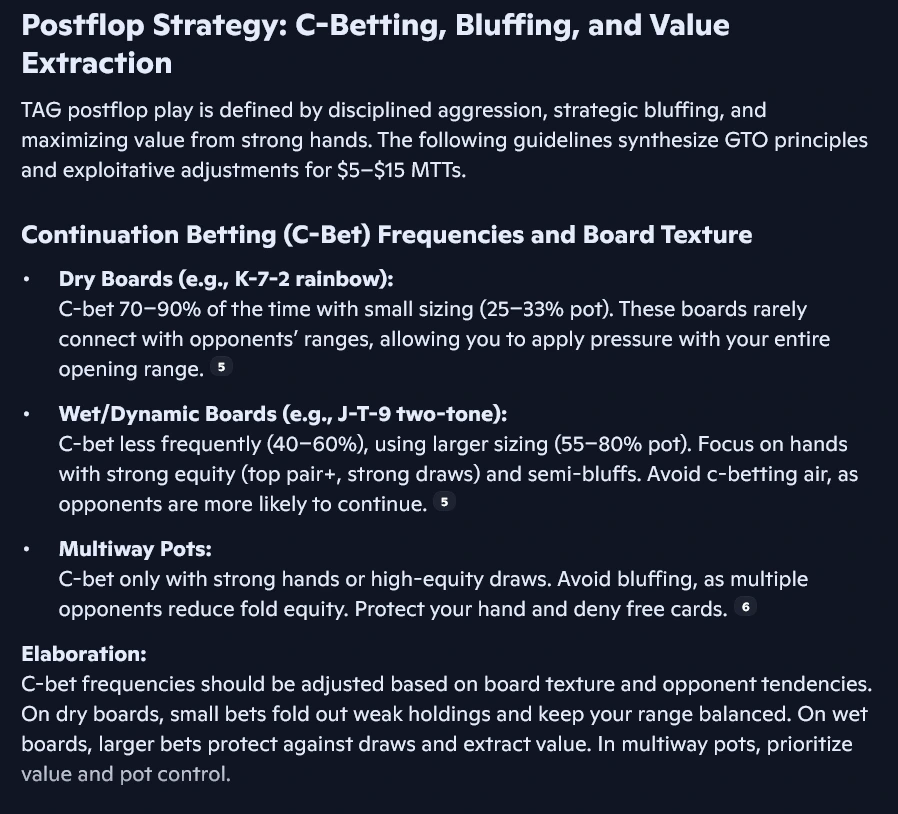
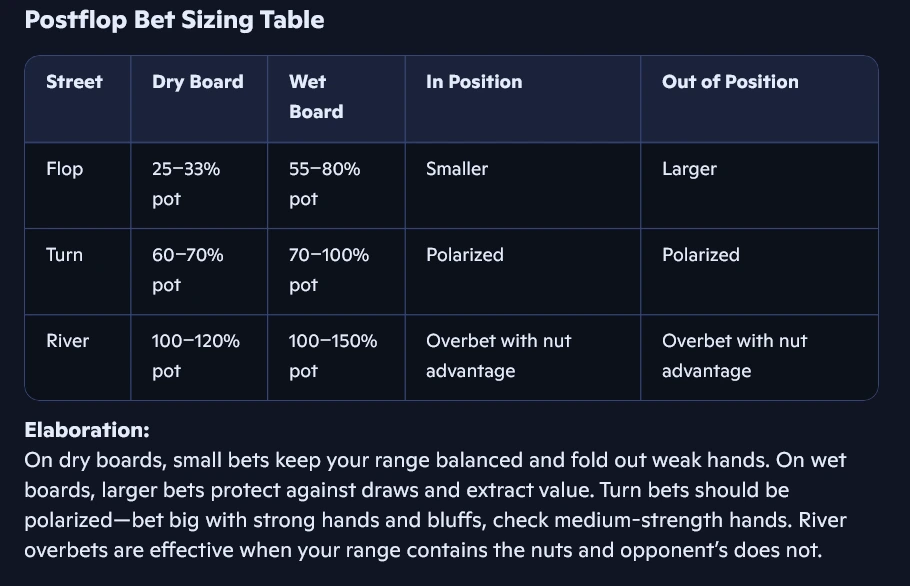
Copilot generated an in-depth report on continuation betting on dry and dynamic flops, including the frequency of c-bets and the recommended sizing.
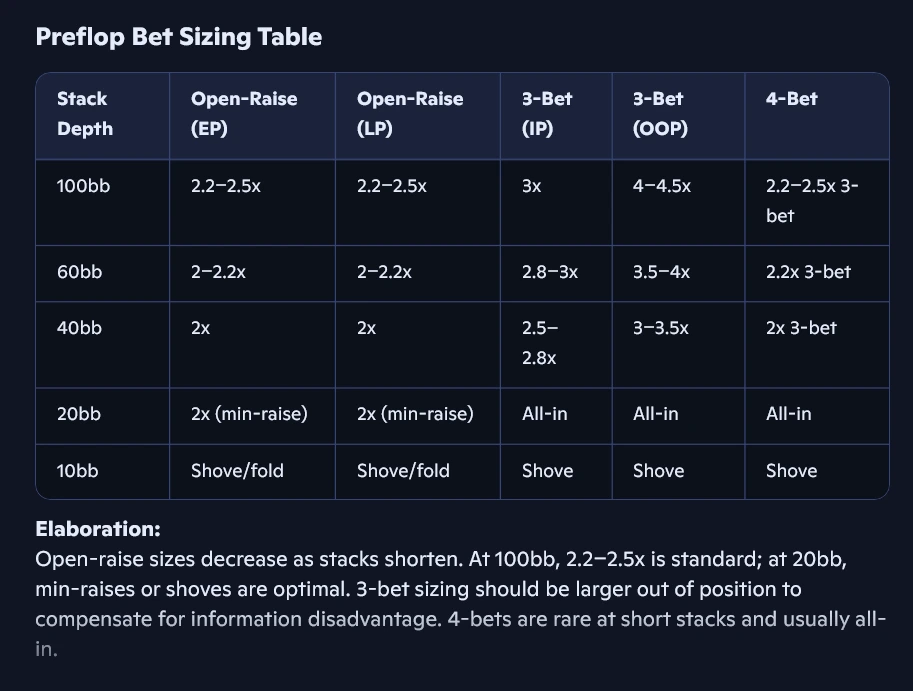
Copilot went on to recommend a series of open-raise sizes across a range of stack sizes, suggesting opening from 2.2-2.5x on a 100 big blind stack before sticking to min-raise for any stack of 40 big blinds and under. At 60bb, Copilot recommended keeping open-sizes at 2-2.2 big blinds. Below is the table it generated, including three-bet and four-bet sizings.
Postflop bet sizings were also generated. It recommends 25-33% on the flop on a dry board, and sizing up to 55-80% on a dynamic flop, which could be a monotone flush board, straight, or open-ended draw boards. In position, Copilot thinks you should bet smaller in position and larger out of position. On the turn, it suggests sizing up to over half pot, 60-70% on a dry board, and 70-100% on a wet board. On the river, it liked 100% + on both dry and wet boards in and out of position.
ICM Fundamentals and Final Table Adjustments
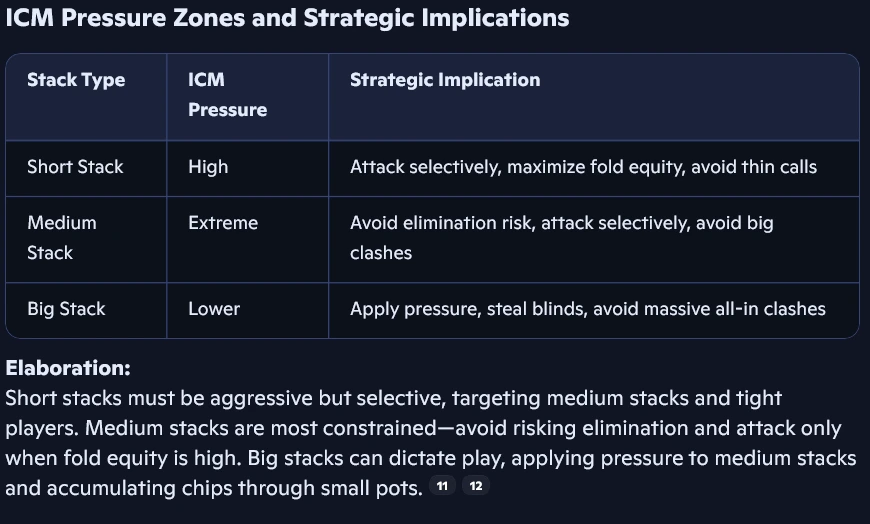
ICM (Independent Chip Model) is crucial for maximizing tournament equity, especially near the bubble and at final tables. Understanding ICM pressure, risk premium, and stack dynamics separates consistent winners from the rest. This is what Copilot had to say on ICM and Bubble Play.
ICM Risk Premium and Bubble Play
- Risk Premium:
The extra equity required to call or raise under ICM. Medium stacks need significantly more equity to risk elimination, tightening their ranges. - Bubble Exploitation:
Apply pressure to medium stacks, widen shoving ranges, and steal blinds aggressively. Avoid clashing with bigger stacks that can bust you. Use fold equity as a weapon. - Short Stack Play:
Shove wider when covered by medium stacks, but tighten up when big stacks are in the blinds, or multiple short stacks remain.
Copilot suggested that there are a range of tools to use that are familiar to most seasoned players. It mentioned ICMIZER to calculate optimal push/fold ranges and risk premiums, as well as GTO Wizard for preflop and postflop ICM charts.
Common Tendencies and Adjustments at The Stakes
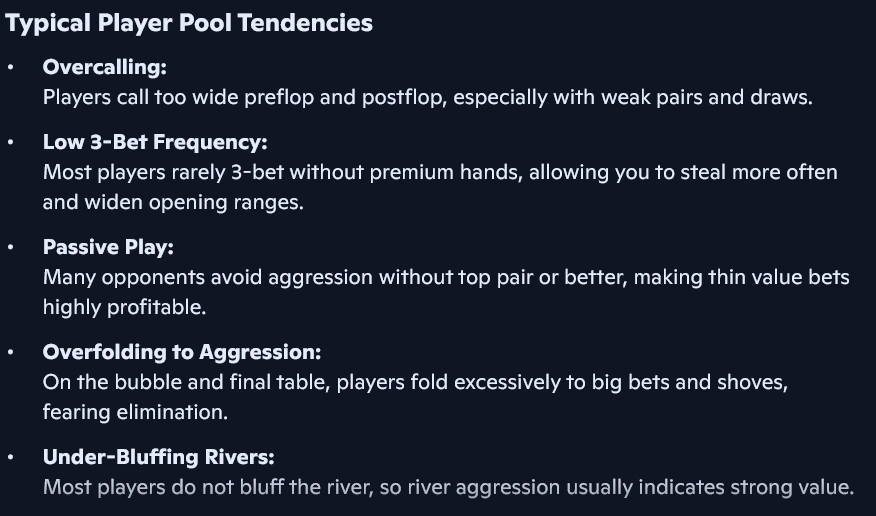
Exploiting population tendencies and leaks from players at these stakes is essential to maximizing win rate. Every player has tendencies, meaning every player has something to exploit, so you must pay attention to your opponents’ habits, when they bet big, when they check, what hands they show down etc. These are the typical player pool tendencies that Copilot found.
Common Mistakes and Leak Fixes
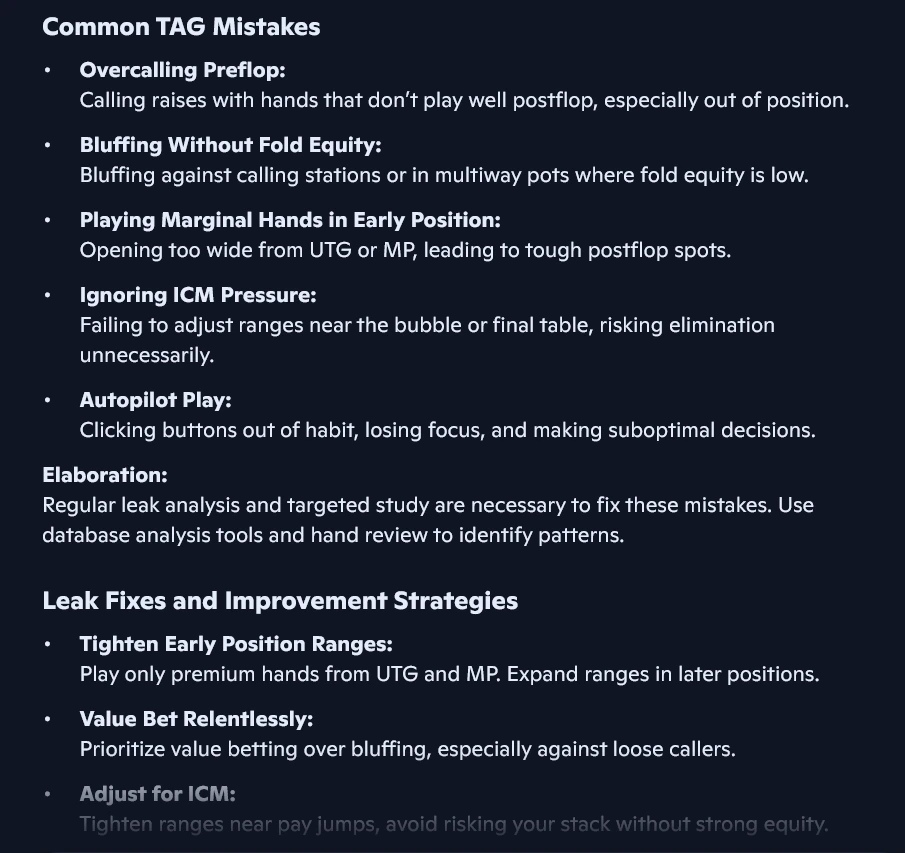
Even players who are trying to stick to the TAG style of play have leaks in their game. Copilot suggested that overcalling preflop is one of the big leaks, especially with hands that don’t play well postflop and out of position. These could be small pocket pairs versus a three-bet whilst being out of position. The fix is to play only premium hands from UTG and MP, and expand ranges in later positions. Copilot’s elaboration for mistakes and fixes involved regular leak analysis and targeted study, which is where study tools like GTO Wizard come in.
The Mental Game
One of the most important aspects of poker is the mental game. This can be dealing with rough patches of variance, mindfulness exercises, and taking breaks from the grind. It also suggested implementing study routines and drills to accelerate their progress. When speaking to Daniel “Jungleman” Cates at the Bombay High Stakes Week in Tallinn, he told Pokerlistings that studying was “Very important. Nearly essential.” Here is a look at what Copilot recommended on the mental game.
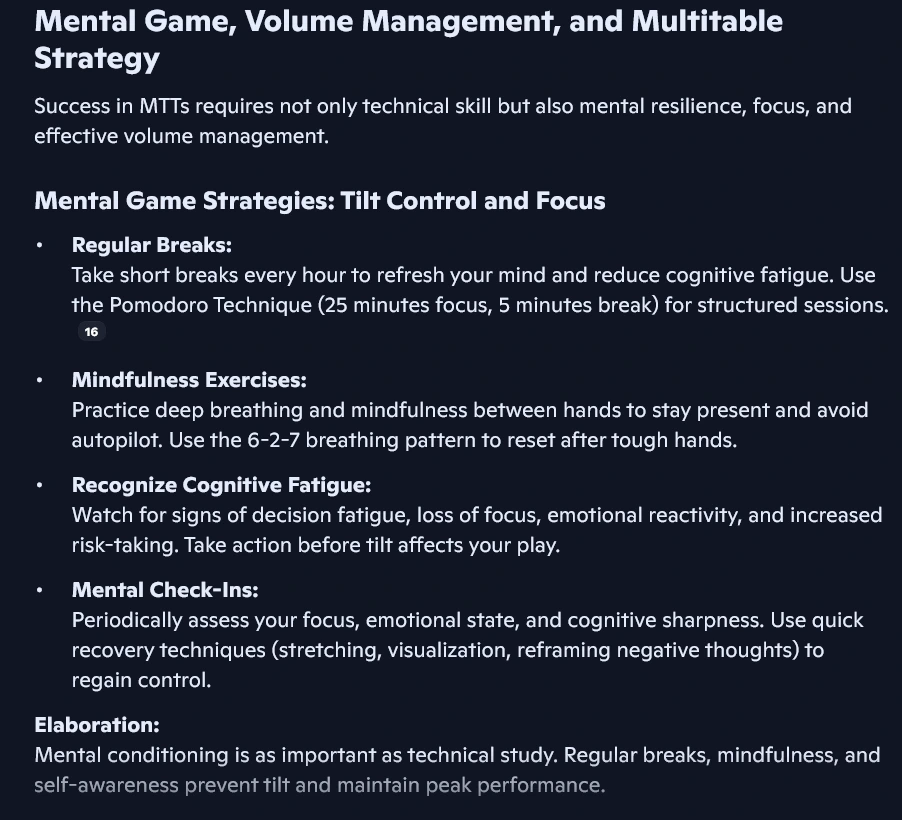
Copilot also suggested: optimizing your schedule, gradually adding tables, and avoiding external distractions like phones and TV to maintain focus.
To Conclude
Copilot generated an incredibly detailed overview of strategy for the $5-$15 tournaments quickly and efficiently. It was presented in a readable manner that is accessible to both old and new players. It is worth checking out Copilot to help you refine your strategies, and it is worth adding in or asking some questions to help boost your knowledge and understand new concepts.
That’s all for now, folks. Another AI software will be assessed in the next article.
Until next time.