
 EN
EN  DE
DE The Irish Poker Open: From a Dublin Club to Europe’s Longest-Running Poker Festival
 PokerListings
-
 CoinPoker 150% up to $2000
18+ | Play Responsibly | T&C Apply
-
 Ignition Poker 150% up to $1,500
18+ | Play Responsibly | T&C Apply
-
 Stake.US Poker $55 Stake Cash + 260,000 GC
18+ | Play Responsibly | T&C Apply
-
 Americas Cardroom 100% up to $2000
18+ | Play Responsibly | T&C Apply
-
 Betonline Poker 100% Up to $1,000
18+ | Play Responsibly | T&C Apply
The Irish Poker Open doesn’t just occupy a special place in our hearts, it also occupies it in the game’s history. First played in 1980, the Irish Open is the longest-running No-Limit Hold’em tournament outside Las Vegas and without question, Europe’s most well-known live poker event.
Over more than four decades, the event has managed to grind through its fair share of highs and lows. It survived the boom years, the downswing that followed, and even the global COVID-19 pandemic. Today, it draws thousands of players from across the world, as it has outgrown just Europe years ago.
PokerListings was on the floor for last year’s event and will return this year. Before the next edition begins on March 26, it’s worth looking back at how the Irish Poker Open has grown from a local tournament into a highlight fixture on the world poker calendar.
The biggest challenge of this year? Battling it out with the World Series Of Poker Europe, which has moved to Prague for the 2026 poker season and selected the ‘holy Irish’ Easter period to hand out their bracelets. Nevertheless, can bracelets beat the Craic Den?
We’ll come back to this question next month.
How the Irish Poker Open Started
The story begins with Dublin bookmaker and poker enthusiast Terry Rogers. Rogers had travelled to Las Vegas in the late 1970s and had a glimpse at the World Series of Poker. At the time, nothing similar existed in Ireland, let alone in Europe. Rogers believed there was no reason Dublin couldn’t host its own major poker tournament.
In collaboration with Liam Flood, Rogers organised the first Irish Poker Open in 1980. The venue was The Eccentric Club, a private club that hosted the inaugural Main Event. The buy-in was set at £1,000, which was significant money compared to now. The field was small, but the concept worked from the get-to. The first champion was Colette Doherty, who was honored during the 2025 edition of the Irish Poker Open, with her son taking the stage beside the host of the event, Phil Baker. She became one of the earliest winners of a major No-Limit Hold’em tournament in Europe.
The Early Years: 1980–1989
The Irish Poker Open spent its first decade building a reputation instead of chasing large numbers. Of course, they were ambitious, but their modest fields made the tournament become known for its strong structures and serious competition. Many of the early players were Irish regulars who developed their games in private clubs and casinos around Dublin.
One player in particular dominated the early era: Donnacha O’Dea.
O’Dea won the Main Event four times, a record that still stands today. However, you need to see the contrast of field sizes here. His victories in 1981, 1984, 1988 and 1990 established him as one of Ireland’s most successful tournament players and gave the Irish Poker Open its first recognisable champion.
Main Event winners during the 1980s included:
| Year | Winner |
|---|---|
| 1980 | Colette Doherty |
| 1981 | Sean Kelly |
| 1982 | Frank Conway |
| 1983 | Jimmy Langan |
| 1984 | Tony Byrne |
| 1985 | Irene Tier |
| 1986 | Bryan McCarthy |
| 1987 | Noel Furlong |
| 1988 | Jimmy Langan |
| 1989 | Noel Furlong |
During these early years, the event moved venues across Dublin. Changing venues is not necessarily a bad thing; you’re often left with no other choice, especially when the event is growing steadily. However, the structure and the format stayed consistent. It remained a straightforward No-Limit Hold’em tournament with a serious buy-in and a very competitive player field.

In the 80s, Rogers also managed to get high rollers from the US taking part in the Irish Poker Open. Names such as Benny Binion, Doyle Brunson, Chip Reese, and Stu Ungar participated in various events in that era.
The 1990s: Gradual Growth
By the early 1990s, the Irish Poker Open had started to draw attention beyond Ireland. Players from the United Kingdom and continental Europe began travelling to Dublin to take part, and this is where it really kicked off. Word had spread that the event offered deep structures and a strong field without the enormous buy-ins seen in Las Vegas, and everyone wanted to be part of it because of this.
The tournament also began to move into larger hotel venues around the city as attendance rates showed an increasing trend. You can also see the broader international participation back in the winner’s list of the 90s:
| Year | Winner |
|---|---|
| 1990 | Liam Flood |
| 1991 | Colette Doherty |
| 1992 | * |
| 1993 | Christy Smith |
| 1994 | Mickey Finn |
| 1995 | * |
| 1996 | Liam Flood |
| 1997 | * |
| 1998 | Mickey Finn |
| 1999 | Liam Barker |
*Not all information is known about the Main Event winners. We will do our best to try and retrieve this information in the coming period.
Some of these players would go on to have excellent careers after their victories at the Irish Open. Noel Furlong won a World Series of Poker bracelet, while Alan Goehring became known for playing high-stakes tournaments in the US. By the end of the decade, the Irish Poker Open had firmly established itself as a regular stop for European players.
The Poker Boom Arrives
The early 2000s changed poker around the world. Online poker sites expanded like a forest fire, televised tournaments increased the game’s visibility, and thousands of new players began entering live events, all in the hunt for that glory that came with winning a tournament. The Irish Poker Open benefited.
The tournament moved into larger venues again and again to accommodate all the new players. The event also started attracting a mix of poker professionals and online qualifiers. As poker’s popularity exploded, mainly due to the likes of Chris Moneymaker becoming World Champion, the Irish Poker Open became one of Europe’s best-known tournaments, if not the best.
Main Event winners during the 2000s included:
| Year | Winner |
|---|---|
| 2000 | Alan Betson |
| 2001 | Jenny Hegarty |
| 2002 | Nick Beirne |
| 2003 | Joe Beevers |
| 2004 | Ivan Donaghy |
| 2005 | John Falconer |
| 2006 | Vincent Melinn |
| 2007 | Marty Smith |
| 2008 | Neil Channing |
| 2009 | Christer Johansson |
Several of these champions were already familiar names on the international circuit, and some are still very much active today. Other names that made careers in those times were players like Andy Black, Tony G, and Neil Channing. Andy Black had deep runs at the World Series of Poker and participated in plenty of televised cash games and tournaments. Tony G, known for the iconic quote ‘On your bike, Phil (Hellmuth)’, might not appear much anymore, but is definitely known by any poker aficionado or amateur player.
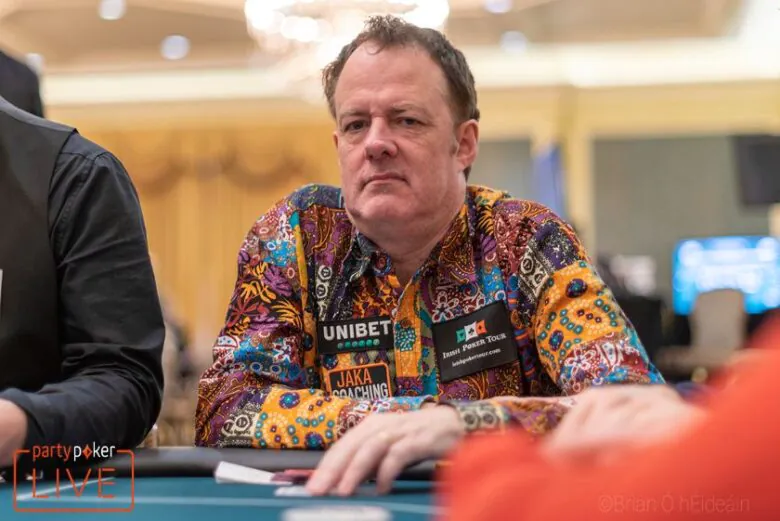
Neil Channing was well known in the UK tournament scene, while a young Dara O’Kearney was in the early years of his poker career, and became known for his podcast with fellow Irishman David Lappin later on, and is now the official ambassador of PaddyPower Poker, one of the main sponsors of the current Irish Poker Open.
What the Irish Poker Open managed to keep, and still hasn’t lost a single bit of it, is its identity. While the fields still increased year by year, the buy-in remained accessible compared with some other European major tournaments.
The Post-Boom Years
After the poker boom hit its ultimate top, many live tournaments across Europe faced a period of adjustment and challenges. The Irish Poker Open experienced changes in organisation and venue during the early 2010s, but it never disappeared from the calendar.
During this period, the tournament was often held at the Citywest Hotel, which provided the space required to accommodate larger tournament fields and expanded tournament schedules.
Main Event winners from the early 2010s included:
| Year | Winner |
|---|---|
| 2010 | James Mitchell |
| 2011 | Niall Smyth |
| 2012 | Kevin Vandersmissen |
| 2013 | Ian Simpson |
| 2014 | Patrick Clarke |
| 2015 | Ioannis Triantafyllakis |
Ian Simpson’s second victory in 2013 placed him among the icons of the Irish Poker Open. Not only did he win the Main Event in 2013, but he went back-to-back at the final table as he finished 4th in 2012. Even during quieter years for live poker, the Irish Poker Open continued to draw solid fields.
A New Era Begins
In 2016, after the passing of Liam Flood, Paul O’Reilly and JP McCann, who had both worked at the event for many years, took over. It would be a drastic handover, as Paul O’Reilly and JP McCann, until this very day, co-owners of the event, adjusted the buy-in to €1,150, and put more effort into offerings away from the tables.

The structure expanded to include a wider range of side events and tournaments alongside the Main Event.
Main Event champions in this period were:
| Year | Winner |
|---|---|
| 2016 | Dan Wilson |
| 2017 | Griffin Benger |
| 2018 | Ryan Mandara |
| 2019 | Weijie Zheng |
Attendance began increasing again, and the Irish Poker Open was gradually rebuilding momentum as one of Europe’s historic poker stops.
The Pandemic Pause
Like most live poker events, the Irish Poker Open was affected by the global pandemic.
Live tournaments were suspended during 2020 and 2021, and parts of the festival schedule moved online instead. Despite the disruption, the tournament’s brand remained strong.
When live poker returned, the Irish Poker Open quickly regained its place on the European schedule.
(Online) Main Event champions in this period were:
| Year | Winner |
|---|---|
| 2020 | Pablo Silva |
| 2021 | Pavel Veksler |
The Modern Irish Poker Open
The current era of the Irish Poker Open is defined by its move to the Royal Dublin Society, going from the wilderness to the city centre of Dublin. The RDS offers a large exhibition space capable of hosting thousands of players, multiple tournament areas, a cash game area, and a Craic Den.
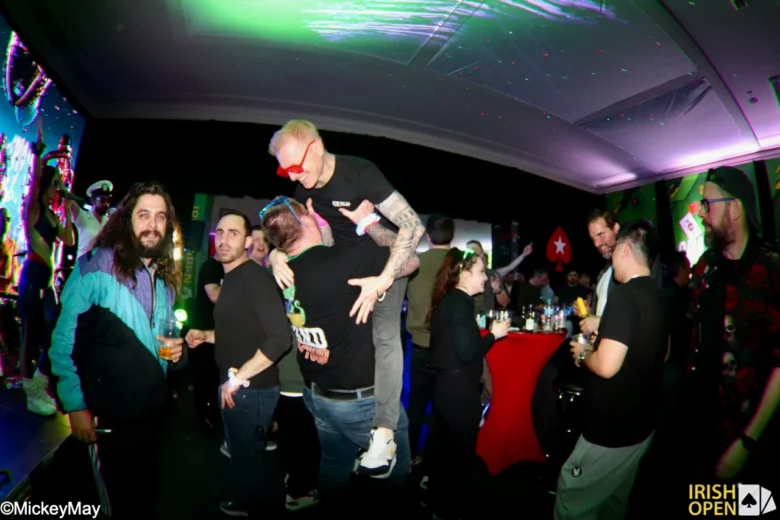
Recent Main Event winners include:
| Year | Winner |
|---|---|
| 2022 | Steve O’Dwyer |
| 2023 | David Docherty |
| 2024 | Tero Laurilla |
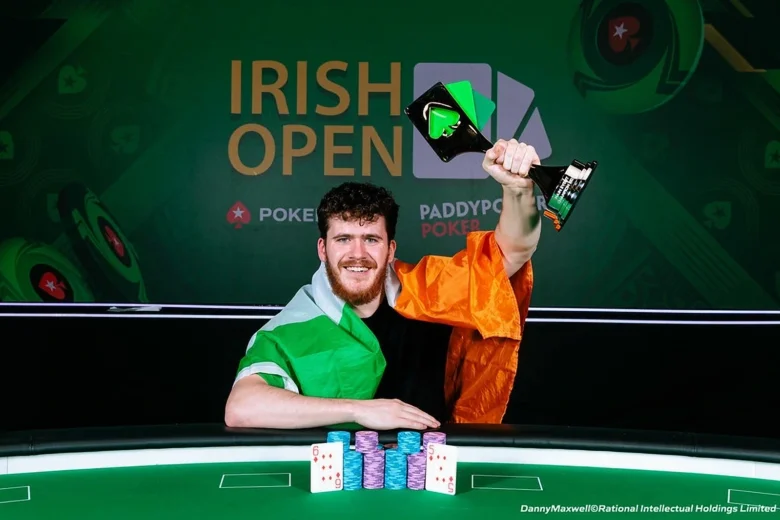
| 2025 | Simon Wilson |
Fields in recent editions have reached record levels. The Main Event now attracts players from across Europe, North America and Asia. Since the takeover in 2016, the event has successfully increased the total number of entries year by year. Where in 2016 a total of 802 entries were made in the Main Event, a new record was set in 2025, when 4,562 entries were made. Ironically enough, the first and last events were won by a ‘Wilson’, while Dan and Simon are not family related, but friends after all.
Records and Notable Achievements
Colette Doherty and Liam Flood are, until this very year, the only people who managed to win the Irish Poker Open Main Event twice. Neil Channing holds the record of the largest first prize with €801,000, and 2016 has the record of having the most entries (4,562), and the largest prize pool with €4,447,950.
In terms of consistent appearances and cashes, several professionals have been regulars across many editions. Jamie Flynn, Dara O’Kearney, and Zeik Tuit, are in the top as visible below:
| Rank | Country | Player | Cashes |
|---|---|---|---|
| 1 |  | Jamie Flynn | 20 |
| 2 | | Zeik Tuit | 17 |
| 3 |  | Jon Kyte | 16 |
| 3 | | Dara Ruairi O’Kearney | 16 |
| 3 | | David Kilmartin Lappin | 16 |
Another notable achievements are the total amounts earned at the Irish Poker Open. Hereby the top 5 earners of the Irish Poker Open:
| Rank | Country | Player | Total Winnings |
|---|---|---|---|
| 1 |  | Neil Channing | $1,287,568 |
| 2 | | Marty Smyth | $899,948 |
| 3 | | Niall Smyth | $835,932 |
| 4 | | James Mitchell | $809,094 |
| 5 |  | Christer Johansson | $794,189 |
Tracking results from the earliest decades is difficult because tournament reporting was less detailed at the time. Modern events, however, provide full records of every cash and final table. The two tables, as seen above, are based on data from The Hendon Mob, the world’s largest poker database. All data about winners has been taken from different sources, but mainly from the website of the Irish Poker Open itself.
Venues Through the Years
The tournament’s venues reflect its growth. It began in the Eccentric Club in 1980 before moving between several Dublin hotels during the 1980s and 1990s. As the poker boom expanded fields, the Burlington Hotel became the home of the event for several years.

Later editions were held at the Citywest Hotel before the festival eventually moved to the Royal Dublin Society, which remains its current home.
Each move allowed the event to accommodate larger numbers of players.
Why the Irish Poker Open Still Matters
Longevity is rare in poker. Tours appear and disappear. Brands change ownership. Entire circuits can vanish within a few years. The Irish Poker Open has outlasted most of them.
Part of the reason is its structure. The Main Event buy-in of €1,150 remains relatively accessible, allowing recreational players to take part while still attracting experienced professionals.
Another reason is the atmosphere. Dublin has always been known for its social poker scene, and that element continues to define the festival. Even as the event has grown, it has maintained the same basic formula that worked in 1980.
Looking Ahead
More than four decades after Terry Rogers launched the first edition, the Irish Poker Open continues to grow. The festival attracts thousands of players each year while still holding onto its original identity as a serious but welcoming poker tournament.

PokerListings will once again be on the ground for the next edition, following the action from the opening flights through to the final table. For a tournament that started in a private Dublin club, the journey has been remarkable — and it shows no sign of slowing down.
PokerListings Popular Articles
How to Transition From Play Money to Real Money Poker Smoothly

Five Slot Games Worth Checking Out at TonyBet Casino
Barbara Akemi: Brazil’s Best Poker Player Right Now?



Log in to join the discussion
Share your thoughts and see what others have to say.