EN
EN  DE
DE Ten Steps to a $10,000 Bankroll for Tournament Players: Ben Rolle’s 2026 Guide

 PokerListings
-
 CoinPoker 150% up to $2000
+18 | T & C apply | Play responsible
-
 Stake.US Poker $55 Stake Cash + 260,000 GC
18+ | Play Responsibly | T&C Apply
-
 Americas Cardroom 100% up to $2000
18+ | Play Responsibly | T&C Apply
-
 Betonline Poker 100% Up to $1,000
18+ | Play Responsibly | T&C Apply
-
 SportsBetting Poker 100% up to $1000

What is the most effective way to go from zero to solid bankroll? One of the most successful poker players of today, Ben Rolle released a free video guide on YouTube, sharing his wisdom and experience with diligent players who strive for consistent success, while opting not to rely on luck or one big score.
To hear Rolle’s detailed discussion of each point, as well as examples for each, watch the video below:
#1 Learn the Five Core Concepts of Poker in Depth
First of all, you need to understand what the terms variance, bankroll management, expected value, odds, and equity mean:
- Variance is the gap between what should happen in the long run and what actually happens in the short run. It doesn’t care how good you are. It only rewards you if you survive long enough.
- Bankroll Management is a personal system of checks and balances that allows you to keep a cool head when managing your poker money, no matter the circumstances. Maintaining a BRM involves not only resisting financially destructive impulses when on tilt, but also resisting the urge to move up the stakes under the influence of emotions created by one big win.
- Expected Value (EV) is a mathematical manifestation of specific results of your actions. In poker you want to make as many EV+ decisions as possible, that’s why you should understand which EV each of your actions have. Ben says: “Remember, I don’t need to win this pot. I just need this decision to be profitable. This is all that matters. And the mindset most people struggle and are never able to apply”.
- Odds means how often something happens compared to how often it doesn’t happen — so, in poker the term describes how often you will hit your hand versus miss it. Pot Odds in this context is the price of your decision.
- Equity is your share of the pot based on how often you expect to win. For ease of understanding, Ben recommends thinking of equity as how much of this pot belongs to you on average.
Understanding them in their entirety is essential because variance can break people emotionally and mentally with its unfairness. Poor bankroll management causes bankruptcy, and insufficient understanding of EV, odds and equity leads to bad unprofitable decisions.
#2 Study Pre-Flop Ranges
Do not memorize them and do not copy them blindly. Your goal is to know them well enough to be able to apply them correctly. Understanding why some hands can’t be opened in a specific situation is vital because your brain is lazy and it doesn’t want to store and properly maintain all different kinds of ranges for various spots.
So, you have to learn what to open as a range, not a sole hand, why exactly you should open it and when it’s time to fold it.
#3 Play Cheap Tournaments for Practice
Practice playing preflop ranges — simply learning them theoretically isn’t enough. Follow this algorithm:
- Study pre-flop ranges carefully.
- Practice for 2-3 weeks until you understand open ranges for different positions good enough — your goal is to be solid, not perfect.
- Start playing poker as low as possible — Rolle says it straight: “Even if you have a $500 bankroll, start with potato stakes. 50 cents, 20 cents, 1 cent. If you want to hit a quick score — forget it. You’re gambling. Play 10 cents, one tournament maximum”.
- Observe, mark or screenshot hands, post questions in RaiseYourEdge Discord (it’s free) or in your community.
- Review hands after each session by using any suitable range viewer to check if your pre-flop decision was correct
Rolle also recommends using Hand2Note if you have the budget, as it’s a beginner-friendly tracker and makes completing these steps much easier.
#4 Focus on Your Value Hands Postflop
This is “Ben’s best advice”, as he calls it, because it is based on a simple truth:
Poker on micro and low stakes up until $50 is simply waiting for good hands and then hitting hard with big bets.
So, your main goal post-flop is to pick a value hand and use it against your opponents. As Rolle describes it:
Micro and low stakes players don’t raise enough for value and they don’t raise enough draws. They like to call. They enjoy seeing cards. They don’t think in terms of EV. Go broke with any top pair top kicker for less than 50 big blinds on boards that don’t provide straight. If you’re over 50 big blinds, just call a flop raise, call a turn, but then fold to river bet unless you improve or unless they bet very small. The pot is 50 big blinds and they bet 10 big blinds. This is postflop explained in a nutshell. Just execute on that. It’s very simple but extremely powerful.
However, on higher stakes you’ll have to be more careful — because the players there are much savvier on average. Also, at higher stakes, the advice in this article will be a thing of the past for you. So let’s move on.
#5 Work on Your Mindset
The hardest thing in poker is not playing right but doing alright. Most poker players experience similar psychological challenges in their gaming experience: tilt, emotional overload and burnout, a disconnect between physical sensations and the feelings that evoke them, and so on.
At one point in time, it was considered normal to suppress emotions, over time it became clear that this decision, while it may be beneficial in the short term, actually causes long-term harm for players.
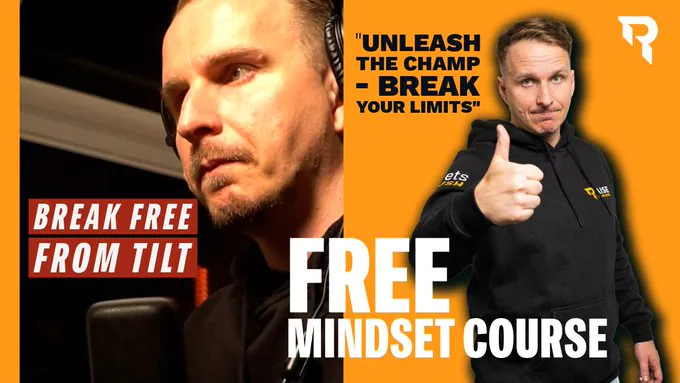
That’s why Rolle, like other leading successful poker players and coaches, is convinced that you need to work on your mindset — otherwise you will get all the disadvantages of tilt and won’t be able to remain successful.
You can work on your own, consult a psychotherapist, or study Rolle’s extensive (and free!) mindtest course, created in partnership with the excellent poker mental specialist Elliot Roe — the choice of the most convenient method is entirely up to you.
#6 Introduce Exploits to Your Game
If you thought that studying pre-flop alone was enough for success, you were wrong — you need to return to it regularly and improve your strategy, because your opponents are also constantly evolving, and your head is capable of forgetting the basics over time.
And as you analyze your game, you’ll eventually start to notice exploits you can implement in your game.
What are exploits? They are adjustments based on your observations of the field or specific opponent that help you to deviate strategy to make more profitable decisions.
By doing these, you become a more effective player at your stakes, as you literally use the general weaknesses of the field and the particular weaknesses of individual players against them to get the most out of each spot.
#7 Connect with People
Ben lives with the belief that being shy is just an excuse for not leaving your comfort zone, just like being afraid to communicate with people or feeling uncomfortable when people laugh at you. As he stated in his video:
It’s an excuse, a limiting belief. Jump in cold water. You’re afraid. You will be laughed at. Yeah, it’s on the Internet. Who cares? And then you want to become a poker millionaire going through a ton of downswings and being f****d by the variance? Yeah, dude, not going to happen. You don’t need therapy or to read another book. Just do things. This is the therapy you need.
He insists that without connecting to people you can’t become truly successful because they give you all kinds of experiences vital for your growth and development:
You need experience and some of them will be successful stories. Some of them will be failures, smaller ones and bigger ones. You will find great people and you get to meet terrible people. It’s a grind. Confidence comes from real life experiences. The results, the wins, even losses that you draw meaning from are wins. Wins that will grow real confidence from within.
#8 Learn About Independent Chip Model
Also known as ICM, this model helps you to calculate the real money value of your tournament chips, considering prize pool and remaining players.
Understanding this model is crucial for tournament players because they always exchange their money for chips in an unequal ratio.
Ben describes the importance of ICM as follows:
As you get closer to the money in tournaments, losing chips hurts more than winning the same amount helps. In cash games, chips equals money. One chip has a certain value. In tournaments, chips are basically the future money potential. And that difference changes everything.
Studying ICM helps you clearly understand the ultimate value of your decisions:
Each chip reflects a certain equity, a certain piece of the cake, a certain piece of the price pool, and that obviously has a certain future potential because you’re not getting that price pool right now. You will get it when you bust in the money or if you win the tournament.
#9 Use Tools and Trainers
The era of self-taught poker players, learning by instinct or relying solely on observation, and elite closed communities with access to rare software, is long gone. With the advancement of technology, learning has become easier and more in-depth, as anyone now has access to poker schools and foundations, but more importantly, to tools that allow one to independently explore the game to incredible depth.

That’s why Rolle whole-heartedly recommends players to use tools: ICM trainers, drill simulators, solvers, calculators, even free quizzes and other materials.
Rolle is, of course, mostly promoting his own products, but it’s worth it — especially if you’re not ready to play poker professionally yet, but really want to try it in the future.
#10 When in Doubt — Back to the Beginning
If you find yourself in spots where you can’t confidently make the right decision, go through the steps on this page again. There’s nothing shameful about it, it doesn’t make you stupid, sometimes your brain just needs a reminder of what the basics look like in order to get rid of leaks.
Also, be mindful of what you do and why — Rolle reminds us that some player actions can signal deeper issues than just a lack of poker knowledge:
If you end up calling too much on the river, you might have a slight gambling issue. Perhaps you’re being too curious. Take it very seriously. This is already a sign of a slight addiction. You favor curiosity over profitability, which is gambling. So, hit the mindset lab. And if it’s too bad, please don’t play poker and seek professional help.
PokerListings Popular Articles

Why Pro Players Are Annoyed With Other Regs Making Mistakes

Five Slot Games Worth Checking Out at TonyBet Casino

Five Mistakes That Can Cause Players to Get Stuck on Small Stakes