
 EN
EN  DE
DE Should Tracking Sites Show Poker Player Buy-ins?

 PokerListings
-
 CoinPoker 150% up to $2000
18+ | Play Responsibly | T&C Apply
-
 Ignition Poker 150% up to $1,500
18+ | Play Responsibly | T&C Apply
-
 Stake.US Poker $55 Stake Cash + 260,000 GC
18+ | Play Responsibly | T&C Apply
-
 Americas Cardroom 100% up to $2000
18+ | Play Responsibly | T&C Apply
-
 Betonline Poker 100% Up to $1,000
18+ | Play Responsibly | T&C Apply

This very discussion became a hot topic in the first week of June 2026, slightly diluting the endless flow of news from the World Series of Poker.
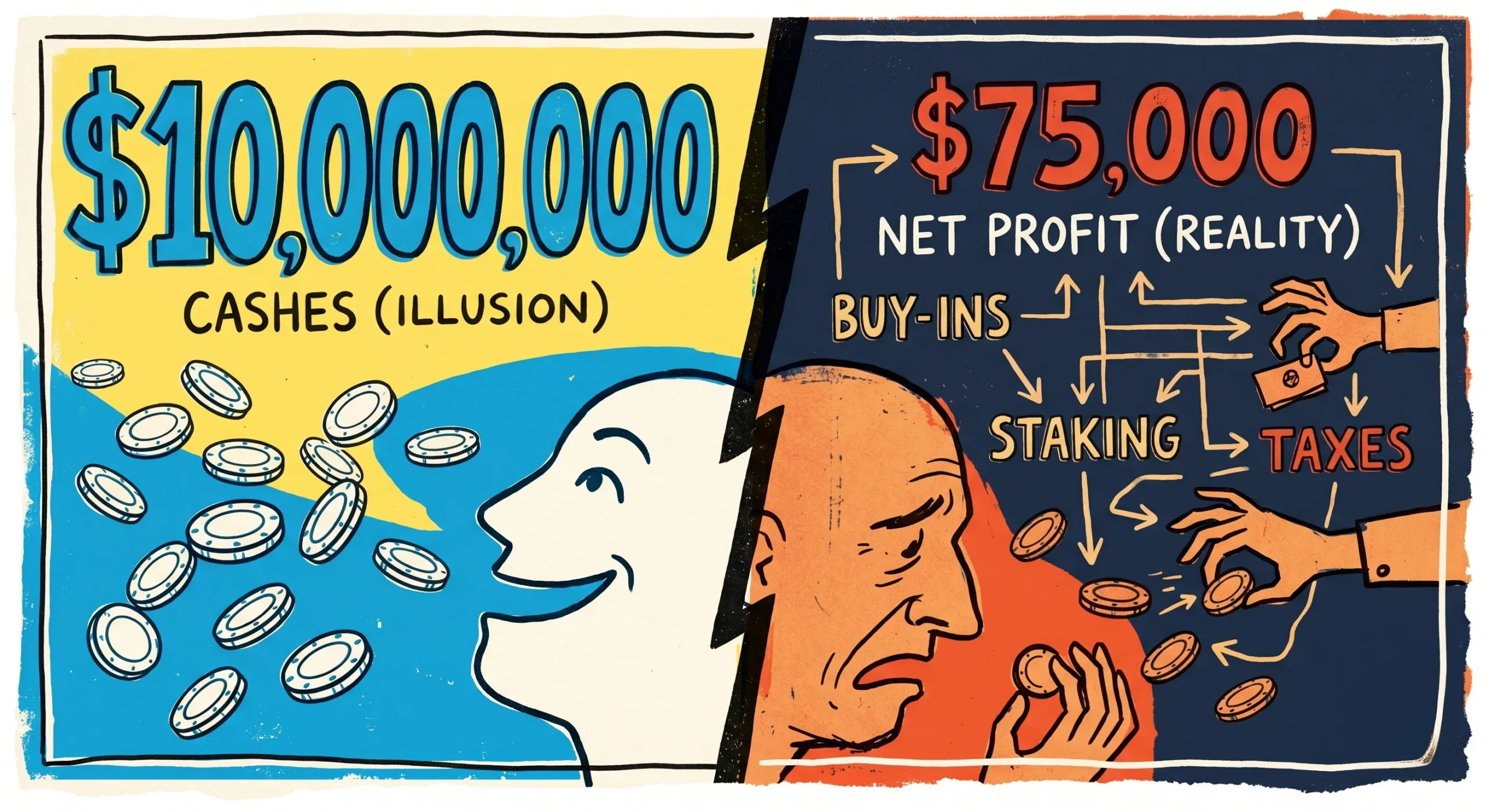
And this is not surprising: some in the poker community have long criticized sites like The Hendon Mob for creating the illusion of poker players’ wild profits by exclusively displaying their winnings, while others emphasize the importance of keeping sensitive player financial data out of the public eye.
But why did this topic return in the summer of 2026, and what is the answer to its main question? Let’s find out.
Sara O’Connor Asks for More Transparency
On June 4th. 2026, Sara O’Connor ignited the spark of the debate on X (Twitter) by sharing her belief that buy-in data should be made public:
“Hendon Mob should track buy-ins as well as results.
If you can track results, you can track buy-ins.
Let’s see who actually profits and how.”
In the comments, she explained that the information on sites that track users seems like a mirage to her, and the lack of transparency grosses her out.
She also emphasized that the current facade of success is bad for poker:
“If it leads to people playing with money they shouldn’t, that’s whats actually bad for poker.
It’s not a comforting lie.
Imo it’s a rancid lie that deludes people on a dream that isn’t real, that they may start to chase, etc.
It’s rotten and unsafe.
We want to be taken seriously as a community? We’ve got to protect each other against the house’s bottom line.
I’m trying to make poker safer and more transparent. I don’t actually need every buy-in. I think reporting ROI/profit makes sense.”
Some players supported her opinion, expressing a desire to reduce the amount of “lying” in poker. For example:
David Berger: If poker atlas and gg poker both supplied this information and excluded all other tournaments that didn’t teach buyins, we would have one awesome database!
Rachel Hoyt: I certainly wish we knew more. I don’t like the fact that a player can play at a table or in a tournament with their backer without anyone knowing. No way are they playing the same against each other as everyone else.
Andy “Equilizer73”: It would help players like me if we had a more realistic view of what pro players actually do. You hear terms like ‘firing bullets’ but for us little people, I think that isn’t realistic at all. All I know is how I like to play. Sometimes I rebuy but most of the time I don’t.
Rutland34: People would be stunned to find out these answers, $1M if played as a pro at $15% ROI after rake, then being staked isn’t great, even $10M over 10 years in earnings may only be $5M after staking and 15% ROI is $75k a year. Even at 100% it’s $160k a year. Poker is hard!
——————————————————————————————————–
However, others perceived this opinion as based on a lack of data and understanding of all the complexities involved.
Regs & Recs Speak Out Against Disclosure of Their Spending
Most players were less than thrilled with the idea of making their and others’ buy-ins, profits, and ROI public. Without further ado, we present a selection of the varied responses.
Victoria Livschitz: Why do you feel entitled knowing the financial performance of others? You are not allowed to know the compensations of other people in corporate environments, are you? Private companies, or individuals, are not required to make their income public in any industry. It’s personal data. Hendon Mob is a leaderboard company, they track winnings for awards, that’s all. Hendon Mob is a leaderboard for points that drive standings. It’s not a financial reporting engine, which would need to be regulated and a whole other ball game.
Aaron Barone: No one wants to see how the sausage is made. […] I’ve been fairly vocal about the issues surrounding Hendon Mob. And I’d love for the “cashes” metric to be replaced with profit. But as someone else pointed out, the logistics of that are difficult andddddd perhaps more importantly, all parties involved benefit by furthering the cashes = crushers narrative. The cashes metric is at least in part used to hoodwink more naive members of the poker community (and attract those from outside).
Aaron Kweskin: Would hurt poker if you exposed losers…less likely to play..tracking loses on live streams has definitely pushed some losing players from playing…
Chris Wallace: I am 100% against this. Losing players being outed publicly is the fastest way to get them to quit playing. This is how SharkScope wrecked sit and go tournaments 15 years ago. Destroyed the ecosystem.
Ole Hanssen: I get your point for WSOP and huge tournament series, but with so many card rooms not reporting anything to Hendon Mob it’s going to be an imperfect science no matter how much work is done to improve the current situation.
Robert Whitley: They are selling a product. If they tell you the player with 70 million in winnings is losing 8 million, it doesn’t sell.
Steven Costa: Do you know why brokerages historically made benchmark comparisons difficult for traders? It’s kinda the same reason we should oppose net profit tracking on Hendon. The average person’s consistent underperformance makes people quit. In poker, that could shrink the rec pool that keeps MTT’s alive. Hendon showing net profit or ROI would be more honest yeah, but it might kill the dream for many. 🤷♂️
Amanda Baker: I think it’s better to let people be delusional about how much they’re “winning.” Why tap the glass? If a rec wants to spend their disposable income playing poker, we shouldn’t shine a spotlight on something they don’t want to know. People want comforting lies, not the truth.
Tracking Sites Cannot Actually Track Players’ Profit
While demanding transparency of finance may seem like a noble cause, in reality the situation with poker players and their profit is much more complicated than the first impression suggests.
Collecting Correct Data is Not Easy
It’s worth starting with the fact that we must separate online and live results because they have different problems with data mining and sharing.
To accurately collect live poker data, a tracking site’s team must constantly maintain a network of contacts with countless tournament organizers, ensuring they promptly provide them with information on tournaments, players, their buy-ins, and winnings. Not only does this require significant time and financial resources for the site, but not all casinos and clubs are willing to share anything with third-party resources. Not to mention, many players don’t want this data leaked to third parties.
To accurately collect information from online poker, sites must not only secure the support of poker rooms, but they will also have to deanonymize players who don’t even disclose their nicknames anywhere.
So, the first problem with the idea of publishing data on profits, buy-ins, and so on is that transferring people’s personal information to a third-party resource is simply dangerous.
The secondary issue is finding a source of income for tracking sites to cover all spendings related to this tracking. Because let’s be real: who would pay for this information? Players? Highly doubtful.
Tracking Sites Can’t Take Everything Into Account
It’s important to remember that even with re-entries, rebuys, and add-ons being counted, tracking sites will never be able to capture the financial arrangements between players, backers, and funds. This means that profit information will still be incomplete, no matter how well the site is able to track losses from the game.
Public Disclosure of Profits Can Cause Real Problems for Players
Perhaps the most serious issue with results tracking is that publishing data that can be used to calculate players’ approximate profits could expose them to legal risks in their home countries. People have hundreds of reasons for hiding their income and expenses from the Internet and public eye. For example, poker is not legal everywhere, and not everyone plays in their country of citizenship — just as not everyone wants to inform their families about the exact profit or loss from poker or pay taxes, for example, if they don’t support their country’s policies.
Reality of Profit in Poker Will Reduce its Appeal to New Players
Finally, while this isn’t the most important point compared to the points above, it’s still significant. The ability to even roughly calculate the actual profit of each player, especially top-tier players, has the potential to significantly reduce poker appeal to people unfamiliar with this world.
Poker is a game of deception, which relies in part on the deceptive public image of an activity in which a person can easily win life-changing money. And although once people get into the game, they quickly realize it requires far more work than luck, without the initial illusion they would likely never had started.
Publishing data on players’ actual profits would easily shatter this illusion — not to mention signaling to people that their financial affairs can easily be made public.
PokerListings Popular Articles

How to Transition From Play Money to Real Money Poker Smoothly

Barbara Akemi: Brazil’s Best Poker Player Right Now?

How Much Does a Professional Poker Player’s Season Really Cost?






Log in to join the discussion
Share your thoughts and see what others have to say.