Pros and Cons of Multi-Tabling in Poker

 PokerListings
-
 CoinPoker 150% up to $2000
+18 | T & C apply | Play responsible
-
 Stake.US Poker $55 Stake Cash + 260,000 GC
18+ | Play Responsibly | T&C Apply
-
 Americas Cardroom 100% up to $2000
18+ | Play Responsibly | T&C Apply
-
 Betonline Poker 100% up to $1000
18+ | Play Responsibly | T&C Apply
-
 SportsBetting Poker 100% up to $1000

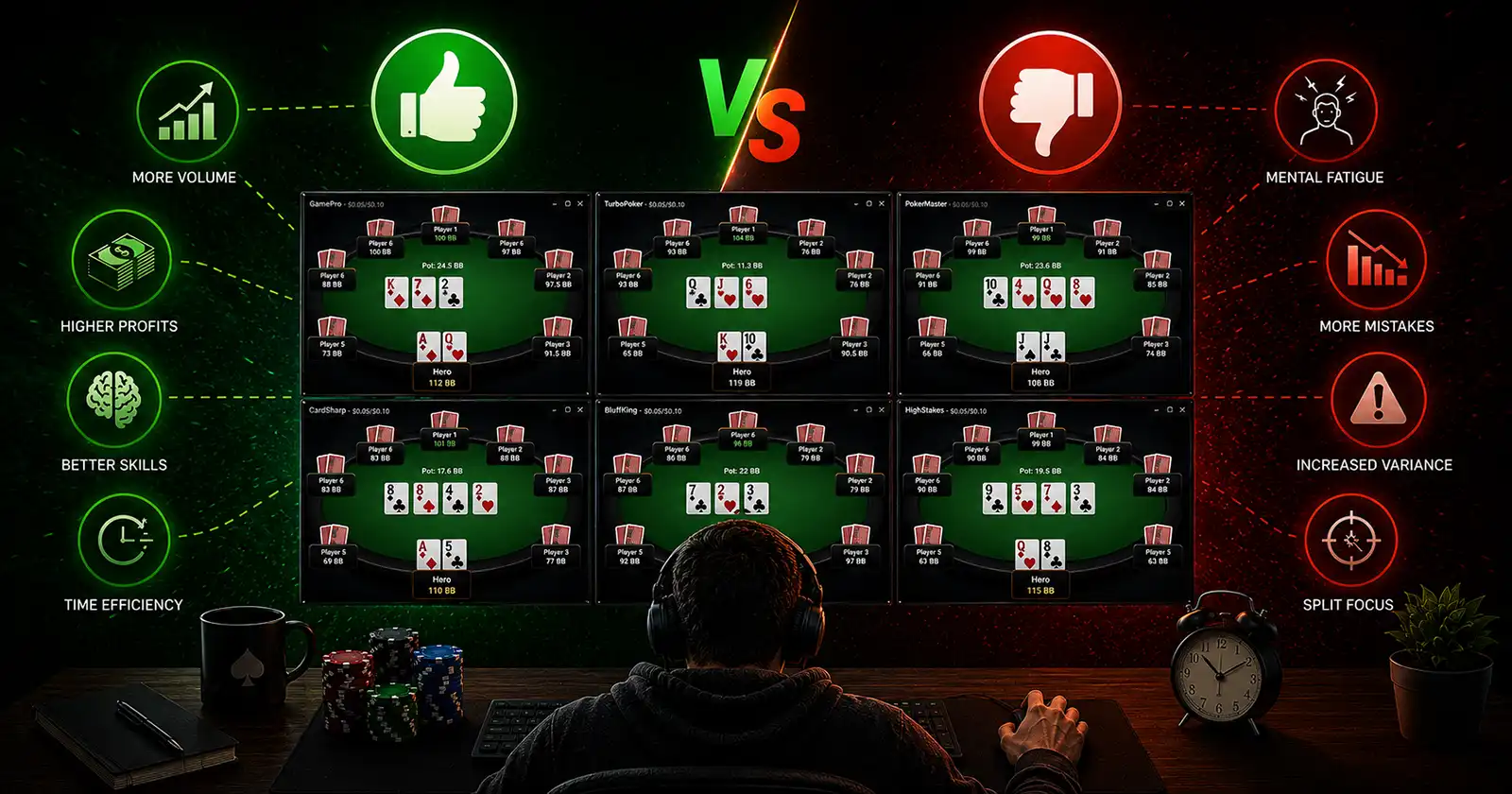
We’re used to thinking that playing multiple tables for volume is one of the pillars vital for a solid and sustainable poker career.
However, by 2026, more and more players are venturing into the idea that multi-tabling may actually be detrimental to players’ performance — or as Carlos “perdigg” aka Perdi | Rendimiento & Anti-Humo put it on X (Twitter):
More tables aren’t more EV. They’re more mediocre decisions per hour.
How right is it? Let’s try to figure it out.
Why Multi-Tabling Became a Standard
Use any variance calculator and you’ll see that the larger the game volume, the less pronounced the variance. This means that the more you play the closer your cumulative results will be to EV.
While live poker was the only available option for players, reaching this point required a significant time commitment — because players simply couldn’t play more than one tournament or cash game at a time.
But when poker became available online, players got an opportunity to play as many games as they could afford simultaneously.
For newer players, free poker formats also became a natural testing ground for learning how to follow several tables at once without putting real money at risk.
Even with restrictions on the number of played tables, which rooms introduced primarily due to limitations in their own software, multi-tabling allowed players to accumulate volumes in a year that would have previously taken decades of grinding.
Poker rooms quickly realized that this was also profitable for them, since every game requires participants to pay a commission.
As a result, operators began introducing loyalty programs and various promotions that encouraged multi-table grinding. Although these were eventually abandoned because the number of grinders targeting volume made incentive programs unprofitable for rooms, many of them still continue to support volume-oriented players in some way, primarily through leaderboards and cashback programs.
When Multi-Tabling Is a Minus EV Choice
Obviously, playing multiple tables at once is not a choice that benefits all players. But why?
Well, Carlos explained it from his point of view in the article on Substack, highlighting that playing 10+ tables at once increases the amount of errors made by players because they:
- Make more folds and use more timebanks
- Tilt and became frustrated due to bad calls
- Experience mental stress and always play B-game or worse
- Play shorter sessions because of exhaustion
Multi-tabling, as a type of multi-tasking, divides attention and causes stress.
When you are stressed, you can’t be “in the zone” — have maximum concentration and flow, make decisions quickly and accurately during the session. So, you simply aren’t on your A-game because you need a lot of resources to manage a lot of different situations simultaneously by constantly shifting attention between tables.
Carlos points out that people focus too much on evaluating EV per hour, but forget to evaluate their cognitive fatigue.

Science supports his claims to some degree as well. For example, according to the “Multitasking: Switching costs” study published by the American Psychological Association, trying to perform two or more tasks simultaneously has mental “switching costs” for people’s brains that slow their cognitive process and increase the margin of error for each next decision at the same time.
Fun fact: According to the “Multitasking in adults with ADHD” comparative study, having ADHD as an adult doesn’t change the outcome of switching tasks but it gives you a better mood and more motivation in the non-interleaving condition than ordinary people get.
How Many Tables Is Enough?
It actually depends on three things you must consider before increasing volume.
- Type of the game: Some games are designed specifically to generate income only with a huge volume of play. For example, Spin&Go players gain almost 100% of winrate from rakeback and leaderboards.
- Tendency to overthink: If you spend time between hands overthinking your actions, causing you to constantly doubt your decisions, it may be an indication that you need to work on your mindset before increasing your playing volume.
- Personal optimal number: People can’t focus and maintain concentration the same way. This difference determines not only how long a person’s attention span is when it’s scattered across several tasks, but also how comfortable they feel with different levels of mental stress.
Given these factors, determining the optimal number of tables to play simultaneously for you will require testing your limits. It’s easy to do: gradually add tables during the session, and when you feel you’ve reached a threshold of concentration and comfort, reduce the number of tables by one or two.
PokerListings Popular Articles

Online Slots with Bonus Rounds: Complete Guide to the Best Games

Denys Chufarin: GGPoker’s Most Famous Short Deck Expert
Why Should Beginners Study GTO and How Does GTO Wizard Help?