
 EN
EN  DE
DE Markup or Discount: What Should MTT Players Offer?

 PokerListings
-
 CoinPoker 150% up to $2000
18+ | Play Responsibly | T&C Apply
-
 Americas Cardroom 100% up to $2000
18+ | Play Responsibly | T&C Apply
-
 Ignition Poker 150% up to $1,500
18+ | Play Responsibly | T&C Apply
-
 Black Chip Poker 100% Welcome Bonus
18+ | Play Responsibly | T&C Apply
-
 Stake.US Poker $55 Stake Cash + 260,000 GC
18+ | Play Responsibly | T&C Apply

Among all timeless topics in poker one remains perpetual: can or cannot tournament players inflate the price of action when selling it, and if they can then how high is permissible? Simply put, should markup continue to exist as a phenomenon — and if so, what range is acceptable for it?
Towards the end of May 2026, the poker community on X (Twitter) raised these questions again — and in this article, we will share with you the current state of affairs regarding this topic.
What is Markup?
Markup is a percentage added to the tournament buy-in that a player charges a buyer of their action to cover expenses, reduce variance, and receive “compensation” for the use of their skill.
This is typically recorded in one of two ways, depending on where the action is being sold and how the arrangement is structured.
In private agreements, it may be expressed simply as a percentage — for instance, a player sells action for a $500 buy-in tournament with a 40% markup.
However, a more popular method of notation utilizes a multiplier system: 1.x, where ‘x’ represents the specific percentage. Returning to the example above, in this case, the player sells action for a $500 buy-in tournament with a markup of 1.4.
This system is used, among other places, in poker rooms with a built-in staking system such as ACR Poker and GGPoker:
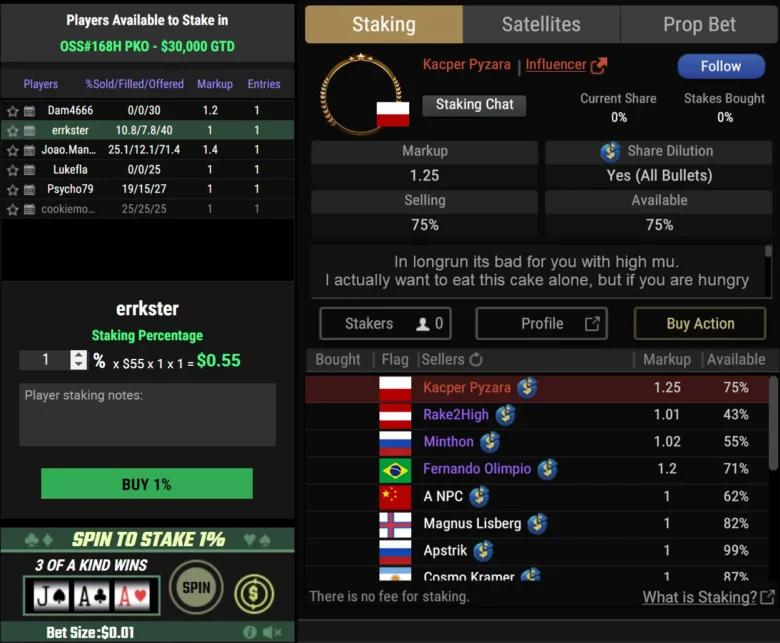
The markup rate is determined individually, based on the player’s results and abilities, the buyers’ financial capacity, and the meta prevailing during the specific time period.
Opponents and Proponents of Markup
Nikita “GetQuacked” Bakarjiev became a topic-starter on markup by sharing his antipathy to this practice:
I’m all for selling action and reducing liability to your own bankroll and letting friends sweat. But if you have zero proven results… and have an ABI of $20 why are we charging a markup on $500+ entry events lol… baffles my mind. Not throwing shade but let’s be realistic here.
His relatively small account attracted attention of Tom ”Tombos21“ Boshoff, GTO WIzard Head Coach, who went even further and stated that MTT players should offer others discount on their action and definitely not markup:
Even if they’re a strong player with a good track record, should MTT pros markup their action? In literally any other area of finance, you pay to offload risk, or get paid to take on risk. If I have a raffle ticket with a 50% chance of being worthless, and 50% chance of being worth $1000, how much should you pay for it? The ticket’s EV is $500, but you should rightfully demand a discount given that you’re taking on all the risk. So I’d argue that MTT pros should actually discount their action (from its estimated value), rather than selling it at a premium.
It was precisely his opinion that sparked a passionate debate, striking a raw nerve with some players, including some well-known poker pros. We selected the most fascinating ones from them.
- Florian Pesce: Not my favorite Tombos take. Markup should be below expected ROI, and that’s how the backer gets paid for taking on extra risk. I get the broader point though. A big chunk of the staking market is -EV because ROI gets overstated or markup is set too high.
- Ian Simpson: Meanwhile there was a serious debate at the tables last week about if 1.8 was an acceptable markup for the WSOP Main. There might be some players with a ROI high enough for that price, but blisteringly fewer than there are players charging that price.
- Galen Hall: You’re confusing face value with expected value. If I think Phil Ivey has a 50% ROI in a MTT, then 1.2 markup is a discount to the EV even though it’s a premium on the face value. Also, in every area of finance, +EV wagers that are uncorrelated with the market are the holy grail and people will pay heaps for them. The hard part in poker is estimating the EV! If we knew for a fact that somebody’s ROI was 50%, finance people would pay more than 1.49 for that (minus counterparty risks and fees and stuff). Zero correlation to markets, incredibly small lockup period, etc.
- Mustapha Kanit: If a guy has 20% ROI and sells you at 1.05 you are printing really hard. Obviously you gonna loose and don’t realize your equity often but this the fucking game we play. It is not the fault of the horse if he doesn’t cash. It is a long run game. Keep trading at positive EV and at some point you gonna get it back. I personally sell mainly at face to partners that make me money in other fields, so it would be stupid to charge any markup but obviously this is a particular case. The fact that many people overestimate their ROI is a different thing and that is the issue — not winning players that are selling at a fair markup.
- Matt Berkey: Your example only parallels to losing/breakeven players. However, I think the overarching sentiment may stand true given the high risk nature of a single event. Perhaps it’s less of a question of is markup a reasonable model than it is a question of how conservative should buyers be when buying at markup. Conventional wisdom has always been to split the assumed ROI, but given how inaccurate those estimates are, sharp buyers are probably paying as close to face as possible for known winners, while fading the rest.
- David Baker: This is one of the dumbest posts I have ever read. You don’t have to sell at markup but plenty of people are valued at markup and making money. When you invest in a player you have no expenses of that player. You can use your time to earn in your area of expertise. You don’t pay for gas, parking, hotel, training, etc. If the investor and the player split the EV of the player the investor gets the best of it. Comparing a poker tournament to a raffle is peak idiocy.
- Sam Greenwood: I think whenever you sell action for a tournament an important thing to do before setting markup is determining the backer/horse profit split. If you’re winning at 10% ROI, what’s a fair MU to sell at? If you have a 10% ROI and think it’s too risky for a backer to buy your action at 1.05 then you should skip similar tournaments where you have a 5% ROI.
Who is Right in This Dispute?
Actually, no one — because both selling and buy-in action with markup are personal decisions of two parties of the deal.
Before selling each player estimates their abilities and skills but also evaluates their financial needs and risks as well as the personal impact of variance.
The player also assesses the likelihood of selling the action at a specific markup — and formulates an appropriate offer.
The buyer also conducts their own assessment — primarily of their personal financial capabilities and the seller’s chances of success.
Ultimately, if people are willing to buy something at markup, a portion of the action will always be sold with it — because that is just how the market works: demand drives supply.
And that means that, at the end of the day, any discussions about markups or discounts don’t really make much sense — but we love them anyway, because that’s just how people work.
PokerListings 





Log in to join the discussion
Share your thoughts and see what others have to say.