
 EN
EN  DE
DE Intuition vs. Technique: The Double Key to Success in Poker in 2026

 PokerListings
-
 CoinPoker 150% up to $2000
18+ | Play Responsibly | T&C Apply
-
 Ignition Poker 150% up to $1,500
18+ | Play Responsibly | T&C Apply
-
 Stake.US Poker $55 Stake Cash + 260,000 GC
18+ | Play Responsibly | T&C Apply
-
 Americas Cardroom 100% up to $2000
18+ | Play Responsibly | T&C Apply
-
 Betonline Poker 100% Up to $1,000
18+ | Play Responsibly | T&C Apply

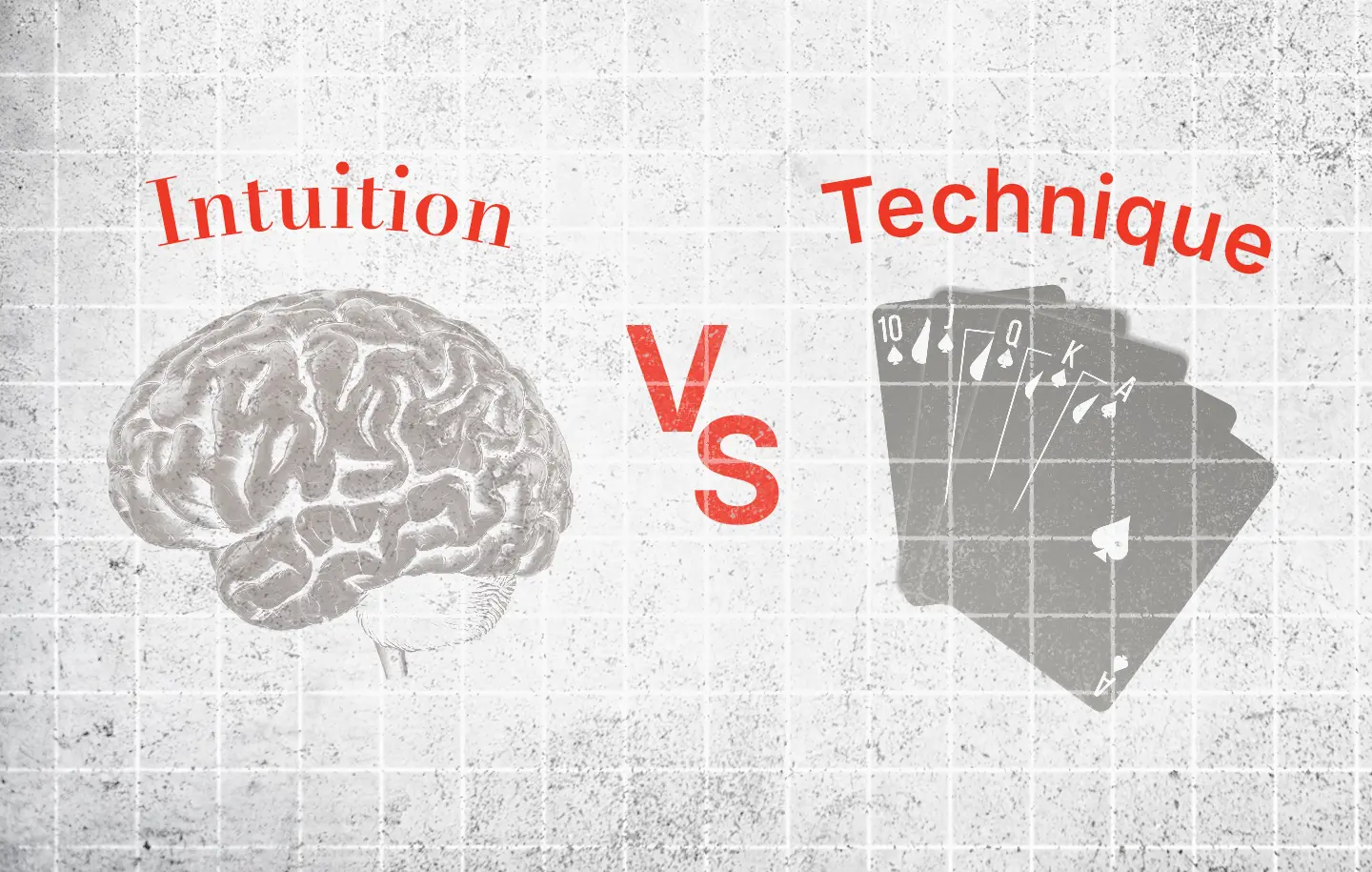
We’ve often seen fairly heated debates around this topic. In poker, is it more profitable to rely on intuition or to use technique 100%? That’s the question we’ll try to answer in this article. These two approaches regularly clash in discussions among poker players. Some prioritize intuition, while others focus on analysis and technical play. Understanding their respective roles, and above all how to combine them, is ultimately a key step in moving from an average player to an expert.
Analysis in Poker: The Pillar of Rational Decision-Making
Strong game analysis is clearly what sets modern poker apart from its purely instinctive roots. It is based on tangible data such as probabilities, pot odds, opponent tendencies, and tournament structure.
Gaining a deep understanding of these concepts requires a lot of practice and helps players control variance as much as possible. By integrating these tools into your game, you can, for example, evaluate the odds of completing a draw and decide whether calling an opponent’s bet is worthwhile. Experienced players therefore regularly use pot odds and implied odds to calculate the profitability of an action.
By contrast, a player who bases their entire strategy on intuition will decide whether to call or not based on instinct, without really knowing whether the decision is mathematically profitable in the long run.
Of course, these calculations do not guarantee success, but they allow for rational decision-making and help control the impact of variance.
Intuition: The Art of Feeling the Game
If poker technique is a science, intuition is its art. It is based on experience, observation, and the ability to sense an opponent’s intentions in the moment. It is not always possible to justify an instinct-driven decision with numbers or precise reasoning, but instinct remains a tool that every poker player should consider.
Many players who focus exclusively on technique view instinct as obscurantism. Personally, I believe it is very important to listen to your intuition when facing a difficult decision. That said, intuition is a double-edged sword, as it won’t always be right.
It must also be said that some players have a more developed instinct than others. I personally had the chance to interview Davidi Kitai, who is considered one of the best French-speaking poker players. What I learned from him is that every player must know whether they can rely on their instinct or not.
As a player, you need to know whether your instinct is generally reliable or whether it is influenced by other factors and, in a way, biased by data that does not come from pure intuition. If your instinct is wrong most of the time, you should rely more on technique. If not, you can afford to integrate more instinct into your game. Broadly speaking, it’s about finding the right balance between technique and intuition. In any case, it’s always beneficial to combine and integrate both into your play.
I’d also like to add that intuition in poker often comes from extensive experience. In other words, the more hands you play and the more varied situations you encounter, the more reflexes you develop that can be described as “intuition.” Some very experienced players explain intuition as nothing more than unconscious memories of spots and situations they’ve already played or encountered in the past.
Our brain stores information throughout games, which gives us reflexes that we label as intuition. It’s an appealing theory, and one I find very interesting.
The Limits of Pure Technique
Technique does have its limits. Poker remains a game of variance, where cards are never guaranteed. A purely mathematical decision can sometimes fail if it does not take the psychological nuances of an opponent into account. Focusing exclusively on numbers can also slow down your game and reduce your responsiveness in complex situations. You may also tend to standardize certain spots, which can limit your creativity at the tables.
The Limits of Intuition
Like technique, intuition also has its limits and is not infallible. As mentioned above, it can be biased by past experiences, emotions, or overconfidence. A player who relies too heavily on instinct risks making irrational decisions too often or underestimating mathematical analysis, which can be costly in the long run.
Intuition and Technique: Finding the Right Balance
True poker skill lies in the ability to combine these two approaches. Neither intuition alone nor pure technique is enough to guarantee success. An expert player knows when to use one or the other, and above all, how to make them work together.
When to Prioritize Technique
Technique is essential in situations where the numbers speak for themselves:
- Pre-flop decisions based on ranges and position
- Evaluating odds and bet sizes for draws
- Bankroll management and long-term strategy
Technique helps standardize decisions and reduce the influence of emotions, especially online, where body language is absent. That said, be careful not to over-standardize situations. In the end, nothing is ever truly “standard” in poker.
When to Trust Your Intuition
To successfully combine technique and intuition, you need to recognize the situations where one will be more useful than the other. When it comes to intuition, here are situations where instinct should take precedence:
- Playing against unknown or unpredictable opponents
- Detecting bluffs or unusual patterns
- Complex tournament situations where decisions carry significant weight
- River situations where calling or folding are the only options, and both decisions put your tournament life on the line
In live poker, intuition becomes almost indispensable, as observing tells and behavior provides information that no software can measure.
Conclusion
To sum up, poker is neither purely a game of numbers nor simply a game of instinct. The key is knowing how to combine both in order to exploit your opponents as effectively as possible. Technique provides a rational foundation and protects against errors in judgment, while intuition allows you to adapt to unpredictable situations.
Learning to juggle these two approaches is a long process that requires practice and a lot of work. I like to illustrate this principle with the profession of a musician. Imagine a pianist who can only play by ear and is unable to read sheet music. They would quickly become limited. Conversely, if they are unable to listen to what’s happening around them and adapt their playing to others, it would severely impact their creativity and their ability to play in perfect harmony with fellow musicians.
Ultimately, the most formidable player is not the one who blindly follows mathematics, nor the one who relies solely on instinct, but the one who knows when to listen to their heart, when to listen to their head, and above all, how to make them work together.
PokerListings Popular Articles
How to Transition From Play Money to Real Money Poker Smoothly

Five Slot Games Worth Checking Out at TonyBet Casino
Classic, Rush, or AOF: Where to Start Your Poker Career




Log in to join the discussion
Share your thoughts and see what others have to say.