
 EN
EN  DE
DE How Much Does a Professional Poker Player’s Season Really Cost?

 PokerListings
-
 CoinPoker 150% up to $2000
18+ | Play Responsibly | T&C Apply
-
 Americas Cardroom 100% up to $2000
18+ | Play Responsibly | T&C Apply
-
 Ignition Poker 150% up to $1,500
18+ | Play Responsibly | T&C Apply
-
 Black Chip Poker 100% Welcome Bonus
18+ | Play Responsibly | T&C Apply
-
 Stake.US Poker $55 Stake Cash + 260,000 GC
18+ | Play Responsibly | T&C Apply

When you look at the results of the best poker players, the numbers can sometimes make your head spin. Some have accumulated several million dollars in career earnings and can cash for several hundred thousand dollars in a single tournament. On the high-stakes circuit million-dollar scores have even become relatively common. Nevertheless, these figures only tell part of the story. Before making money, a professional poker player has to spend a huge amount on expenses, especially on the live circuit. For High Roller players, the scale is even more impressive. In this article, we are therefore going to try to lift the curtain on what a season as a professional poker player really costs.
Buy-ins: the biggest expense

Let’s obviously start with what costs the most: the tournaments themselves! In 2026, the calendar allows players to compete practically all year round. Between the WSOP, the EPT, the WPT, Triton, as well as the WSOP Circuit and regional festivals, a professional who wants to travel regularly could almost move from one tournament to the next without interruption. But buy-ins add up extremely quickly, and the final bill can be particularly painful at the end of the year.
Let’s simply take the 2026 WSOP. The schedule featured 100 bracelet events, with affordable tournaments such as the $500 Colossus, but also numerous $10,000 Championships, a $50,000 Poker Players Championship and even a $250,000 Super High Roller. The Main Event still cost $10,000. Obviously, no player enters all 100 events. But imagine a professional playing around twenty tournaments during a stay in Las Vegas, with an average buy-in of $2,000. They will already have put up $40,000 in entry fees alone. And that only represents a few weeks of the year!
Over a full season, an international grinder playing around one hundred tournaments with an average buy-in of $1,500 therefore generates a buy-in bill of $150,000. Of course, that does not necessarily mean the player has spent $150,000, because cashes and deep runs will sometimes offset part of that amount. The true poker result is therefore the money won minus the buy-ins invested. But to play a full season, the player still needs to be capable of putting those sums on the table.
It is therefore easy to understand that min-cashes are not enough to finish such a year in profit. A player needs one or two very deep runs to make the season worthwhile.
A professional can lose for several months in live poker
This is probably one of the hardest things to understand when looking at poker from the outside. A very good player can easily be losing for several months because of variance (the element of luck). In tournaments, variance is so significant that even a professional with a substantial edge over the field can play 30, 40 or 50 events without recording a result big enough to cover the amount spent on entries.
Once again, let’s take a very simple example. If a player enters 50 tournaments with an average buy-in of €2,000, they have invested €100,000. During that period, they make several cashes and collect €65,000 in total. From the outside, their Hendon Mob profile could therefore show an additional €65,000 in tournament earnings. In reality, however, they have just lost €35,000 playing poker! And this calculation does not even include hotels, flights or meals yet.
This is precisely why publicly displayed tournament earnings can sometimes be misleading. A player with several million dollars in recorded tournament results has obviously not made several million dollars in profit. To know the real profit or loss, you would need access to all of the buy-ins they paid in order to calculate the net result.
Travelling all year also costs a fortune
As you can imagine, buy-ins are a poker player’s main expense, but there are plenty of other costs to add to the bill. On top of the entry fees comes the second major expense: travel.
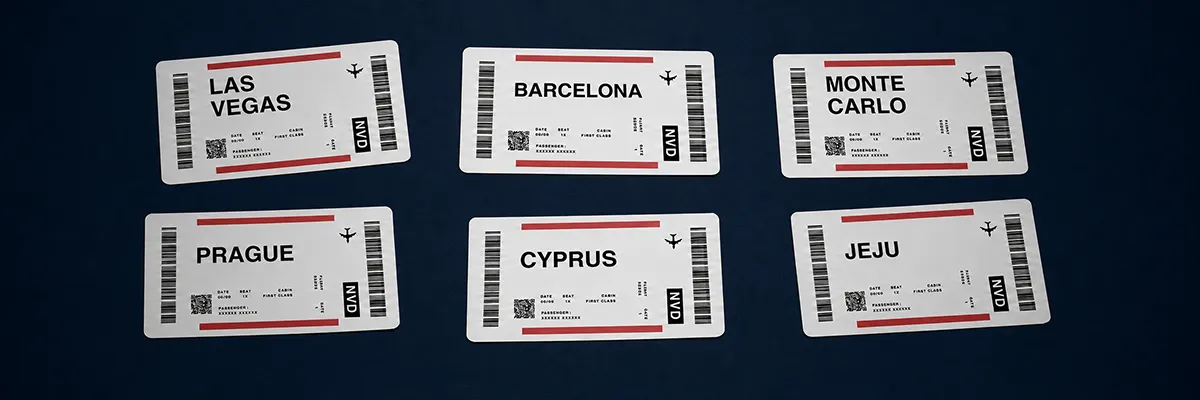
An international professional can spend a large part of the year moving between Las Vegas, Barcelona, Monte Carlo, Prague, Cyprus and Jeju!
Each trip can potentially involve several costly expenses, including:
- A plane ticket;
- Several hotel nights or a rental;
- Local transportation;
- Meals;
- Baggage;
- Insurance;
- Additional expenses that seem negligible individually but become significant over the course of a year.
Over a season involving around fifteen trips, spending €20,000 to €30,000 just on travel and accommodation is therefore far from unrealistic! And some players spend considerably more…
The problem is that these expenses are fixed and permanently ‘lost’. A €5,000 buy-in can potentially turn into a €100,000 score. A hotel room costing €180 a night, however, will always remain a €180 hotel room! A player who finishes the season breaking even at the tables can therefore still lose money once all professional expenses are taken into account.
Bankroll management is essential
It is also important to distinguish between the cost of a season and the capital required to play it. A professional is obviously not supposed to put all of their money into just a handful of tournaments. Variance means they need to maintain a large enough bankroll to withstand long periods without a major result.
A professional poker player who regularly enters €1,000 or €2,000 tournaments should therefore not simply have €10,000 in their account and expect to finance an entire season! Even when they are a long-term winner, they can go through a downswing of several dozen buy-ins.
The bankroll is therefore not really an annual expense because it remains the player’s property. But it represents capital that has to remain available and is essential to the activity! And the higher the buy-ins become, the more important this requirement is…
This is one of the reasons why even some of the best players in the world do not own 100% of their action in the tournaments they play.
Staking: something that changes the equation

When a player enters a $100,000 tournament, they do not necessarily put up the full $100,000 personally. They can sell part of their action.
For example, a professional may keep 30% of their action and sell the remaining 70% to different investors. In that situation, they are personally risking only $30,000 of a $100,000 buy-in, but in return they will also receive only the share of any profit corresponding to their 30% stake.
Other players have actual “backers” financing their activity. This system can be very useful for many players because it allows them to significantly reduce variance and partly explains how some professionals can enter dozens of High Rollers every year. The problem is that it also makes public tournament earnings even harder to interpret.
When a player wins a tournament and poses for journalists with a two-million-dollar check, nobody necessarily knows how much of those two million actually belongs to them. They may own 100% of their action, or only 20% or 30%!
In High Rollers, the numbers become completely crazy
The best example is obviously the Triton circuit. At the 2026 Jeju stop, the schedule included tournaments with buy-ins of $20,000, $25,000, $30,000, $125,000 and $150,000! The $100,000 NLH Main Event attracted 178 entries for a $17.8 million prize pool.
In September 2026, another Jeju stop features a $200,000 Invitational, a $100,000 Main Event and a $150,000 Anniversary tournament. A professional playing several events at a single festival can therefore generate several hundred thousand dollars in buy-ins in just a few days.
Over a full year, some players on this circuit can theoretically exceed several million dollars in cumulative entries. Obviously, playing entirely with their own money at these stakes would require a considerable fortune! Staking, swaps (players exchanging percentages of their action) and selling pieces therefore become an essential part of this economy.
According to Benjamin Chalot, founder of ATM only four or five players would come to the Triton circuit using entirely their own money while keeping 100% of their action.
There are also many hidden costs
The life of a professional poker player does not stop at tournaments and hotels. A modern player may also pay for analysis software, GTO tools databases, coaching, or access to private study groups. They may also need an accountant or tax adviser, particularly if they travel across several countries.
On top of that, there may be international health insurance, banking fees, currency conversion costs or computer equipment! Added together over twelve months, these expenses can represent several thousand euros more.
Finally, there is one cost that is much harder to quantify: time.
A player who spends 150 days a year travelling devotes a huge part of their life to poker. When they are eliminated from a tournament after ten hours without earning a cent, that time appears in no statistic, which is significant because unlike a conventional salaried job, a professional poker player is never paid simply because they worked!
So how much do you really need to budget to be a professional player?
As you will have understood, there is no single answer because costs can vary considerably depending on the stakes being played and the player’s ambitions. A grinder who mainly plays regional tournaments costing a few hundred euros can build a season with a relatively reasonable budget.
On the other hand, a professional travelling on the main international circuits can easily put €100,000 to €300,000 through buy-ins and expenses over the course of a year!
As for regular Super High Roller players, the amounts involved can reach several million dollars, even though a large part of their action is often sold or financed by investors.
Above all, it is important to remember that the true cost of a season cannot be measured only by entry fees. You also have to look at the percentage of action the player actually owns, travel, hotels, professional expenses and taxation to properly understand what a year as a professional player really costs.
Ultimately, a professional player does not only need to know how to win at poker. They need to be able to finance the right to keep trying for long enough!
PokerListings 







Log in to join the discussion
Share your thoughts and see what others have to say.