
How to Interpret Poker Stats from Poker Tracking Software and HUDs

 PokerListings
-
 Stake.US Poker $55 Stake Cash + 260,000 GC
18+ | Play Responsibly | T&C Apply
-
 Americas Cardroom 100% up to $2000
18+ | Play Responsibly | T&C Apply
-
 CoinPoker 150% up to $2000
+18 | T & C apply | Play responsible
-
 Betonline Poker 100% up to $1000
18+ | Play Responsibly | T&C Apply
-
 SportsBetting Poker 100% up to $1000

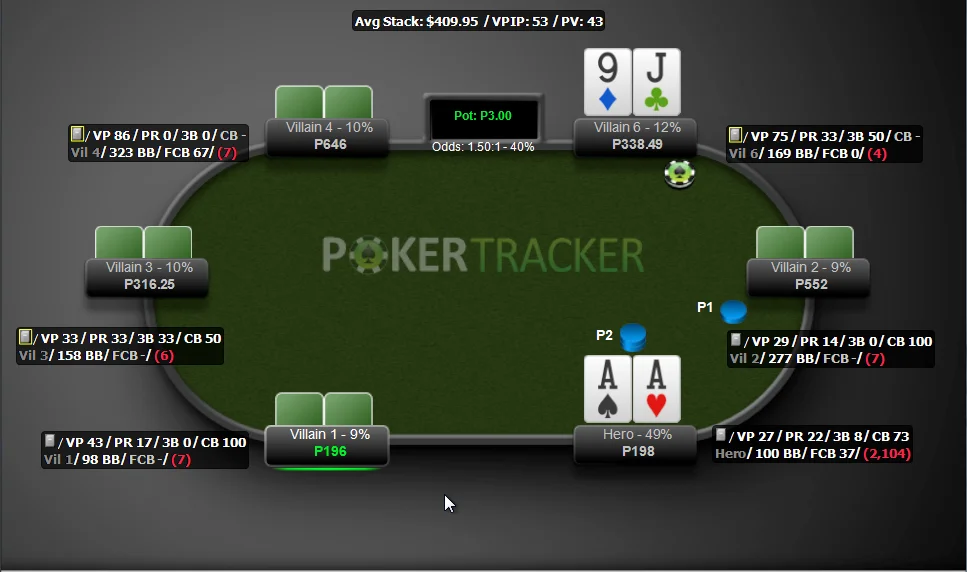
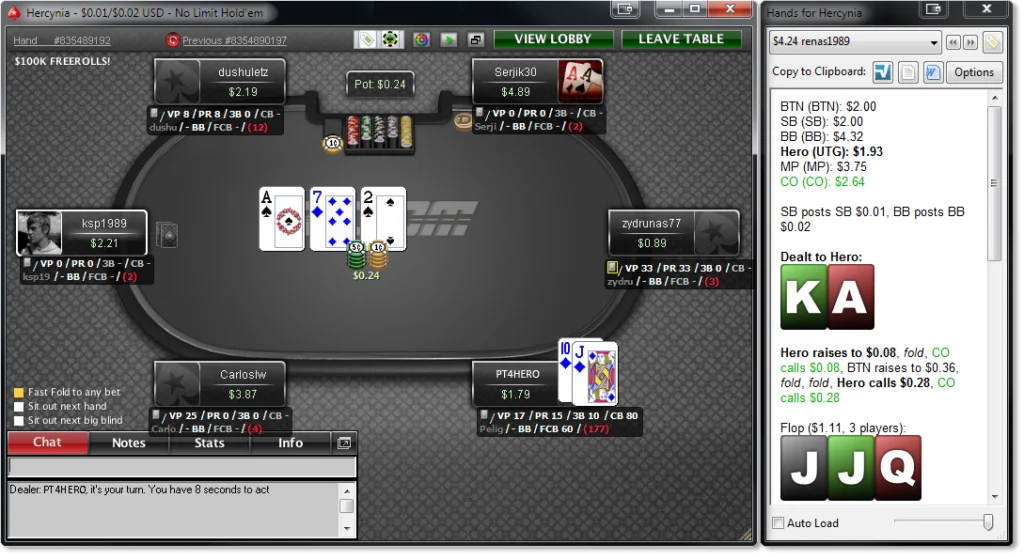
Besides accurately tracking your wins/losses, live poker tracking software like Poker Tracker and Hold’em Manager track every move your opponents make. Using the heads-up display (HUD) you can convert that information into easy-to-understand, good poker stats and display them beside your opponents’ names in real time, right on the table.
You can find information and precise details about your opponents’ playing tendencies on the poker HUD explained. And understanding these stats can make a huge difference in your win rate. Stats are something that all winning players use to a degree, but very few use to their full potential. Learn to master this powerful tool and you’ll reap big benefits. Here’s a quick run down of the most popular poker hud stats explained.
HUD Poker Meaning: A “head-up display” (HUD) is an app that you use together with your poker site in real-time to collect and display stats about your opponents. You can have the info appear in floating panels next to each player on the table itself. This is arguably the main component of poker hand tracking software.
Beginner’s Guide to Poker Tracking Software and HUDs
Poker stats software may be the biggest difference between online and live poker play. These programs help track and analyze your own leaks and other players’ behavior through the poker site’s hand histories. Then using a variety of hud stats, turn it into useful info to access and update in real-time as you play more poker hands and gain more info. Because quickly discerning what kind of player you’re up against is vital to making good decisions. If you want to improve or play for a living, then these programs are almost essential. Because they record and crunch data in ways that would be impossible otherwise.
Hold’em Manager and Pokertracker are the OG of the online poker tracking software world (trial versions available for both). Beginners may be reluctant to invest $60-$100, which equates several buy-ins. And the pace of playing poker online is faster than live play, so new online players may find the extra poker analysis software distracting. In fact, we don’t recommend using tracking software until you’ve played at least 1,000 hands of your poker game type. But even if you’re just getting started, it’s worth getting familiar with HUD poker. HEM and PT are some of the best poker tracking software around.
HUDs and poker hand tracker software are even more useful when multi-tabling, and perhaps this is why we still see waves of disapproval for these tools. As multi-tablers may drive the fish away from the game, which is bad for poker. Yet without any tools, fewer players would be able to compete successfully in today’s field. So many real poker sites, like PokerStars and 888poker, allow poker tracking software so players can analyze and adjust their games as they go. Other operators like GGPoker have a no-HUDs policy and offer their own in-house Smart HUD and PokerCraft tools.
Poker Tracking Software: Your Poker Stats vs Opponents
Your Own Study
The most useful aspect of tracking software for beginner poker players is that you can use recorded hands to see if your stats look “normal.” By comparing my poker stats with those of other winning players, I can get a general idea of where my leaks might be. Note that because of different player styles, not every respect in which you differ statistically from winning players will necessarily be a leak. Also note that you can’t really analyze huge data sets before you’ve played 10,000 hands.
But luckily, tracking software has more useful features too. For example, recording isolated hands to ask others about later. Or just to revisit your own play. Especially because time banks are unforgiving, and you may have made another play without the time pressure.
Your Opponents’ Play
Online poker tracking software lets you get a better sense of how your opponents play, so you can exploit them. You can look over hands they played, examine their poker statistics and see if any leaks stick out. If you use a heads-up display (HUD), you can see all these stats while playing, and use previously-developed reads to exploit. This is no excuse for not taking notes, as your most useful info will be more specific than raw statistics. HUDs are extremely useful tools for beating online games today, and a large number of players are using them.
How to Read Poker HUD Stats: Pre-Flop Stats
These are the most popular pre-flop stats. But it’s not just about knowing what the stats mean – you must also understand how to use them to draw useful conclusions from your opponents’ games.
VPIP % (voluntarily put money in pot)
This is the average total % of times your opponent puts money into the pot. That could mean raising preflop, cold calling and completing big blinds. The higher a VPIP, the looser the player is – and vice versa. For 6-max no-limit hold’em most regulars fall between 19-25% VPIP. See a PokerStove of 19% VPIP to get an idea of what hands that player would play.
PFR % (Preflop Raise)
How often your opponent raises preflop. Most players’ PFR is 4-6% of their VPIP. Hence, if they play 20 VPIP, the PFR is usually 14%-19%. The bigger the gap between VPIP and PFR, the more often a player cold calls and so has a wider cold-calling range with many weak possible hands. For example, a player with a 35% VPIP and a 10% PFR has a 25% cold-calling range and is most likely a poker fish. A player with a close VPIP and PFR is also going to have a higher three-bet%, because they’re cold-calling less often.
3b (three-bet) %
This is how often your opponent re-raises before the flop. As an example a 3% three-bettor would be AA-TT, AKs-AQS, and AQo and would have no light three-bets in its range. You can adjust from there.
Example:
Imagine you open to 3x from the cutoff with A K , and a player on the button who has a 3% three-bet range re-raises. In this spot, you might narrow their range down to strong pairs and top Broadway combos. However, if you have noticed them three-betting more frequently over the last 50 hands, you might suspect they’re including lighter holdings like [Aq] J or even smaller suited connectors.
F3 (Folds to 3-bets) %
This stat is extremely helpful when deciding which hands to three-bet and which to call with before the flop. Obviously someone with a high fold-to-three-bet stat is a player you can three-bet light relentlessly. Someone with a low fold-to-three-bet stat is someone you can three-bet wider for value.
How to Read Poker HUD Post-Flop Stats
AG (Aggression Factor)
Most players fall between 1-3. Anything less is very passive and anything more is very aggressive. If a player with a 0.5 AG is playing back at you, they’re probably not bluffing and you would need a very good hand to continue. On the other hand, if someone with a 6 AG is playing back at you, your top pair is starting to look pretty good.
WTSD % (Went to Showdown postflop)
Most players fall between 20 and 32%. Having a low WTSD can either mean they fold often pre-showdown or they make opponents fold often before showdown. A good way to tell the difference is using WTSD % in conjunction with AG. Seeing a WTSD poker stat is helpful, but seeing a number and figuring out why they go to showdown as often as they do is invaluable.
If your opponent is passive and doesn’t go to showdown often, then they’re weak-tight. If they’re aggressive with a low WTSD, they make people fold often pre-showdown. If your opponent shows down 35% or more, they’re showdown happy. If their aggression is low, they may not be betting with the lead often enough. If, however, they’re aggressive yet still have a high WTSD, they probably call way too often with weak hands on the river.
CB (Continuation-bets as the preflop raiser)
Most players have 55% – 88% so look at the PFR stat too. The lower the PFR%, the higher the player’s CB%. That’s because the fewer hands the player is raising preflop, the stronger the hands they’ll have. Making them more worth betting on the flop. As a player’s PFR gets higher, they’ll miss the flop more often because they’re raising more marginal hands preflop. If the CB stat remains high, then they’re likely c-betting air often and are therefore exploitable.
2B (Second barrel as preflop raiser)
Obviously you should use this with the CB stat. If your opponent has both high flop c-bet and turn c-bet pokerstats then they’re barreling air often. And you should, in turn, call down lighter. If your opponent has a high flop c-bet and low turn c-bet then you’ve identified your opponent as a one-and-done. These guys fire one barrel at the flop and give up when called. If your opponent is a one-and-done player then floating becomes your best friend.
FCB (Folds to C-bets) %
The higher a player’s FCB poker stat, the more “fit or fold” he plays. The lower the number, the more often he calls the flop with marginal hands. Used with the VPIP stat, you can really get a feel for a player’s overall game. A player that has a large VPIP and a small FC is going to be seeing lots of flops and turns. This could indicate the player is a fish, but if it’s a regular, look at their bet-when-checked-to stat. If that’s high, then you’ve found an opponent who loves to float.
F2 (Folds to Second barrel)
Some fish love to call pre-flop and love to call the flop but won’t continue past the turn without a decent hand. You can instantly tell these types of players if they have a low FC stat and a high F2 stat. Obviously you should punish these types of players by firing second barrels more often.
How to Beat Microstakes Cash Games Using HUDs
The best poker hud stats are VPIP (voluntarily put in pot), PFR (preflop raise) and AF (aggression factor). Because they tell you what type of player you’re playing against over even a small sample size, like 10 hands. Also make sure to include your opponent’s fold to cbet stat, fold to turn cbet, their cbet and turn cbet, their 3bet, fold to 3bet and steal percentage.
If somebody has a 90% VPIP (playing 90% of their hands) in an orbit or two, you can feel confident they’re a bad player. On the flip side, if their VPIP is only 10% you can be pretty confident this is a tight regular. PFR also tells you how aggressive a player is. So if the 90% VPIP player has a 10% PFR, you can discern this is a passive fish. If their PFR is 80%, then this player is a maniac fish.
A good rule to remember is that preflop aggression usually translates to postflop aggression and the reverse is also true. Preflop passiveness usually indicates postflop passiveness. But the player’s AF will also help you determine this. You’ll need a bigger sample with this stat than VPIP /PFR. However, 3 or less is a fairly passive player and 4 or more is aggressive.
An overlooked key to success in online poker is table selection. A lot of your profit comes from bad players, especially at the micros. One of the easiest ways to spot them is going through your poker tracker online database and looking at the big hands you recently won. You’ll find most of them involve bad players. However, using notes or color tags, which all sites provide, also goes a long way. When you tag a weak player, you can exploit them more easily.
How to Improve Your Redline (Non-Showdown Winnings)
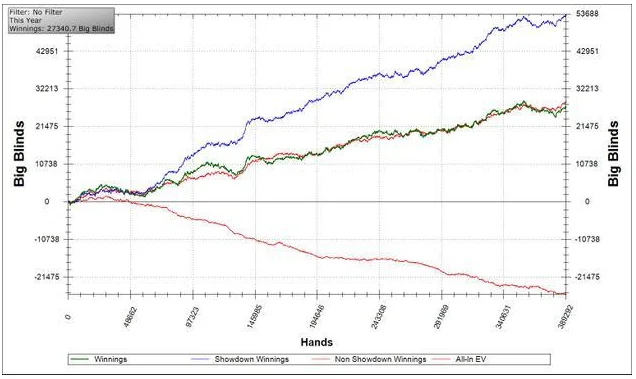
Online players who use poker stat tracking tools like Hold’em Manager or online Poker Tracker software know all about the “redline.” For live players, or players just starting out, “redline” winnings are your non-showdown winnings. That is, the hands you win without having to flip over any cards. You can see non-showdown winnings in HEM or PT by going to your graph page and hitting “display showdown winnings.”
If you have an upward-sloping redline – that means you win more money than you lose in non-showdown pots. Losing more than you win in non-showdown hands is a common leak that many players have. However, you can be a successful poker player even with a negative redline, since different playing styles do different things to your graphs. Where you run into problems is if your redline looks like a sharp, downward slope.
What Causes a Downward-Sloping Redline?
It’s putting money in the pot and then folding hurts your redline. So your overall win rate is going to suffer if you’re guilty of the following:
- Continuation betting too often, in bad spots or just one-and-done c-betting
- Playing the out-of-position guessing game
- Calling with too many draws and playing them passively (ie. you fold when you miss)
- Calling raises with weak made hands and folding to further action
- Calling too many three-bets and folding too many flops
- Check-calling weak hands that are essentially two-pair draws
- Playing passively in three-bet pots as the aggressor
How to Fix Your Redline
Play Fewer Tables
One of the best things about playing online vs live poker is that you can play many tables at a time. Hundreds of hands per hour instead of a gruelling 20 hands. But almost everybody that has a sharp, downward-sloping redline plays too many tables.

Now “too many” differs from person to person. Some can play 12 tables simultaneously without rushing decisions or going on autopilot. Others may struggle with two. So notice how you feel when multi-tabling, because if you’re playing your session on auto-pilot you’re playing too many tables.
The more tables you play, the less attention / focus you can dedicate to each. Meaning you make more mistakes. No longer are you thinking, “My opponent is tight-aggressive and will probably peel with 9-9 on 10 3 4 .” You’re just thinking, ” I raised pre-flop I c-bet, hurrrr.” So when they call, you shut down on the turn or river – and bam, money wasted.
Example:
Picture yourself playing six tables simultaneously. You hold K Q on the button and raise preflop, only to face a 3-bet from the big blind. You call, then the flop comes J 7 3 . You glance at your other tables, quickly check your HUD, and see you’ve been 3-bet a lot, but you still fold to a single c-bet out of habit. Over time, these quick-fold decisions in multi-way or small pots create a big leak in your redline.
Better C-Betting = Better Redline
C-Bet Less and C-Bet in Better Spots. If your opponent is a calling station, you should be c-betting a lot less. C-bet when the board seems to help your range, or if you plan on firing multiple barrels. If you’re going to “one-and-done” the board, don’t c-bet at all. Double barrel cards that strengthen your perceived range and hurt your opponent’s range.
- The C-Bet for Beginners
- When Not to Continuation Bet
- When to Fire a Second Barrel on the Turn
- Make Every Bet with a Purpose
The following are some bad c-bets spots you should learn:
- Multi-way pots and Draw-heavy boards – because more opponents can catch a piece of the board and call.
- Calling stations – You can’t bluff someone who never folds.
- Flops that don’t help your perceived range – Plan multiple barrels or just don’t c-bet.
- Showdown-value hands – flopped hand with good showdown value isn’t strong enough to bet for value, but good to check through.
Play More Hands in Position
When you play out-of-position, you have to act with no information and your opponent gets the huge bonus of getting to see what you do first. What that means for your redline is that you’re going to be left guessing a ton. You’re going to peel with your second pairs and your weak top pairs, and then you’re going to fold to further action.
How to Plug Your Leaks
You may think every play you make is plus-EV, when in reality it may be a losing proposition. So even though you’re making money, you could still have leaks that cost you. Tools like Holdem Manager are great for analyzing your game, looking for leaks that cost money and hurt your winrate. Using filters, you can find non-profitable spots and why they’re non-profitable. From there it’s just plugging that leak and your win rate will see a boost in the long run. Filter to your main game and remember to use a bigger sample size (+300k hands) for more accurate findings.
Preflop mistakes are the smallest you can make because the betting is small so you’re only risking a small portion of your stack. However, in the long run, small leaks added up lead to big losses. Meanwhile, the flop, turn and river is where the real money is made and lost because each street has bigger bets and by the river your decisions may affect your entire stack. So using filters in your tracking software, you can look at every preflop action for non-profitable situations and leaks to plug.
Preflop Leaks
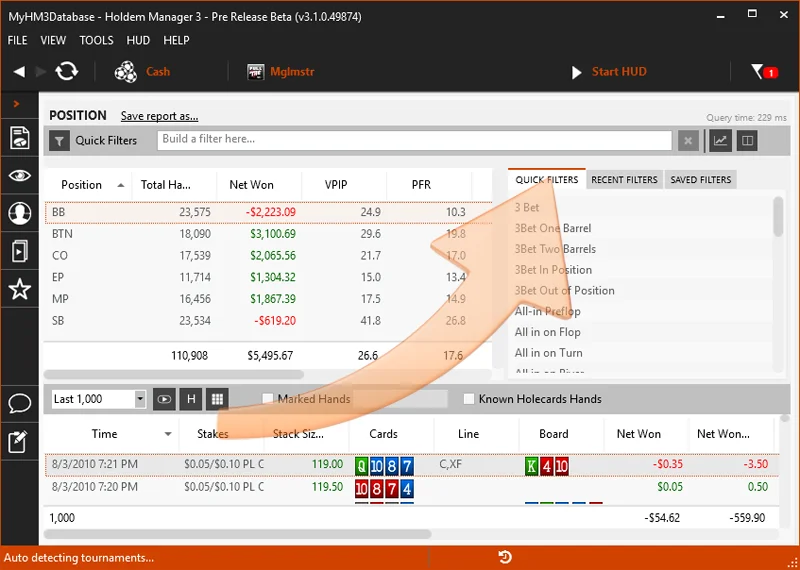
- Early Position Play. In the main filter tab click ‘early position’ which will filter all hands played UTG and under the gun +1. First look at your VPIP and PFR – they should be almost half of your overall VPIP because you should be playing tight. If your UTG VPIP and PFR are close to your regular VPIP you’ve spotted a leak and should tighten up from UTG. Filter further in the hole cards tab to see if you’re profiting with the bottom of your UTG range (ATo , Axs, T9s).
- Middle and Late Positions. You can do the same for all positions by changing your first filter to middle position, cut-off, button and using the hole card filter. Using the preflop action facing player box you can also look at scenarios where you isolate a preflop limper, and so on.
- Playing against raises. Via the Main Filters tab, select all positions and in the next box preflop action facing player you select vs. 1 raiser. Filter further, by your opponent’s position, your position, hand type etc, until you track down where you’re bleeding money.
- Blinds vs late position steal. Select SB, BB and one raiser. In ‘position of first-raiser’, hit BU and CO, then from ‘filter by actions’, tick ‘filter by preflop actions’ and ‘call’. This shows the hands where you called a raise from the blinds against a late position steal.
- Blind vs blind play. Filter yourself as SB and the aggressor and select raise in the preflop actions. The real info is in your play from the big blind vs a small blind steal raise. So hit BB in the position box and 1 raiser, and set the position of the first raiser to SB. Again, set preflop action to call to find leaks.
Postflop
Here are the postflop leaks common to many low-stakes players.
- Calling too often on the flop, turn and river. You can look at your stats by street using the filter by actions tab. Set preflop to call, flop to call and go from there. Examine each street individually. If you call too often on the flop, the flop number will be small, and for the turn and river, the flop number will start big and get small by the river. You can further filter by using the hand values tab. Are you calling too often with top pair no kicker? Or are you just playing out of position too often?
- How you play draws. To look at your results with your draws go to the hand values tab and select the draws you want to look at. You can filter for everything from nut draws to gutshots.
- Look at how you do as the preflop raiser when you c-bet the flop, check the turn, then call on the river. It’s just setting different filters to play around with.
- Some scenarios to look at are firing three barrels as a bluff, playing hands with showdown value (with or without the lead), playing out of position without the lead, etc.
Three-bet pots
There are a lot of three-bet pots in aggressive games so you should improve your three-betting. You can filter by hands that you 3-bet to see how profitably you’re three-betting from the blinds vs a steal. To look at your play in three-bet pots, set preflop action facing player to one raiser and one raiser plus callers. Then switch to the filter by actions tab and filter by preflop actions, and select raise. From there you can look at hands where you’re three-betting light or for value by using the hole cards tab.
You can filter further for how you play three-bet pots from the blinds, on the turn when you’re called, etc. Next, look at your play in three-bet pots as the caller via the filter by actions tab and select raise call and call call. That will bring up all three-bet pots where you don’t have the lead.
How Accurate Are Poker Stats?
The thing about stats is that they can be extremely misleading without an accurate sample size. Hold’em is a variance packed game and in the short term stats can vary considerably. One of the biggest mistakes you can make is treating a player’s online poker stats as gospel. Especially when you have a small sample size. Only to find in real life they play in a completely different manner.
Hold off from drawing advanced conclusions about how someone plays until you have logged enough hands. What “enough hands” means varies from stat to stat. A hundred hands might be more than enough to draw conclusions from the VPIP and PFR stats. But, it’s not enough to understand WTSD, barreling frequencies, or three-bet stats. As with everything in poker, the bigger the sample size the better.
Don’t Undervalue Note Taking
You build your poker game on information. Every hand you play with someone contains valuable insights into their playing style and betting patterns. But when playing hundreds of opponents, trying to keep mental notes is futile. So take advantage of the in-built poker note-taking software. When you add a note to a player, it sticks to them, so if you run into them on the same site later, you can still see it.
Keep your notes short and informative. So not “IDIOT HITS GUTSHOT WTF”, instead write your opponents’ tendencies for your future self. Use abbreviations and acronyms to keep your notes clean:
- OTB: Off the button
- OOB: Out of the blinds
- UTG: Under the gun
- PFR: Pre-flop raise
- NFD: Nut-flush draw
- TPTK: Top pair, top kicker
- TPNK: Top pair, no kicker
- TPGK: Top pair, good kicker
- OOP: Out of position
- IP: In position
- 3B: Three-bet
- C/R: Check-raises
- C/C: Check-calls
- CS: Calling station
- BVB: Blind versus blind
- AI: All-in
- BB: Big blind/Big blinds
- HBL: High blind limper
Example:
You open 4BB on the button with A A and BB calls. Flop comes A 4 5 and BB checks. You bet over ⅔ pot and BB calls. Turn comes 4 , BB checks, you bet half pot and your opponent calls. River comes 8 , BB checks, you bet almost full pot and your opponent check-raises all-in. You call and they show 6 9 for the flush. Your aces-full scoops the pot.
What note would you add for the BB? You can say “Calls OOB with weak holdings vs butto
Use Poker HUDs as a Tool, Not a Crutch
The true value of hand-tracking software is underrated while poker heads-up displays (HUDs) are overvalued. It’s obvious that using a poker heads-up display backed up by a database of hands will give you more information. But having a HUD won’t instantly transform you into a winning player. Also, relying too heavily on stats leaves you playing a robotic game that will stunt your growth as a player. Or even lead to mistakes.
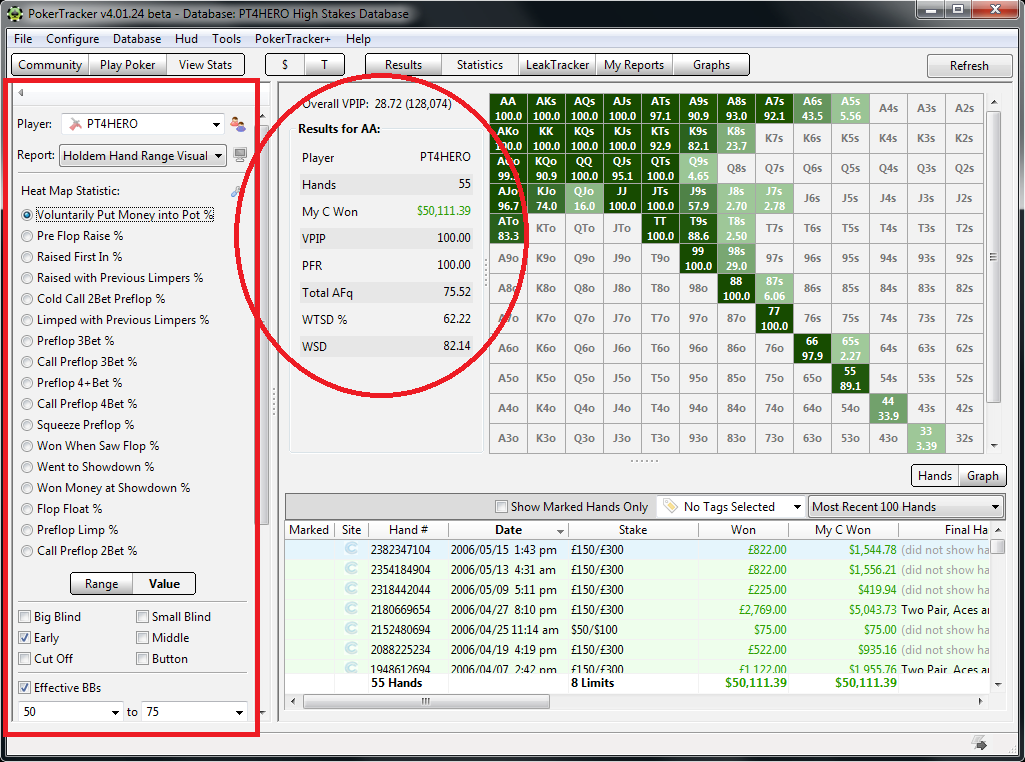
For example, it’s not a HUD that puts your opponent on a range. Say you pull up the Hold’em hand range visualizer and filter to just 3-bet pots and see the percentage was 9.6%. We know the opponent is 3-betting 9.6% of the time – but what’s their range? Most players will take 9.6% but that’s a self-weighted range. In reality, over 43% of all hands were possible in the range.
To help deal with problems like this, tools like PokerTracker may allow you to custom-tweak opponents’ ranges based on what you know about their play. However, players may also deviate from their standard style for a variety of reasons. The poker player stats don’t tell the whole story. And too many players rely only on stats in a game, painting everyone with a broad, sweeping brush. When in reality, you can have three very different players with similar stats
The real power of tracking software comes from running reports and filtering to review
Adapting to Evolving Player Pools
Modern online poker environments are filled with players who have also embraced tracking technology. This means you are not just collecting information on them; they are likely doing the same with you. As a result, the meta-game has evolved. In some cases, you may find that standard exploitative strategies no longer work against certain skilled opponents. This is where advanced methods, potentially touching upon GTO (Game Theory Optimal) approaches, can come into play. You might decide to three-bet slightly more balanced ranges in positions where your stats suggest you’ve been exploitable, or mix in fewer continuation bets on certain board textures where your data shows you’ve been bluffing too frequently.
Information wars can also lead to false leveling, where each side tries to out-guess the other with minimal data. The best safeguard is consistent analysis of your opponents’ long-term numbers, combined with an awareness that short-term adjustments may mask your typical ranges. Familiarizing yourself with concepts like minimally exploitable ranges can help you make profitable decisions against savvy players who utilize software as aggressively as you do.
Customizing Your HUD
It’s often tempting to use the default HUD settings, but you might find that custom configurations give more accurate reads. Instead of simply displaying your opponents’ VPIP, PFR, or 3-bet percentages, you can break these down by position. A villain’s three-bet stats from the button may differ drastically from their stats in early position. You can also isolate stats for short-handed play, deep-stacked scenarios, or situations where the big blind ante is in play. By doing so, you won’t miss key information hidden by aggregated averages.
Consider your own image as well. If your opponents see your overall 3-bet percentage at 6%, they might expect you to have a narrower range. If you’ve begun mixing in more polarized 3-bets from the cutoff and button, your real range could be significantly wider. Continually reviewing the data you present, and adjusting your lines to exploit how opponents might misread that data, is what separates good players from those who remain static.
FAQ
What is a poker HUD?
A poker HUD (heads-up display) is a software feature that shows real-time statistics about your opponents, such as how often they voluntarily put money in the pot or three-bet preflop. It takes hand histories gathered by tracking software and displays relevant metrics beside each player’s name at the table.
Why is VPIP important?
VPIP, which measures how often players voluntarily put money in the pot, reveals how tight or loose someone is. It helps you gauge your opponent’s hand ranges. If VPIP is high, they play more hands. If it is low, they are more selective.
How reliable are small-sample HUD stats?
Small-sample HUD stats can be misleading. Variance in a few hands can make someone look looser or tighter than they really are. Waiting for a bigger sample size, especially for more nuanced stats like three-bet or fold-to-c-bet, is crucial for accurate conclusions.
When should I start using tracking software?
Many players recommend waiting until you have played at least 1,000 hands in your chosen format. This helps you build a basic feel for the game without getting overwhelmed by data. Once you’re more comfortable, introducing tracking software can significantly improve your understanding of your own leaks and your opponents’ tendencies.
How can I fix a severe downward-sloping redline?
A consistently dropping non-showdown line usually stems from folding too often or c-betting in bad spots. Try reducing the number of tables, c-betting more selectively, and playing more hands in position. Reviewing hand histories with filters in your tracking software can pinpoint where you are bleeding chips.
What should I note about an opponent besides HUD stats?
You should record how they play draws, how they respond to pressure on each street, and whether they deviate from standard lines in specific spots. When you see them overvaluing marginal hands or making unusual calls, noting that behavior helps you exploit them even if their overall stats look tight or solid.
How do I adapt my strategy against players who also use HUDs extensively?
You can balance your ranges and vary your aggression frequencies to avoid being predictable. If you suspect your opponent is using past data to label you as overly loose or tight, adjust accordingly by mixing up your lines. Employing a more balanced approach or even incorporating a few GTO-based concepts can protect against advanced exploitation.
Related Poker Strategy Articles:
PokerListings 




User Comments
the HD stat and the FST stat isn’t explained in the article,somebody knows what it stands forjQuery111006110486459854507_1422370812277?
Danial: You didn’t explain the “FST” stat I can see in all your pics.
HI, are these stats based on FR or 6 max????
It obviously depends on which games and which stakes you are playing.
At MSNL and above players definitely are on the more aggressive side and obviously at Heads up they’re VPIP will be much higher.
But in all of my experiences at $1/$2nl and $2/$4 most winners fall in the 19%-$27% any more aggressive and they just end up being spazzy.
So which game are you playing? It might be much different then the games I play?
And I made a mistake about the three bet range. In my pokerstove I forgot to tick off AKo and AQo.
But someone with a 3% threebet probably wouldnt three-bet TT or AQo and probably only AQs half the time.
When I have time I’ll update the article. Thanks for pointing it out.
Hi Daniel,
from my experience today regulars are much more agressive than VPIP 19-25%. The VPIP of those winning players is very often over 30% ….????????
In 3bet paragraph is written that 3% range means re-raising with AA-TT, AKs-AQS, Ako and AQo – this range is 4.7% of all starting hands…?????
Thank you for your explanation.
why do I run so bad?
Thanks Dan for your explanations. It helped me to understand your point of view.
For example I personally beat the 9-max game for at least 20 big blinds / 100 hands. That’s why it was surprising for me. But I do play only one table.
While in 6-max I’m a losing player, that’s the funny part 🙂 Of course the hands sample in 9-max is much larger for me, but still everyone has to have a favorite game 🙂
Chorjak,
BB/100 is method of measuring winrate.
bb with no capitals is big blind per 100 and BB with capitals equals BIG Bet which comes from limit poker and is 2x the bb.
So lets say you’re beating the game for 4BB/100. That would be $16/100 hands per table.
Obviously you’re playing more than one table so that can really add up.
Yes, it doesn’t seem like that much, and if you were playing live $1/$2 you could beat the game for much much more.
But with online poker there are very, very few players beating 6max or full ring for more than 4BB/100.
Hope that helps.
Dan
JMoney,
Huds are completely legal because they use only information gained while you were at the table. Meaning, they don’t use data mined hand histories or any thing like that.
Don’t sweat it, it definitely isn’t cheating. I wouldn’t write an article on how to cheat 🙂
Dan
Daniel, please tell me what did you mean by ‘ a player crushing the game for 4BB/100’ cause it’s not very clear for me. Are those big blinds / 100 hands or big bets / 100 hands. It seems a very small amount for me. In limit poker for example 4 big bets mean 8 big blinds. And in 100 hands it’s still a very marginal win. Please explain me that concept. Thanks.
Hi Daniel,
Great article. And very timely as I just download Poker Tracker to log and review my hand histories/sessions. I am new to these programs and plan on testing Hold’em Manager as well.
I’ve found this program to be EXTREMELY helpful when reviewing my hands. Far better than reviewing the text version of my hand histories.
I have yet to try the HUD on live games because I’m nervous of the “3rd party software” clause on the terms of use for FTP.
Do these programs fall under that category?