
 EN
EN  DE
DE Breaking Down the Biggest 2026 WSOP Poker Hands – Part 3

 PokerListings
-
 CoinPoker 150% up to $2000
18+ | Play Responsibly | T&C Apply
-
 Ignition Poker 150% up to $1,500
18+ | Play Responsibly | T&C Apply
-
 Stake.US Poker $55 Stake Cash + 260,000 GC
18+ | Play Responsibly | T&C Apply
-
 Americas Cardroom 100% up to $2000
18+ | Play Responsibly | T&C Apply
-
 Betonline Poker 100% Up to $1,000
18+ | Play Responsibly | T&C Apply

The 2026 World Series of Poker has completed more than half of the tournaments and the Main Event is within sight, the big names continue to shine and the hands that take place at the final tables continues to impress, wow, and even surprise us! Let’s continue our deep dive into some of these hands and break them down!
Event #26 – $2000 NLHE – Dunaway Goes Deep Again, No Thanks to Ace-King
Braxton Dunaway followed up his final table run at last year’s Main Event with his second career bracelet in event #26, defeating 967 others to claim the gold and the $288k first place prize. While the final table was tough, Dunaway played well overall but did hit a speed bump when he put Briant Alavez to the test when four players remained at the final table.
In level 31 with blinds at 100k and 200k with a 200k BB Ante, we find Alavez sitting in the big blind with a 3 million chip stack, and Dunaway was in the cutoff with a 11.5 million chip stack. Dunaway raised pre-flop to 400k, and Alavez came along. The flop went check-check, but the turn brought out a continuation bet from Dunaway of another 400k, to which Alavez check-raised to 1.2 million, quickly called by Dunaway. The river saw Alavez bet 700k, to which Dunaway put Alavez all in. The Mexican went into the tank, but emerged calling and collecting a massive pot for him.
- Dunaway
A A
K
A
K
 K
K
- Alavez
5 5
2
2
5
2
2
- Board
K K
2
2
5
5
8
8
10
10
K
2
2
5
5
8
8
10
10
Calling off your entire stack with bottom two pair on a board that a backdoor straight and backdoor flush hits, along with cards that don’t generally favor the big blind takes a massive amount of courage and a solid read on your opponent, but Alavez played this hand extremely well. Flopping a monster so to speak on the flop with bottom two pair against a pre-flop raiser that more than likely only has top pair is a dream spot – especially for a shorter stack at the final table of a WSOP bracelet event, but the turn proved troubling for Dunaway when he called the check-raise so quickly, and then jammed the river when the scariest card possible hit. Alavez did not have a pot size bet behind, so he did not have a lot of fold equity to lay down most hands – certainly not two pair in this spot and correctly deduced that he was good based on Dunaway’s actions.
Speaking of, Dunaway may have been blinded by the allure of Ace-King hitting top pair top kicker on this flop, and having the ace of spade blocker – which is debatable if blockers are real – based on how he was running at the final table, and seeing a spot to eliminate a player and ladder everyone else up. Alavez’s check-raise on the turn looks as much like a bet to build a pot as it does protection against the draws that materialized on the turn.
Dunaway may have read this bet as the latter, so when the scare card hit, his instinct was to represent that hand and force the issue. But when a player has so little behind – roughly 50% of pot – your read on them needs to be iron clad if you are going to pay them off as Dunaway did, and there were red flags that Dunaway dismissed for whatever reason. Thankfully for him, those chips returned to his stack by the end of the tournament, but this is a great example of why we ask the question to ourselves – why is my opponent doing what they are doing?
Event #29 – $50K NLHE High Roller – The Turning Point for Survana
Santhosh Survana won his third WSOP bracelet, capturing event #29 – the $50k High Roller for a shade under $2 million, defeating a star-studded final table in the process. A final table that accelerated eliminations in the first levels of the last day, and seeing others taking the lead before this hand put Survana in a position to win.
With three left and in level 21 with blinds at 120k and 240k with a 240k BB ante, Survana sits with 13 million in the big blind, and Anatoly Zlotnikov has 21 million under the gun. Zlotnikov raised to 485k and Survana defended. The flop saw Zlotnikov continue for another 700k, followed by a call from Survana. The turn did nothing for Zlotnikov to slow down, firing 1.9 million, and again, Survana happy to call. The river brought a third bullet from Zlotnikov, this one for 3.8 million chips, to which Survana called and scooped the pot up.
- Zlotnikov
A
A
9
9
- Survana
K
K
10
10
- Board
3
3
6
6
7
7
K
K
5
5
Zlotnikov saw an opportunity to try and squeeze Survana out of this tournament by firing all three bullets at this pot, knowing that this was the only way he was going to win the hand given how it ran out. However, unlike the previous hand, given what Zlotnikov was holding, Survana was wise to NOT raise and allow Zlotnikov to keep firing – again, this coming down to Survana’s read on Zlotnikov with these two big name pros and well known to each other. Survana was not going anywhere on that flop and not folding when he improved to the best hand on the turn, allowing Zlotnikov to keep building his pot.
One should question why Survana did not check-shove the river – he did have a very strong hand, one that Zlotnikov would certainly not have called off – even if the pot size was such that he had the odds to call – but getting a fold and not revealing your hand conceals a bit of information to your opponents that could be critical later on in the final table. For Zlotnikov’s part, he had the heart of a lion here, betting into a board that increasingly got worse for him, but seeing the passiveness from Survana, one must question the river bet. If Survana was chasing, EVERY draw hit the river. If Survana had a pair, even a small one, there was only one card to be wary of – the King.
If Survana calls the turn, and a lower card hit the river, is Survana folding to a big bet? In hindsight, Zlotnikov needed to check the river and save the 3.8 million at the end as there was really no way Survana was folding regardless of his hand and the action.
Event #36 – $100K NLHE Super High Roller – Yuri Isn’t Just a Mixed Games Player
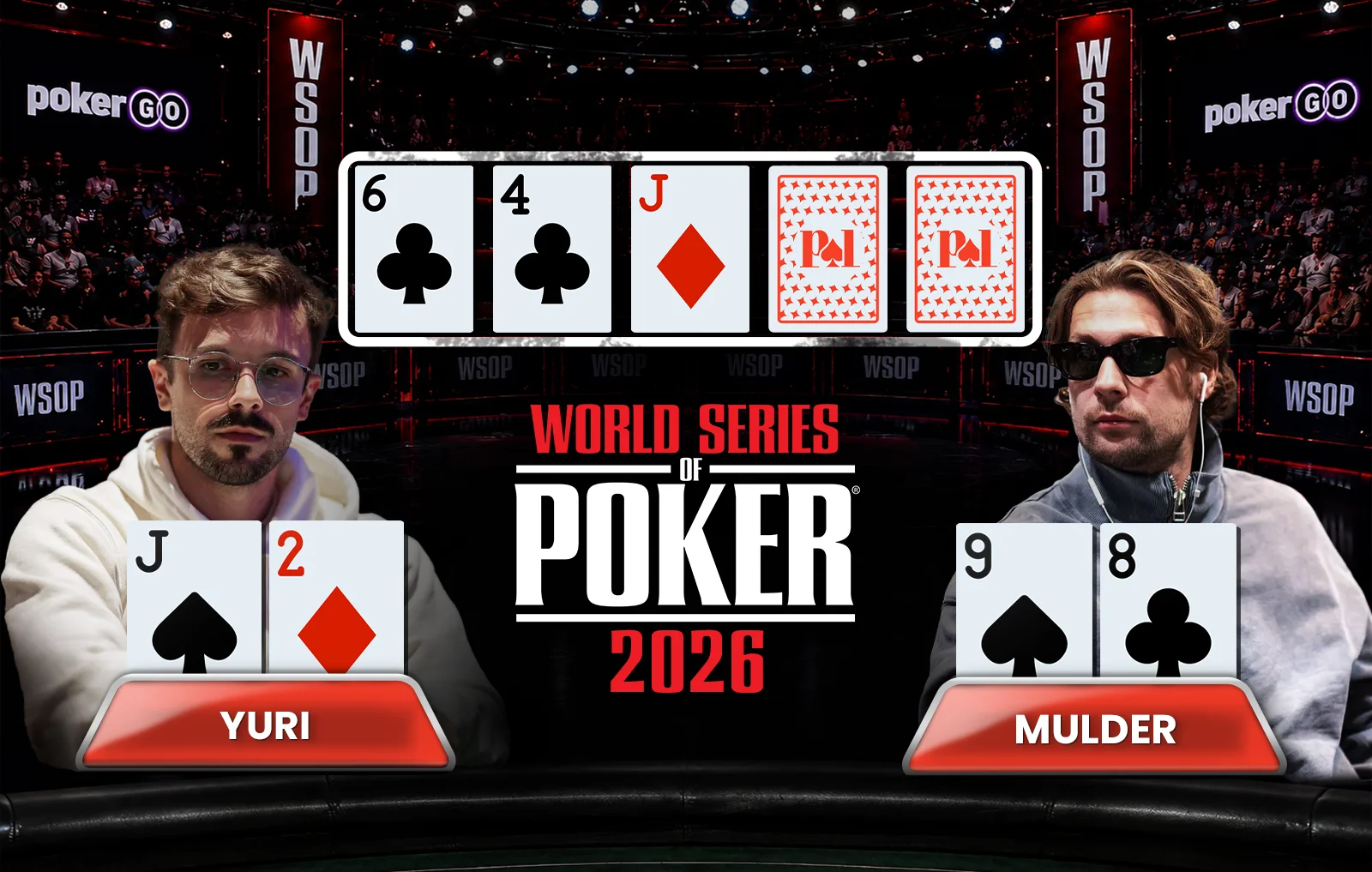
Brazilian pro Yuri Dzivielevski captured one of the biggest buy-in tournaments of the summer – and $2.8 million in the process – when he defeated 114 other players in the $100 NLHE Super High Roller, all while his family was preparing to welcome a new addition. In the process, he beat several big-name pros at the final table, including Tean Mulder heads-up, and we look at one of the encounters between Yuri and Mulder that saw the chip lead swing to the Brazilian’s favor.

In level 37 with blinds at 500k and 1 million with a 1 million BB Ante, Yuri limped from the button with a stack of 24 million, while Teun Mulder started with 45 million in the big blind, and checked his option. The flop saw Yuri bet 1 million, and Mulder raised it up to 3 million, which Yuri called. Mulder fired 3 million on the turn, to which Yuri called and sent them to the river, which Mulder fired another 7.5 million into the middle, to which Yuri called.
- Yuri
J
J
2
2
- Mulder
9
9
8
8
- Board
6
6
4
4
J
J
3
3
2
2
Sometimes when a poker player chooses to bluff and they tell the story properly, the bluff works – but sometimes you run into a player that has too good of a hand for the bluff to get through, and this is exactly what happened to Mulder in this case. He committed to the bluff on the flop that should have hit his range better than Yuri’s, but that did not slow down the Brazilian. His second bullet getting called that completed a straight draw should have made him nervous heading to the river, but when a deuce hits – that of course never changes anything – decided that a third bullet was the only option and did not back down. To Yuri’s credit, he read this hand for exactly what it was, even though there was no raise pre-flop and no one should ever go broke in an unraised pot pre-flop. Top pair short handed is too powerful of a hand to give up on, and when he improved to two pair, the balance of calling with that versus the chance that Mulder had a five – which was likely given the check pre-flop and the raise on the flop – especially if he read Mulder for weakness from his aggression.
Event #41 – $250K NLHE Super High Roller
Adrian Mateos again proved that he is one of the best poker players in his generation by winning the ginormous $250K Super High Roller for over $4 million, and beating some of poker’s top names, including Bryn Kenney who lost to him heads-up. Along the way, Mateos met some turbulence, including this wild three-way all-in that Mateos found himself on the wrong side when all was said and sone.
We are seven-handed in level 20 with blinds at 200k and 400k with a 400k BB Ante. Mateos enters the hand with just under 16 million; Sean Winter sits with 4.35 million, and Brandon Wilson had 4.25 million. Wilson opened to 2BB – or 800k from the cutoff, while Mateos was in the small blind and three-bet to 3 million, covering Wilson. Winter decided to four-bet to 3.95 million, going all-in. Mateos seeing the opportunity to knockout two players called, and the three watched the board get dealt:
You arguably won’t see a crazier hand like this where two players are all-in with Wilson ahead pre-flop; Mateos get life by flopping the nut flush draw, only to see Winter scoop the side pot on the turn by nabbing top pair, and then the board pairing on the river. So, let’s dig into what went down here:
- Winter
A
A
Q
Q
- Wilson
J
J
J
J
- Mateos
A
A
10
10
- Board
9
9
8
8
6
6
Q
Q
6
6
Wilson’s moves were fairly limited here – first into the pot, he raises up with a premium hand, and when action returns to him, he is calling off to possibly triple up if he can hold and ladder by eliminating Winter.
Mateos to his credit being the chip leader at this point attempted to isolate Wilson and keep Winter out of the pot, but one needs to look at the stack sizes to determine how best to keep Winter out. While Winter only had 3.95 to start, by this point with Wilson’s 800k raise, there already was 1.8 million in the middle, and Winter would only have had 3.95 million behind – SPR of 2. If Mateos calls, and Winter calls, Winter’s SPR goes below 1 – as would Wilson’s so the pot dynamics led themselves to Mateos shoving to try and keep Winter out of the pot, as any other action would give Winter the odds to call with a wide range of hands – forget the fact that he had Ace-Queen, and the fact that he already had invested 800k into the pot.
Mateos would not have been able to do anything to keep Winter out in reality but the math can remove some options from the table as they just don’t make as much sense as others, and this is a spot where a shove from Mateos might, might, have been able to keep Winter away. Instead, Winter gets to be the one to shove all-in, and when action returns to Mateos, knowing he has the worst hand, has no choice but to call given the pot dynamics – essentially all the money went in anyways but Mateos calls (versus shoves) with the worst of it, and loses both the main and side pot. Luckily for him, it didn’t stop him from winning, but this could have been a moment to shift the momentum away from himself and onto Sean Winter.
Next time we’ll open hands from more of the final tables and breakdown the action as we march towards the biggest poker tournament in the world starting in a matter of days!
PokerListings 



Log in to join the discussion
Share your thoughts and see what others have to say.