
 EN
EN  DE
DE How Much to Tip a Casino Dealer: The Complete Guide to Tipping Etiquette in American Casinos

 PokerListings
-
18+ | Play Responsibly | T&C Apply
-
 ChipnWIN Social Casino 15,000 GC + up to 100 SC
18+ | Play Responsibly | T&C Apply
-
 A1 Social Casino 1,000,000 GC
18+ | Play Responsibly | T&C Apply
-
 CrashDuel Casino 100% up to 200,000 GC + 50 SC
18+ | Play Responsibly | T&C Apply
-
 UpUp Casino 1,000,000 GC + 5 SC
21+ | Play Responsibly | T&C Apply


The noise hits you first when you step onto a busy casino floor. Amidst the flashing lights and clinking chips, the staff at the table games are quietly executing highly skilled service work.
Casino dealers typically earn base wages that sit near the legal minimum, often averaging between $8 and $12 per hour before tips. Gratuities do not merely supplement their income. They represent the vast majority of their take-home pay, often accounting for 50% to over 100% of their total earnings.
While tipping remains entirely voluntary, understanding this wage reality reframes the gesture from an optional courtesy into a meaningful recognition of service. American hospitality culture operates heavily on this principle. The gaming floor is no exception.
How Dealer Tip Pooling Works
Before placing a bet on the layout, you should understand where your gratuity actually goes. At most traditional table games, tips do not go directly into the individual dealer’s pocket. Instead, they flow into a shared pool, historically referred to as a toke pool.
This inventory is managed by the casino and divided among all dealers on a specific shift or rotation cycle. Every chip added to the box directly increases the baseline share for the entire crew.
A notable exception to this rule occurs in the poker room. Poker dealers operate on a different system, keeping 100% of the individual tips they earn at their tables.
General Tipping Guidelines: Benchmarks by Session Outcome
The widely accepted baseline for tipping a table dealer is $1 to $5 per hour of active play. This is a practical floor rather than a rigid ceiling. The exact amount should scale based on the stakes of the table, the quality of service, and your overall session results.
| Session Scenario | Suggested Tip Amount | Operational Notes |
|---|---|---|
| Small-Stakes Casual Session | $1 to $2 per hour | Standard $1 chips are entirely appropriate |
| Winning Session (Up 20%+) | 1% to 5% of net winnings | Spread wagers throughout the session |
| Losing Session | $1 to $5 total | Acknowledge professional service regardless of luck |
| High-Limit Tables | $25 to $100+ | Scale the tip to match the elevated stakes |
| End of a Long Session | $5 to $20 | Accounts for multiple dealer rotations |
| Hand-Pay Slot Jackpot | 0.5% to 1% of the payout | Paid in cash bills since chips are unavailable |
Tipping When Winning
When you enjoy a successful run, a percentage-based approach provides the cleanest framework. Tipping between 1% and 5% of your net session winnings is the standard baseline among experienced players.
If you win $200 at a blackjack table, a $5 to $10 tip is proportional. The smartest approach is to distribute this gratuity across your entire playing session rather than dropping a single large tip at the end. Spreading wagers builds genuine table rapport and ensures that every dealer who rotated onto your table during your session receives recognition.
Tipping During a Losing Session
Losing your bankroll does not exempt you from standard etiquette. A small tip of $1 to $5 for good service is highly appreciated even when the cards run cold.
The dealer has zero control over the house edge, the shuffle, or the dice outcomes. Their professional responsibility is to run the game with speed, mechanical skill, and a welcoming presence. That service quality exists independently of your luck. Viewing a casino trip as an entertainment expense makes maintaining this discipline much easier.
How to Tip: Cash vs. Betting for the Dealer
You can execute a tip in two primary ways at a table game. The first method is sliding casino chips directly across the felt toward the dealer, usually accompanied by a clear verbal cue like “for the crew.” The second, more engaging option is placing a toke bet, which is a wager made on the dealer’s behalf alongside your own.
Paper currency is never used directly on the layout of a live table game. Casino chips are the exclusive medium for table gratuities. Trying to hand a dealer a $5 paper bill creates an immediate procedural violation for casino security cameras.
Executing a Toke Bet Step-by-Step
Placing a live wager for the table crew adds an interactive element to standard casino tipping. Following the correct physical sequence ensures your chip complies with overhead security protocols without disrupting the flow of play.
Place the dealer’s chip at the very start of a new hand, never during active play.
Set the token just outside the main betting circle or directly on top of your own wager, slightly offset.
Say “dealer’s bet” or “this rides for the crew” clearly so the supervisor can log the wager.
If your hand wins, the dealer collects both the original chip and the corresponding winnings from the layout.
If the hand loses, the chip goes to the house bankroll alongside your wager. No awkwardness is required. It stands as a good-faith gesture regardless of the outcome.
The most natural moment to deliver a direct chip tip is during a color up, which occurs when you exchange your smaller-denomination tokens for larger ones before exiting the table. Leaving the odd, low-value chips behind as a parting gratuity is standard table practice.
Tipping Conventions by Game Type
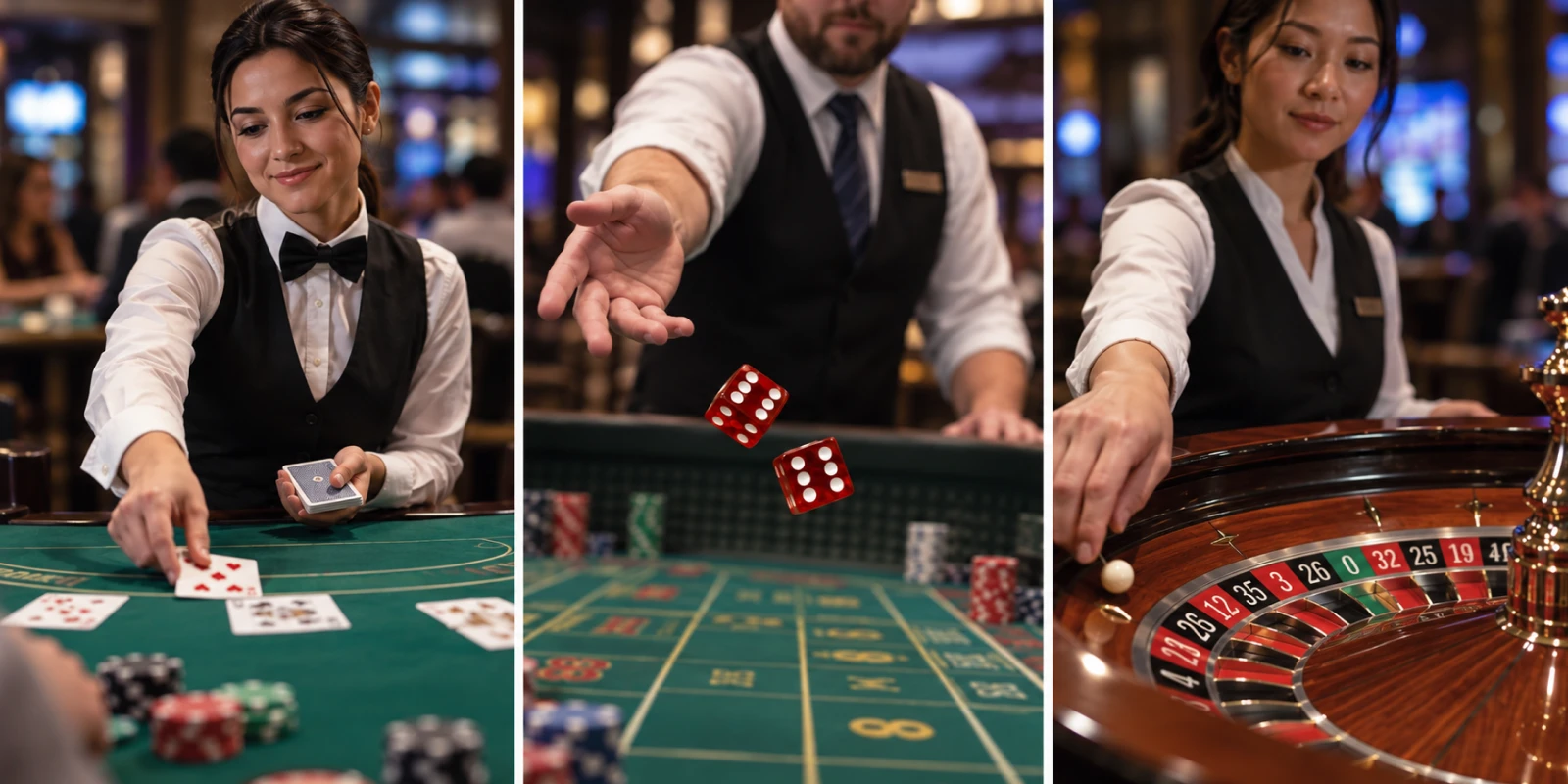
Each specific casino game carries its own distinct tipping culture shaped by the pace of play and long-standing floor traditions.
Blackjack
Blackjack features the most structured tipping rhythm on the casino floor. The standard convention is wagering or sliding $1 to $5 after a significant winning hand or once every 30 to 60 minutes.
Hitting a natural blackjack with its traditional 3:2 payout serves as a primary tipping trigger among regular players. High-tier side bet payouts on configurations like Perfect Pairs or 21+3 also warrant a celebratory token for the dealer.
The Craps Table
Craps features a highly theatrical, communal tipping culture. Gratuities are placed as active wagers on behalf of the entire four-person dealer crew, rather than handed directly to an individual.
Popular options include placing a hardway bet for the dealers, a standard pass line wager for the boys, or a two-way yo, which is a split bet on the 11 where half the payout rides for you and the other half goes to the crew. Because the stickman, boxman, and base dealers operate as a tight functional unit, tipping the crew rewards the entire operational team simultaneously.
Roulette
Roulette involves significantly less back-and-forth interaction between the player and the staff. The game moves at a deliberate, procedural pace.
Because roulette carries a steep house edge of over 5%, placing a live toke bet on the layout means there is a high mathematical probability the crew will receive nothing. Sliding a direct chip tip of $5 to $10 at the end of your session is the preferred approach, ensuring the gratuity lands safely in the tip box.
Baccarat and High-Limit Rooms
Baccarat culture reflects a quiet, formal atmosphere with significantly higher financial stakes. In high-limit rooms, regular players scale their tips upward, often sliding $5 to $25 tokens quietly across the felt at the conclusion of a session.
Avoid placing toke bets on high-variance spots like the tie bet, which carries an aggressive house edge of roughly 14%. Stick to direct chip transfers to ensure reliable recognition.
Carnival Games and Tax Thresholds
Carnival games like Mississippi Stud, Three Card Poker, Pai-Gow, and Ultimate Texas Hold’em follow tipping patterns similar to blackjack. However, you must account for the legal jackpot thresholds.
When an exotic bonus payout hits $1,200 or more, mandatory IRS reporting kicks in immediately. The table supervisor will halt play to process official W-2G paperwork.
Tipping during this administrative pause can create procedural confusion. The cleanest workaround is waiting for the paperwork to clear, then placing an offset bet for the dealer on the subsequent hand.
The Poker Room Ecosystem
Poker rooms operate on an entirely separate economic system. Because poker players compete against each other rather than the house, tips are not pooled among the floor staff. Each poker dealer keeps 100% of the individual tips they accumulate during their table rotation.
Standard etiquette is tipping $1 after winning a pot, scaling to $2 or $5 for large pots. While land-based poker rooms rely on physical chips, digital cardrooms and online platforms like Ignition Australia handle rake and hand execution automatically, using built-in digital interfaces for optional dealer tipping in live streams.
Hand-Pay Jackpots on Slot Machines
A hand-pay jackpot occurs on any slot or video poker machine when a single win hits the $1200 threshold, triggering automated state or federal tax compliance. A slot attendant must physically walk to your terminal, verify the machine diagnostics, complete the necessary tax paperwork, and hand over your cash winnings.
Because this constitutes a direct, personalized service interaction, a gratuity is standard practice. The baseline benchmark sits between 0.5% and 1% of the total jackpot payout.
- $1,000 to $1,999 Jackpot: $5 to $15 tip
- $2,000 to $4,999 Jackpot: $15 to $40 tip
- $5,000+ Jackpot: $25 to $75+ depending on the interaction
Keep a small stack of $5 and $10 paper bills ready in your wallet for this scenario. Casino chips are completely unavailable at standard slot banks.
Tipping Casino Support Staff
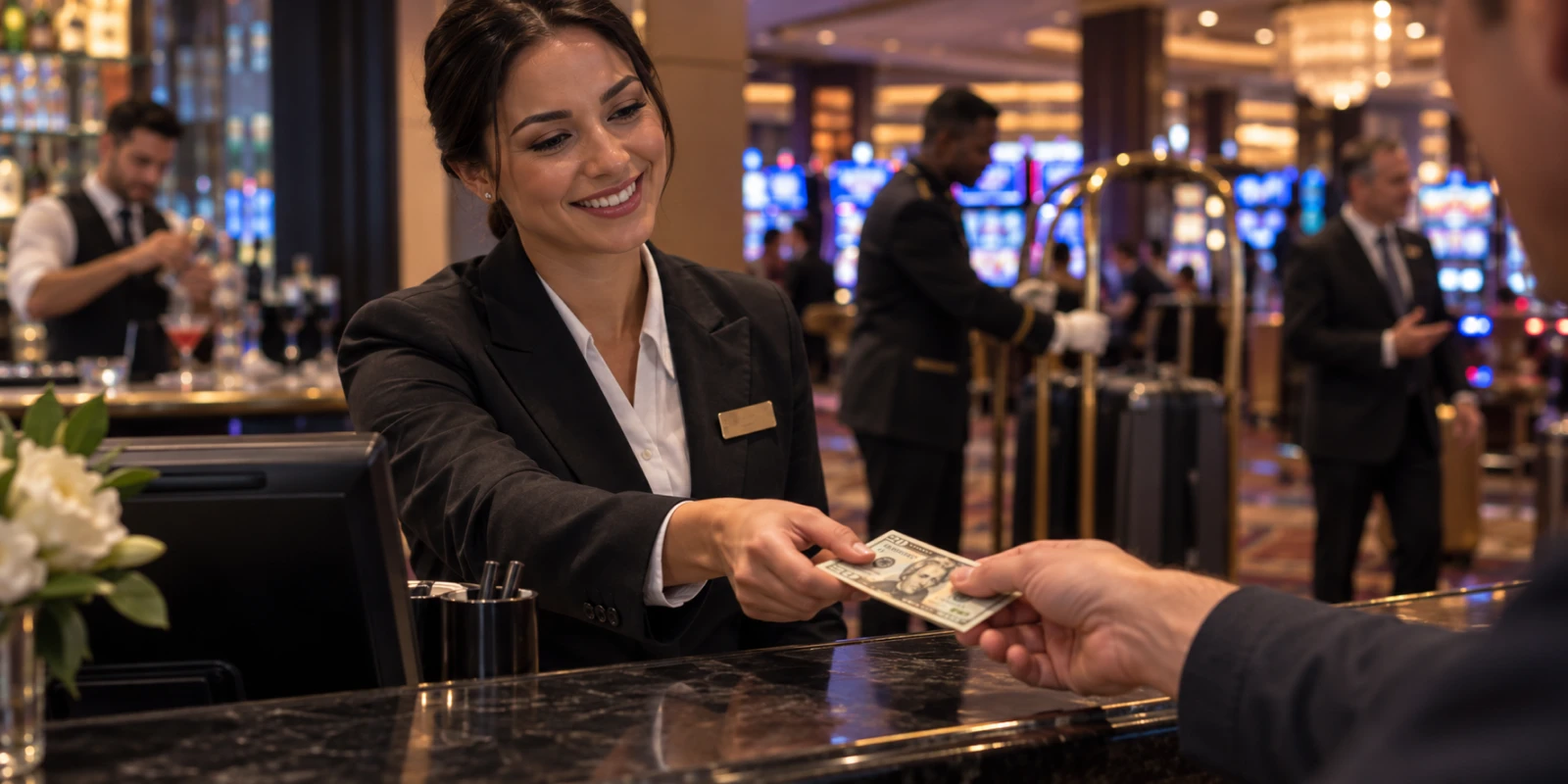
A smooth casino visit relies on a vast network of hospitality workers operating well beyond the card tables. Recognizing these supporting roles ensures you maintain complete floor etiquette from the valet entrance to the resort lounge.
- Cocktail Servers: Casino beverage servers rely heavily on tips to supplement very low base hospitality wages. The standard floor etiquette is $1 to $2 per drink, regardless of whether the beverage is alcoholic or complimentary. Attentive service across a multi-hour session warrants a $5 bill. Cash is highly preferred here, as chips are awkward for servers to exchange at the end of a shift.
- Valet and Bell Staff: Valet attendants expect a tip of $2 to $5, which should be split between your initial arrival and final vehicle pickup. Bellmen handling luggage expect $1 to $2 per bag.
- The Casino Cage: Routine chip cashouts do not require a tip. However, if a cage cashier handles a complex financial transaction, such as processing a wire transfer, establishing a corporate credit line, or counting out a massive six-figure win, a $5 to $20 tip reflects the complexity of the service.
- Casino Hosts: Hosts manage room upgrades, VIP dining reservations, and complimentary travel profiles for consistent players. Tipping a host acknowledges a long-term professional relationship rather than a single transaction. Because property rules vary regarding host gratuities, presenting your token inside a discreet envelope is the safest approach.
Common Casino Tipping Myths
Persistent floor rumors frequently distort how new players approach tipping etiquette at live table games. Debunking these common misconceptions helps clarify the actual operational mechanics of a casino floor.
Myth 1: Tips do not matter because they all get pooled anyway
While table game tips are pooled and divided among the shift crew, the overall size of that collective pool directly dictates every employee’s baseline take-home pay. Individual contributions compound directly over a shift.
Myth 2: Tipping can alter the game outcomes
Dealers are bound by strict procedural protocols monitored by overhead surveillance cameras. They have zero physical mechanism or legal authority to alter shuffles, spins, or dice outcomes in a player’s favor.
Myth 3: You should only tip at the very end of your session
Because casino dealers rotate tables every 20 to 30 minutes to manage mental fatigue, waiting until the end of a long session means you will likely tip a different employee than the one who served you for multiple hours. Periodic tipping during active play resolves this issue seamlessly.
Live Dealer Innovations and Online Tipping
This tipping culture is no longer confined exclusively to the physical tables of land-based gambling properties. As digital platforms expand across highly competitive jurisdictions, players frequently utilize interactive UI modules and live chat systems to reward real-time dealers hosted on legal online casinos in the U.S. or international gaming applications.
Maintaining these patterns in virtual lobbies ensures that standard hospitality etiquette successfully bridges the gap between physical card rooms and remote streaming studios.
Frequently Asked Questions
How much should you tip a dealer at a casino?
The standard baseline is $1 to $5 per hour of play at most table games. Adjust upward for winning sessions (1% to 5% of net winnings is appropriate) and for high-limit tables where $25 to $100 is more proportional.
Should you tip in chips or cash at the blackjack table?
Always use casino chips, not paper bills, at table games. Dealers cannot easily accept cash at the table. Slide a chip directly toward the dealer or place it as a toke bet above your main wager.
Do casino dealers keep their tips or are they pooled?
At most table games, tips go into a shared toke pool divided among all dealers on the shift. Poker room dealers are the major exception; they keep their own tips individually.
Should you tip by placing a bet for the dealer?
Yes, toke bets are a popular and appreciated form of gratuity at blackjack, craps, and other table games. Place a chip above your main bet and say “dealer’s bet.” If the bet wins, the dealer collects both the chip and the winnings.
What is the minimum acceptable tip for a casino dealer?
A single $1 chip is the practical floor at lower-stakes tables. It is always better than nothing and dealers genuinely appreciate it. At higher-stakes tables, $5 is a more appropriate minimum.
Should you tip a dealer if you’re losing money?
Yes. A $1 to $5 tip for good service is appropriate even during a losing session. Dealers have no control over game outcomes. Their job is to run the game professionally and create a positive experience.
Should you tip on a hand-pay jackpot?
Yes. Slot attendants who process hand-pay jackpots ($1,200+) provide genuine personal service by verifying the win, completing IRS paperwork, and handling the payout. Tipping 0.5% to 1% of the jackpot is customary. Have cash bills ready, as casino chips are not available at slot machines.
PokerListings 
Log in to join the discussion
Share your thoughts and see what others have to say.