
 EN
 DE
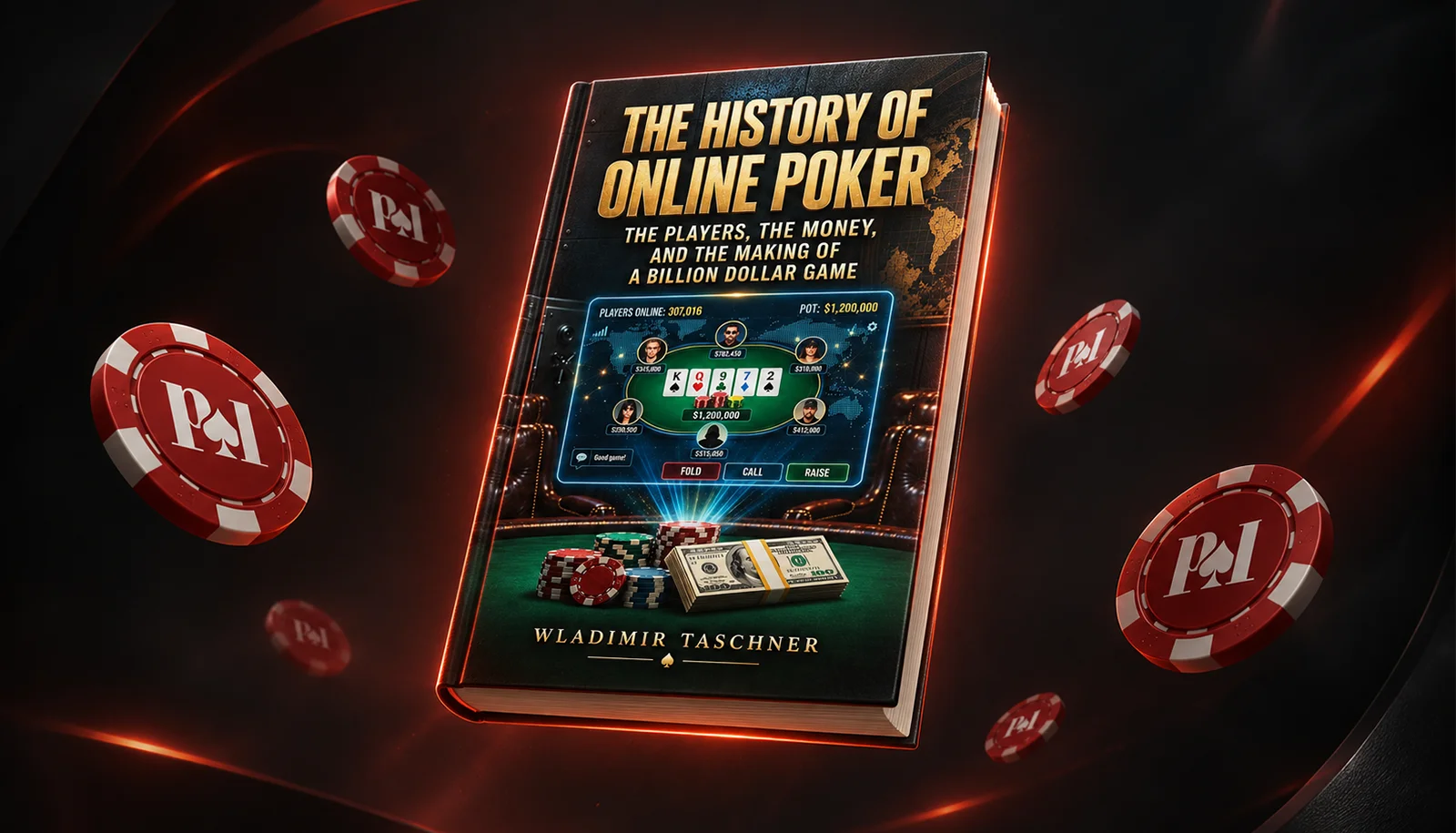
Wladimir Taschner Nailed The History of Online Poker

 PokerListings
-
 CoinPoker 150% up to $2000
18+ | Play Responsibly | T&C Apply
-
 Americas Cardroom 100% up to $2000
18+ | Play Responsibly | T&C Apply
-
 Ignition Poker 150% up to $1,500
18+ | Play Responsibly | T&C Apply
-
 Black Chip Poker 100% Welcome Bonus
18+ | Play Responsibly | T&C Apply
-
 Stake.US Poker $55 Stake Cash + 260,000 GC
18+ | Play Responsibly | T&C Apply

Among the poker books released in 2026, one has largely escaped the notice of the general public. It is neither a training manual nor a personal biography, but rather a true almanac of poker history — a rare, in-depth volume that will be of interest to absolutely everyone. I had the good fortune to read this thick book — and I’m eager to share my review with you.
Minor Flaws That Do Not Affect the Overall Quality of the Book
Before praising the book, I want to briefly point out a few of its flaws, which might slightly affect the reading experience.
The History of Online Poker begins with the table of content that, while generally well-formatted, is occasionally confusing. For example, within the section on The Poker Boom, there is a part titled The Recreational Player, which feels a little out of place in a book that, in its introduction, positions itself as a historical work.
There are also important footnotes throughout the text but in the PDF version I read, you can only view them by skipping to the end — which forces you to interrupt your reading flow and breaks your immersion.
The text contains descriptions of some interesting hands where stack sizes are given in chips rather than in big blinds — a detail that also disrupts the smoothness of the reading experience.
Sometimes the author also repeats himself too much, so by the middle of the book, you start experiencing a strong sense of déjà vu. He also doesn’t particularly like to highlight players’ nicknames within the text, which sometimes makes them look like typos with no context, as is the case with the player raisenu.
However, these are all minor points. For me, the book’s main drawback was the constant jumping between dates within the same time period. For example, Chapter 8 covers the years 2006, 2003, 2005, then 2006 again, followed by 2002, 2001, 2010, and 2008 — exactly in this sequence. With a timeline like this, you sometimes have to reread sections several times just to put together the actual order of events.
Otherwise, it’s a very engaging book — and here’s why.
Why You Actually Must Read the Work of Wladimir Taschner
Firstly, The History of Online Poker is written with genuine passion. The author put a great deal of effort into gathering facts and presenting them in an accessible format — even if there are a few rough edges in the formatting.
Secondly, the book is an easy read. It never becomes tedious or boring but even manages to strike a fine balance between historical detail and engaging storytelling.
Thirdly, some sections of the book come as a genuine surprise, even if you are well-versed in the history of poker. In particular, the introduction regarding the first poker tournaments held via email contains a wealth of details that newer generations of players — for whom online poker has simply been a given from a young age — are almost certainly unaware of.
Fourthly, the book allows us to trace not only how the online poker industry has evolved, but also how the poker community itself has changed. I was particularly struck by a recurring theme throughout the book: the gradual decline of the social aspect of poker. While somewhat sad, this is also useful, as it enables us to look back at the mistakes made by poker players — both professionals and amateurs — and work together to ensure they are not repeated.
Finally, it is highly commendable how Wladimir shines a light on the key figures from each stage of online poker’s evolution. And he doesn’t just focus on the players — as is the common trend today — but also highlights those who often remain in the shadows: developers, math enthusiasts, and even the businesspeople who saw potential in poker, believed in it, and helped it grow.
Although this book was written by a poker enthusiast for fellow poker lovers, it will also be of interest to anyone who wants to learn more about how online poker became so widespread, understand why people continue to play despite increasing regulation, and discover new perspectives on the game.
PokerListings 




Log in to join the discussion
Share your thoughts and see what others have to say.