
 EN
EN  DE
DE Exercises & Lessons Disguised as Tips: New Brilliant Book About Omaha by JNandez

 PokerListings
-
 CoinPoker 150% up to $2000
18+ | Play Responsibly | T&C Apply
-
 Ignition Poker 150% up to $1,500
18+ | Play Responsibly | T&C Apply
-
 Stake.US Poker $55 Stake Cash + 260,000 GC
18+ | Play Responsibly | T&C Apply
-
 Americas Cardroom 100% up to $2000
18+ | Play Responsibly | T&C Apply
-
 Betonline Poker 100% Up to $1,000
18+ | Play Responsibly | T&C Apply

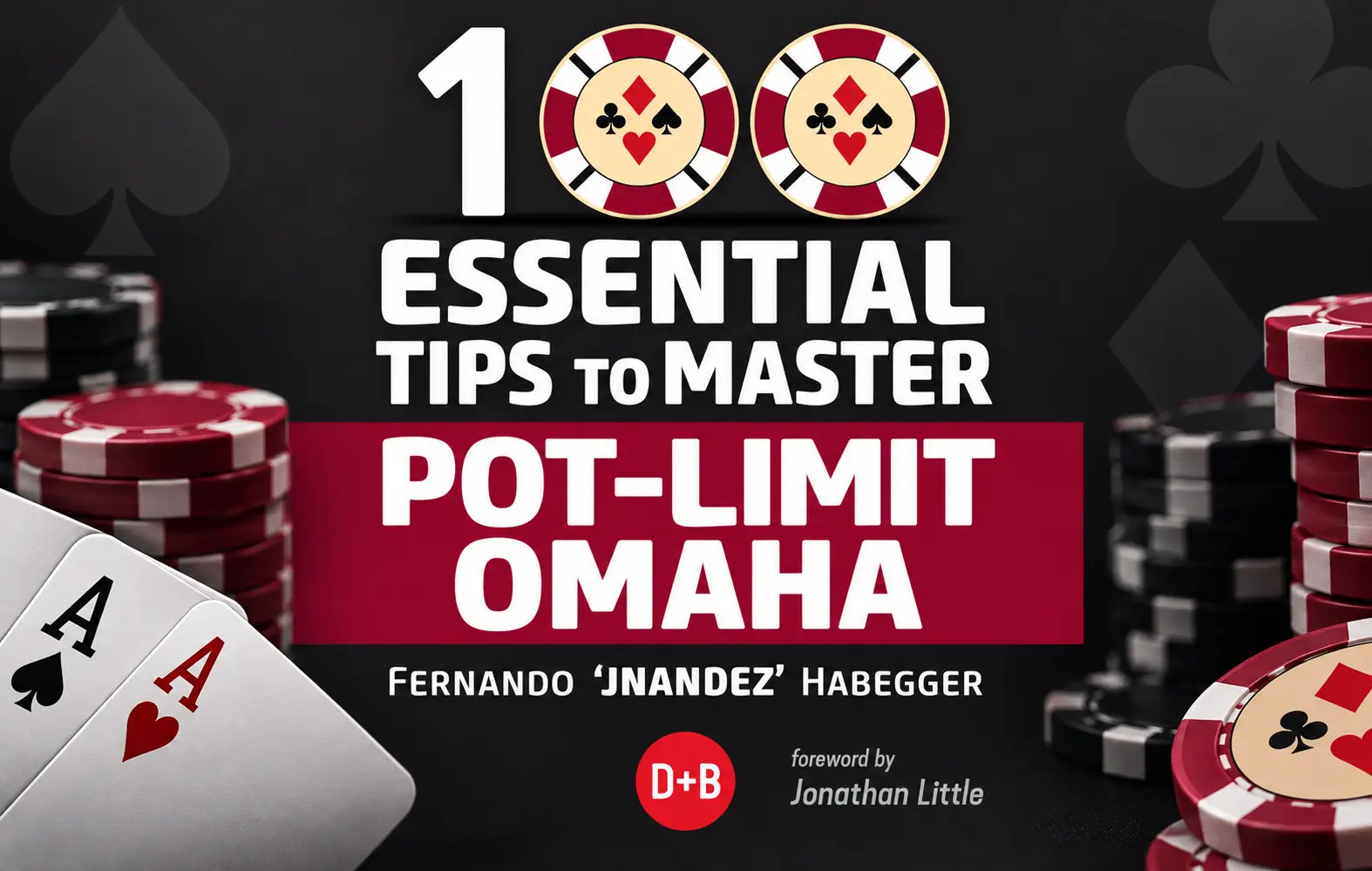
In October 2026, D&B Poker will release the ultimate guide for Omaha players and all those wishing to learn more about the game — 100 Essential Tips to Master Pot-Limit Omaha by renowned expert Fernando “JNandez” Habegger.
I was lucky enough to read it before its release and am now eager to share my impressions with you — and there are plenty of them.
A Few Little Bumps on the Road
Overall, Habegger’s new book is good. However, I want to start not with praise but with a few minor drawbacks that I think are important for everyone to know before buying this guide.
First of all, as you might have guessed from the title of my review, if you haven’t read any poker books of the “N Tips” format before, the title of this one will be misleading. The fact is that actual tips take up very little space; the book consists primarily of quiz-style exercises and accompanying explanatory lessons. Consequently, the tips serve more as a summary — a role that, in my opinion, is better handled by the Key Takeaways sections.
Ultimately, this book is a training guide rather than just a collection of tips, and that is an important point to consider when buying it.
Also, the book’s table of contents isn’t the most helpful. The 100 tips are organized into 10 chapters with titles like “Stack Size,” “Ranges,” and “Equity” and they do little to help locate specific tips. By comparison, a similarly titled book by Jonathan Little for Hold’em players lists all the featured tips with brief descriptions in the table of contents, which is far more convenient.
Secondly, Fernando’s book suffers from a problem common to works of this kind: the attempt to appeal to the widest possible audience while simultaneously remaining useful to those who already play poker and have some understanding of the specific game.
Consequently, despite the generally accessible language and narrative style, some sections still suffer from over-explanation of the basics, while others — such as the topic of solvers — may seem too complex for beginners to comfortably comprehend.
Thirdly, all the exercises follow the same format:
- Look at the spot and the accompanying question
- Consider and select an answer
- Then check the correct answer and the explanation
And this works perfectly for online quizzes — but not so well on paper. I read the book as a PDF on a tablet and would often accidentally scroll a bit too far, revealing the answer immediately — or I’d skip past it and get a little disoriented by the sudden appearance of the explanations. This certainly does not make the book or its content any worse, but it does make reading it slightly more difficult.
However, that’s all trivial — even taking those points into account, I recommend reading 100 Essential Tips to Master Pot-Limit Omaha, even if you primarily play Hold’em. Let me explain why.
Book That Makes It Impossible Not to Think
In an era where people are offloading not only their everyday tasks but their own cognitive functions to AI, JNandez’s book does something vital: it encourages you to think. And not just about the specific questions posed by the various exercises, but also — on a broader scale — about the game, the players, and the mathematical dynamics of the entire process.
This is aided by the fact that the book is written in a very accessible style, without constantly injecting the author’s opinions into the narrative. For the most part, the information is organized, phrased, and presented with great clarity — avoiding both unnecessary verbosity and the technical dryness typical to some poker players.
The book begins by making a clear point: PLO is worth your time and interest. And as someone who plays Omaha only very occasionally, I can say it’s right: as I worked my way through pages, I didn’t just want to play more Omaha — every three to five exercises, I was itching to finish reading and get to the table to test my newfound understanding.
I particularly liked how the book promises from the start to focus on small spots that collectively generate EV for players — and it doesn’t stray from that goal just to chase the “wow” factor of incredible hands or massive pots.
However, this book is certainly no walk in the park — while reading, I repeatedly found myself physically sensing my “little grey cells” being activated, and at times I even felt quite dumb — but that was okay, because the book doesn’t belittle or humiliate you for your lack of knowledge; instead, it encourages you to work through it methodically and with curiosity.
One such moment occurred when I realized how poorly I understood the nuances of playing double-paired and double-suited hands as the surrounding factors — such as table position, stack size, opponents’ actions and range, and so on — changed even slightly.
This is precisely the book’s strongest aspect — what makes it truly brilliant — namely, how effectively JNandez demonstrates the vast differences in playing the same hand or position under varying circumstances. This emphasis does more than just teach you the theory; it helps train you to view spots with flexibility, seeing them as dynamic and fluid rather than static situations.
Of course, reading this book didn’t instantly turn me from a complete novice into a master of the game — but it made me think about the game with greater attention, interest, and respect than before.
I also want you to avoid my personal mistake of trying to devour all 376 pages of 100 Essential Tips to Master Pot-Limit Omaha at once. This is the kind of book best read in small chunks, without feeling any shame about revisiting the same sections to fully grasp the material.
In my view, the essence of this book is succinctly expressed in a single passage, which I will take the liberty of quoting:
Every hand has an outcome, and the outcome is loud. Underneath the outcome is the real number, the expected value of the decision you made, and that number is usually quiet. The players who improve are the ones who learn to hear the quiet number through the loud one.
100 Essential Tips to Master Pot-Limit Omaha is already available for pre-order on the D&B Poker website — and in my opinion it is worth every penny.
PokerListings 





Log in to join the discussion
Share your thoughts and see what others have to say.