
 EN
EN  DE
DE Are Live Cash Games Underestimated by Online Grinders?

 PokerListings
-
 CoinPoker 150% up to $2000
18+ | Play Responsibly | T&C Apply
-
 Ignition Poker 150% up to $1,500
18+ | Play Responsibly | T&C Apply
-
 Stake.US Poker $55 Stake Cash + 260,000 GC
18+ | Play Responsibly | T&C Apply
-
 Americas Cardroom 100% up to $2000
18+ | Play Responsibly | T&C Apply
-
 Betonline Poker 100% Up to $1,000
18+ | Play Responsibly | T&C Apply

For a long time, online cash games have been the natural environment for many ambitious players. Faster, more accessible, much easier for building volume, and often supported by tools that allow players to analyze their game in detail, online cash has many obvious advantages for a grinder who wants to improve seriously. Live cash games, on the other hand, can sometimes appear far less modern. Fewer hands per hour, more time spent waiting, travel costs, and sometimes significant rake. Yet this comparison between the two formats only tells part of the story.
While online poker offers impressive efficiency when it comes to volume, live cash games can provide something particularly attractive: games where the skill gap between players can sometimes be much wider. And when the main objective is to make money, the speed at which you play is ultimately only one factor among many.
Online, Everything Is Built Around Volume
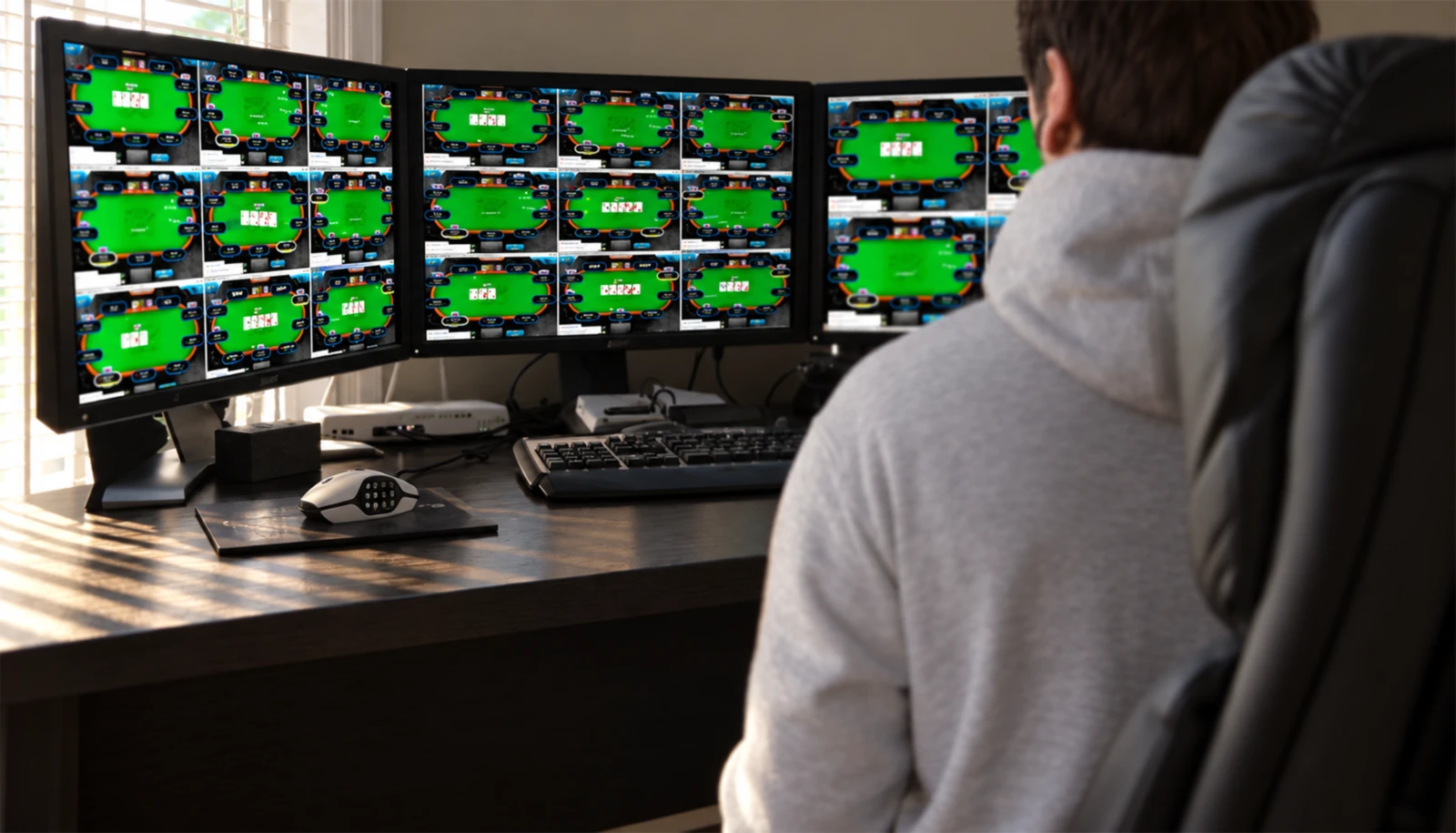
It is easy to understand why many grinders naturally prefer online poker. Within seconds, a player can open several tables, choose different stakes, and start playing immediately. Once the session is over, they usually have a complete hand history, precise statistics, and a large amount of data to analyze.
This structure also makes it possible to generate a huge amount of volume. While a live poker table will deal only a limited number of hands per hour, an online player can play several hundred over the same period, especially when multitabling. For someone looking to improve technically, that difference is considerable.
Ultimately, online poker offers an environment that is particularly well suited to working on your game. But that efficiency can sometimes lead to confusion between two very different ideas: playing a lot and winning a lot.
The Number of Hands Is Far From Everything
A player can put in huge volume without necessarily generating an exceptional hourly rate. Everything depends on their edge, the rake, and the average level of the games they play. This is exactly where live cash games can become interesting.
An online player, for example, may have only a small edge in a highly competitive game, and even if they play a huge number of hands, each decision ultimately earns relatively little on average. A live player, by contrast, may play only around thirty hands per hour while enjoying a much bigger advantage over several opponents at the table. Comparing raw volume then becomes far less relevant. It is also worth remembering that the stakes played live are generally higher than those played online.
Playing ten times as many hands is not necessarily more profitable if the edge per hand is much smaller. This is one reason why some online players may underestimate the potential of live cash games. They look first at the pace of play, when the real question should be: “How much does each hour spent playing actually earn?”
Live Fields Can Be Much Less Homogeneous

One of the main differences between live and online poker probably lies in the composition of the tables. Online, especially as the stakes increase, regular players often make up a large part of the field. Many work on their game with software, use databases, study GTO solutions, and sometimes play several hundred thousand hands every year. The average level can therefore become very high.
Live, it can be a very different story. The player profiles are usually far more varied. Around the same table, you may find a professional poker player, an experienced regular, an amateur who came to spend the evening, an occasional player who mainly enjoys the social aspect, and sometimes even someone playing simply because they happened to be visiting the casino.
Many recreational live players will play too many hands, size their bets poorly, defend too wide, underestimate position, or make decisions based more on emotion than on a genuinely structured strategy. For an experienced online grinder, this difference in skill level and approach can be particularly interesting.
A player who is used to facing competent opponents all day can suddenly find themselves in a game where certain mistakes they hardly ever see online appear several times per orbit.
The Pace of Live Poker Can Still Frustrate an Online Player
It would obviously be wrong to present live cash games as an ideal environment. The first issue with live poker is unquestionably the pace. Spending several hours at a table while playing relatively few hands can be extremely frustrating for someone used to multitabling. Periods without action can feel endless, especially when interesting hands are rare. This slower pace also reduces how quickly a player accumulates experience, and that is not insignificant.
A bad day online can involve several thousand hands. Live, building a truly meaningful sample can take an enormous amount of time. Variance therefore becomes particularly difficult to measure. A player can go through several very positive or negative weeks without being able to draw solid conclusions about their true win rate. This is probably one of the hardest aspects for an online grinder to accept.
Live Rake Can Also Be a Major Factor to Consider
Another point regularly raised by online grinders is rake. In some live poker games, the casino’s cut can represent a significant share of the pots. Depending on the structure, the stakes, and the conditions offered, that fee can seriously reduce the overall profitability of a game. On this point, criticism from online players is perfectly legitimate. A game full of weak players is not automatically great if the rake structure absorbs a huge share of the available edge.
That is exactly why a live player has to think about the bigger picture. Looking only at the level of the opponents is not enough. You also need to consider rake, travel costs, the time spent getting to the casino, possible meals, and all the other expenses linked to the session. None of that applies if you decide to play in your pajamas from your bedroom in front of your computer.
In the end, a game that initially looks very profitable can become much less attractive once all of these factors are taken into account.
The Real Comparison Should Be Based on Hourly Rate
Ultimately, comparing online and live poker only by the number of hands played does not make much sense. For a player mainly looking to generate income, the most relevant metric is probably hourly rate. Imagine an online grinder who can play several poker tables at the same time with a relatively low win rate. Their volume is huge, but their edge per hand is limited.
Meanwhile, a live player produces far fewer hands but plays in a much softer game. If their advantage over the other players is large enough, their hourly rate can easily be higher despite playing far less volume. This is what can make live cash games very attractive for certain profiles.
Unfortunately, poker does not pay you by the number of hands played. What really matters is the value you generate during the time devoted to the activity.
Live Poker Still Requires Different Skills

A very strong online player will not automatically become an excellent live player. The different pace, environment, social interactions, and length of sessions can require significant adjustment.
Live, you sometimes need to stay focused despite long periods without playing a hand. You also need to learn to observe opponents more closely, follow the action without the help of software, and remember certain important pieces of information. The social aspect can also play a much bigger role.
Creating a good atmosphere at the table, avoiding unnecessary conflicts, and making the experience enjoyable for recreational players can have real economic value. In some games, especially private ones, a player’s reputation and behavior can even directly influence their access to the best games. This type of skill is obviously not required in the same way online.
So, Are Live Cash Games Really Underestimated?
Probably by some players, yes. The low number of hands played, the slower pace, and the absence of certain tools can make live poker seem less efficient. But that analysis becomes incomplete as soon as you overlook the most important factor: the average level of the opponents.
A live grinder does not need to play hundreds of hands per hour to be profitable. They need to play in games where their edge is large enough to offset the rake, the costs, and the time involved.
Ultimately, the best professional player is probably not the one who plays the most hands or who insists on preferring one format over the other. It is the player who can identify where their skill has the most value. And for some online grinders, that answer may well be found around a casino table more often than they imagine.
PokerListings 








Log in to join the discussion
Share your thoughts and see what others have to say.