
 EN
 DE
How Does Kalshi Work: A Complete Guide to Trading Event Contracts

 PokerListings
-
18+ | Play Responsibly | T&C Apply
-
 Stake.US Sports $55 Stake Cash + 260K Gold Coins
18+ | Play Responsibly | T&C Apply


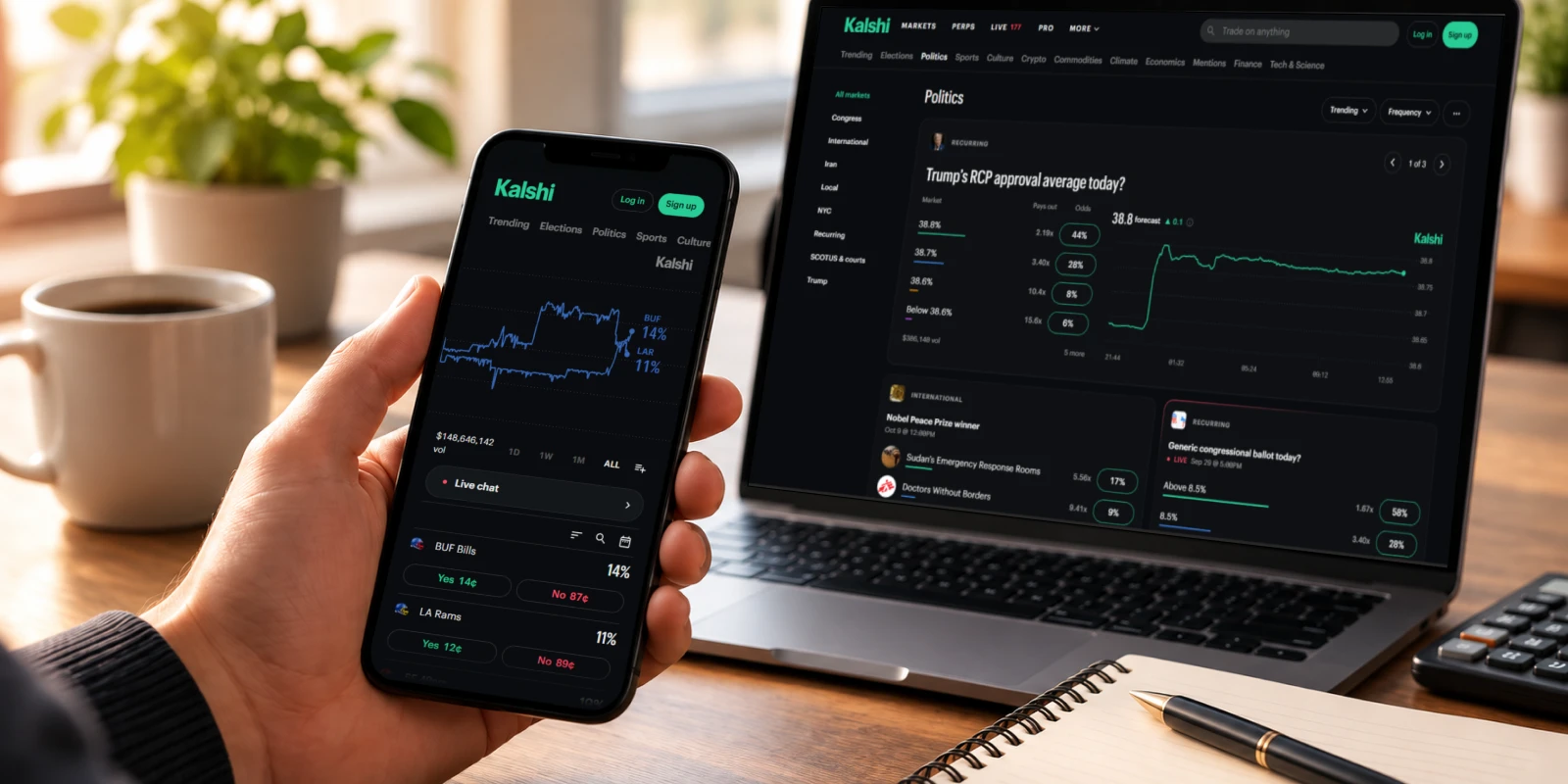
Kalshi is a CFTC-regulated exchange that lets traders buy and sell contracts based on real-world events. Unlike betting sites, Kalshi operates under direct oversight from the Commodity Futures Trading Commission. That oversight makes it a regulated prediction market rather than a gambling platform. Traders take positions on straightforward outcomes: whether inflation drops below 3%, whether a tax bill passes, or whether Chicago gets six inches of snow.
The exchange organizes these questions into event contracts spanning economics, politics, weather, sports, and culture. A Federal Reserve rate contract sits alongside election or weather markets on the same dashboard, and every position settles against a verifiable public source.
Before opening a position, keep these core operational facts in mind:
- Kalshi is registered with and regulated by the CFTC
- Trades happen on event contracts tied to real-world outcomes
- Contracts pay out $1 or $0 depending on the result
- Markets cover politics, economics, weather, sports, and culture
- Pricing reflects live trader sentiment, not a fixed house line
How Kalshi Works: The Mechanics of Event Contracts
Every event contract on Kalshi follows binary logic. You buy “Yes” or “No” on a specific outcome, and the contract resolves to $1 or $0 at expiration. The share price, ranging from 1 cent to 99 cents, reflects the market’s implied probability that the event occurs. A contract trading at 65 cents means the market sees a 65% chance of a “Yes” outcome.
Consider a contract asking whether the Fed will cut rates in March. If “Yes” shares trade at 30 cents, the market projects a 30% likelihood of a cut. Buying at that price requires 30 cents upfront. If the Fed cuts rates, the contract pays $1, returning a 70-cent profit per share. A “No” resolution pays nothing. Prices move constantly because live order flow sets the market, not a bookmaker setting line odds.
| Contract | Price | Implied Probability | Payout if Correct |
|---|---|---|---|
| Fed cuts rates in March | 30¢ | 30% | $1.00 |
| Candidate X wins election | 55¢ | 55% | $1.00 |
| City records snow > 6 inches | 12¢ | 12% | $1.00 |
Kalshi splits these instruments into event-driven markets, tied to single occurrences like Fed meetings, and outcome-driven markets, tied to broader metrics like monthly inflation data. Both formats share the same pricing and settlement rules.
Getting Started: Creating an Account and Placing a Trade
Signing up on Kalshi mirrors opening an account with Robinhood or Polymarket. The process links basic setup directly to trade execution.

Sign up using an email address and password via the web platform or mobile app.

Complete identity checks by submitting basic personal details and a government-issued ID.
Deposit funds via bank transfer (ACH), debit card, or supported payment rails.

Browse contract categories (economics, politics, weather, sports) and select a target outcome.
Choose a Market Order for immediate execution at the current best price, or a Limit Order to set a specific entry price.
Hold the contract to resolution, or sell early to capture profits and limit downside risk.
You don’t have to hold contracts until expiration. If you buy a “Yes” contract at 20 cents and breaking news pushes the price to 50 cents, selling early locks results in a 30-cent profit immediately. The same mechanism lets you cut losses if momentum shifts against your position.
The trading interface resembles a standard brokerage platform: a price chart sits at the top, an order book displaying live bids and asks sits to the side, and order controls sit front and center. Most traders handle everything through the mobile app.
Payouts, Settlement, and Pricing Explained
When an event contract settles, Kalshi pays $1 to the winning side and $0 to the losing side. Net profit equals the gap between your purchase price and that dollar payout. Buying a winning “Yes” contract at 40 cents yields a 60-cent profit; an incorrect forecast forfeits the 40-cent stake.
Settlement happens automatically once official results are posted. You don’t need to file a manual claim. New traders often notice that “Yes” and “No” prices don’t always total 100 cents. That gap is the bid-ask spread, created because Kalshi is a peer-to-peer exchange where traders deal with each other rather than a house counterparty. Institutional market makers quote both sides to keep trading fluid, though niche markets with lower volume can experience wider spreads that make fast exits trickier.
Order books record all live buy and sell requests across the market. Taking a market order fills your position against the best available price from another trader. Because prices react instantly to news, market makers receive incentives to post continuous liquidity, keeping spreads manageable for active accounts.
Is Kalshi Legal and Regulated?
Kalshi operates as a federally regulated exchange rather than an offshore betting site. The CFTC supervises its operations directly, and a 2024 federal court ruling confirmed Kalshi’s authority to offer election contracts after regulatory challenges. That decision established clear legal precedent across the country.
Several regulatory benchmarks define how the platform operates in the United States:
- Federal Oversight: Regulated directly by the CFTC as a Designated Contract Market
- National Availability: Legal and accessible to traders in most U.S. states, though availability in some states may be limited
- Segregated Funds: U.S. dollar balances are held under federal financial custody standards
- Judicial Precedent: U.S. Court of Appeals rulings upheld political and event contract listings
This structure provides traders with direct legal protections under US financial oversight, avoiding the regulatory ambiguity of offshore sportsbooks.
Peer-to-Peer Exchange Model vs. Traditional Sportsbooks
Sportsbooks set lines, take wagers, and collect a built-in fee called the vigorish. Kalshi runs an open exchange with no house taking the opposite side of your trade. Prices fluctuate strictly on order book demand from individual traders and liquidity providers.
| Operational Feature | Traditional Sportsbook | Kalshi Exchange |
|---|---|---|
| Pricing Source | House bookmaker sets proprietary odds | Central Limit Order Book matches market orders |
| House Margin (Vig) | Built-in margin added to every line | Zero house margin; transparent transaction fees |
| Trade Counterparty | The sportsbook itself | Other market participants and liquidity providers |
| Account Restrictions | Successful accounts risk betting limits or bans | Consistent profitability triggers no account restrictions |
| Market Scope | Restricted primarily to sports events | Economics, policy, weather, culture, and sports |
Traditional gamblers often rely on fixed lines and published sports betting picks created by bookmakers. Kalshi expands probability trading beyond athletic games into economic and political outcomes, where peer-to-peer pricing ensures profitable trading strategies will not trigger account limits or bans.
Kalshi vs. Crypto Prediction Markets
While crypto prediction platforms (such as Polymarket) list similar event contracts, their underlying infrastructure differs:
- Currency and Banking: Kalshi operates in U.S. dollars via standard bank transfers (ACH) and wire payments. Crypto platforms rely on stablecoins (such as USDC) and digital wallets.
- Regulatory Compliance: Kalshi is registered with the CFTC and enforces mandatory identity verification (KYC). Overseas crypto platforms operate on public blockchains outside federal U.S. jurisdiction.
- Market Access: Crypto platforms offer international market selection, while Kalshi provides direct legal protections under U.S. financial regulations.
Kalshi Fees: What It Costs to Trade
Kalshi charges small transaction fees on trades and winning settlements. Rather than a flat percentage, the fee is calculated using a formula tied to the contract’s price. This structure means fees are highest on contracts priced near 50 cents (even odds) and become progressively lower for long shots or heavy favorites. The exchange imposes no minimum deposit to register, though external payment processors may charge standard transaction fees.
Eligible cash balances of $250 or more currently earn roughly 3.25% interest, credited monthly. Unallocated funds sitting in an account or backing open orders generate yield instead of idling.
Pros and Cons of Using Kalshi
Evaluating the platform requires balancing its legal protections against its operational limits:
- CFTC Oversight: Fully regulated U.S. exchange providing deposit security and operational transparency
- Zero House Edge: Prices reflect peer-to-peer supply and demand without bookmaker vigorish
- Interest on Cash: Earn 3.25% APY on uninvested cash balances of $250 or more
- No Account Limits: Profitable traders face no account restrictions or betting bans
- Learning Curve: Order book mechanics require basic familiarity with limit orders and implied probabilities
- Niche Liquidity: Smaller, low-volume markets can experience wider bid-ask spreads
- Capital Lockup: Long-dated contract positions tie up funds until market resolution or early sale
- Lower Daily Volume: Total daily market listings are smaller than high-volume sportsbooks
Traders who prefer probability modeling over fixed sports betting odds will find the exchange a flexible alternative.
Frequently Asked Questions
What is Kalshi and how do event contracts work?
Kalshi is a CFTC-regulated U.S. exchange where traders buy and sell binary positions on real-world outcomes. Shares trade between 1 cent and 99 cents based on live market probability, settling at $1 for winning positions and $0 for losing ones.
Is Kalshi legal and regulated in the United States?
Yes. Kalshi is registered with the CFTC and operates as a Designated Contract Market. A 2024 federal court ruling upheld its election contracts, and the platform is available in all 50 states.
How do Kalshi contracts and pricing work?
Each contract price reflects implied probability set by real trader activity, not a bookmaker. A contract priced at 40 cents implies a 40% chance of “Yes.” Winning contracts settle at $1; losing ones settle at $0.
How does Kalshi differ from a traditional sportsbook?
Kalshi uses a peer-to-peer model with no house setting odds or profiting from a vig. Sportsbooks price bets to guarantee an edge and may restrict winning bettors, while Kalshi places no such limits on consistent traders.
How does Kalshi make money if there is no house edge?
Kalshi collects transaction fees on order execution. Because it matches buyers and sellers as an exchange, it does not take the opposite side of trades or profit from trader losses. Revenue stems entirely from trading volume fees across its markets.
PokerListings 




Log in to join the discussion
Share your thoughts and see what others have to say.