
 EN
EN  DE
DE How to Play Irish Poker: Traditional & Drinking Game Rules

 PokerListings
-
 CoinPoker 150% up to $2000
18+ | Play Responsibly | T&C Apply
-
 Americas Cardroom 100% up to $2000
18+ | Play Responsibly | T&C Apply
-
 Ignition Poker 150% up to $1,500
18+ | Play Responsibly | T&C Apply
-
 Black Chip Poker 100% Welcome Bonus
18+ | Play Responsibly | T&C Apply
-
 Stake.US Poker $55 Stake Cash + 260,000 GC
18+ | Play Responsibly | T&C Apply

Based on our experience, Irish Poker has recently become one of the most popular choices among poker enthusiasts due to its unique combination of Texas Hold’em and Omaha rules. But how exactly do you play Irish Poker? What variations of this game exist, and which strategies prove to be most effective? In this guide, we will answer all these questions in detail and help you master the game.
What is Irish Poker?
Irish poker is truly a mix of the rules of Texas Hold’em and Omaha Poker. Players start with four hole cards, as if playing Omaha, but must discard two cards after the flop. The remainder of the hand plays like a standard Texas Hold’em hand. Irish poker is popular live card game and online also, which is why there are Irish Poker tournaments almost every day.
Basic Irish Poker Rules
Pre-flop action in this game works just like in regular Omaha Poker. The player to the left of the dealer button places the small blind, and the next player to their left places the big blind. Each player is then dealt four cards, starting with the small blind. The betting starts with the player to the left of the big blind and moves around the table. If no one raises before the action reaches the big blind, the big blind can choose to check.
The flop is dealt just like in Omaha or Hold’em: three community cards are placed face up on the table. A new betting round begins, starting with the first active player to the left of the dealer button. Once all bets are placed, the remaining players must discard two of their four cards. After this, the game continues exactly like Texas Hold’em through the turn and river.
How to Play Irish Poker
Irish Poker begins with the dealer shuffling the deck and dealing four face-down cards to each player at a table of 2-10 participants. Before looking at their cards, blinds are placed (small and big blinds) by the two players to the dealer’s left, with the big blind typically set at double the small blind.
After the blinds, each player reviews their hand and the first betting round starts clockwise from the left of the dealer. Strategy here revolves around assessing the potential of your four cards for combinations like pairs, suited cards, or potential straights.
The dealer then places three community cards face-up, known as the flop. Players must discard two of their own four cards, narrowing their options for a strong hand. Betting and dealing continue through additional rounds until the final “river” card is dealt. The player with the strongest hand, using two private cards and three community cards, wins the pot.
Irish Poker Hand Rankings
Below, we have created a comprehensive table that ranks the possible hands in Irish Poker from strongest to weakest. Familiarising yourself with these rankings will help you make better decisions at the table, whether it’s time to raise your bet or fold your cards.
| COMBO NAME: | Description: | EXAMPLE OF HAND: |
|---|---|---|
|
1
Royal Flush |
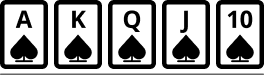
The highest possible hand, consisting of A, K, Q, J, and 10, all of the same suit. |
The highest possible hand, consisting of A, K, Q, J, and 10, all of the same suit. |
|
2
Straight Flush |
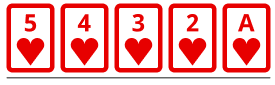
Five consecutive cards of the same suit, such as 5, 4, 3, 2, and A of hearts. |
Five consecutive cards of the same suit, such as 5, 4, 3, 2, and A of hearts. |
|
3
Four of a Kind |
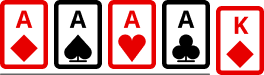
Four cards of the same rank, for example, four Aces. |
Four cards of the same rank, for example, four Aces. |
|
4
Full House |
A hand made up of three cards of one rank and two cards of another rank, like 3 Aces and 2 Kings. |
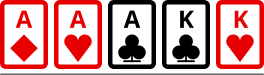
A hand made up of three cards of one rank and two cards of another rank, like 3 Aces and 2 Kings. |
|
5
Flush |
Any five cards of the same suit that aren’t in sequential order, such as A, K, Q, J, and 9 of clubs. |
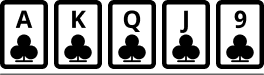
Any five cards of the same suit that aren’t in sequential order, such as A, K, Q, J, and 9 of clubs. |
|
6
Straight |
Five cards in sequential order, regardless of suit, such as A of clubs, K of hearts, Q of diamonds, J of spades, and 10 of hearts. |
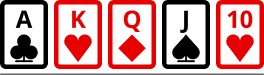
Five cards in sequential order, regardless of suit, such as A of clubs, K of hearts, Q of diamonds, J of spades, and 10 of hearts. |
|
7
Three of a Kind |
Three cards of the same rank, for instance, three Aces. |
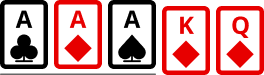
Three cards of the same rank, for instance, three Aces. |
|
8
Two Pair |
Two pairs of cards with matching ranks, such as 2 Aces and 2 Kings. |
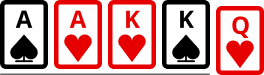
Two pairs of cards with matching ranks, such as 2 Aces and 2 Kings. |
|
9
One Pair |
Two cards of the same rank, like two Aces. |
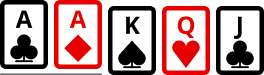
Two cards of the same rank, like two Aces. |
|
10
High Card |
The weakest hand, determined by the highest single card, with Ace being the strongest. |
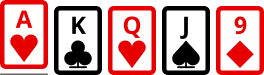
The weakest hand, determined by the highest single card, with Ace being the strongest. |
Example of an Irish Poker Table Game
To provide a clear understanding of how Irish Poker unfolds, we have modelled an example of a typical game table for you. This illustration highlights the dynamics and strategic decisions players face in each phase of the game, from the initial betting round to the final showdown.
At the beginning of the game, Player A receives A Q 10 8 , while Player B is dealt K K J 7 . Both players carefully evaluate their hands, with Player A noting the potential for straights and flushes, and Player B holding a strong pair of Kings. After placing initial bets, the community cards, known as the flop, are revealed as J 9 5 . The flop provides Player A with flush and straight possibilities, while Player B achieves a strong top pair and a possible straight draw.
During the discard phase, Player A decides to hold onto A Q for the flush potential, discarding the remaining cards, while Player B retains K K for the strong pair and the slim chance of a flush. The turn and river cards, 2 and 6 , solidify Player A’s flush, securing them the winning hand against Player B’s Kings. This example demonstrates the importance of evaluating odds and adapting strategies during Irish Poker’s unique discard phase.
What Should I Discard in Irish Poker?
Board texture and flop action are key when deciding your next move in Irish Poker. If you flop top pair but face strong resistance, it’s likely your opponent has a stronger hand, like a set or a nut draw.
Pay attention to the flop: are there draws on the board? If so, are you chasing the nuts, or do you have a top pair? In Irish Poker, top pair is often a weaker hand, especially when there are draws. It’s usually better to avoid sticking with the top pair if a draw is present.
If no draws connect on the flop, focus on your pairs and hold onto your best kicker. However, if a draw completes on the board, avoid chasing weak draws or low straight draws unless it’s very cheap or free to play. Chances are, someone started with a stronger pre-flop drawing hand.
While there aren’t many dedicated Irish Poker strategy guides, you can improve by learning from similar games. Check out resources like A Complete Beginner’s Guide to Omaha Hi-Lo Poker or PLO Top Strategy and Commandments to sharpen your skills and become a better player.
Playing the Irish Poker Drinking Game
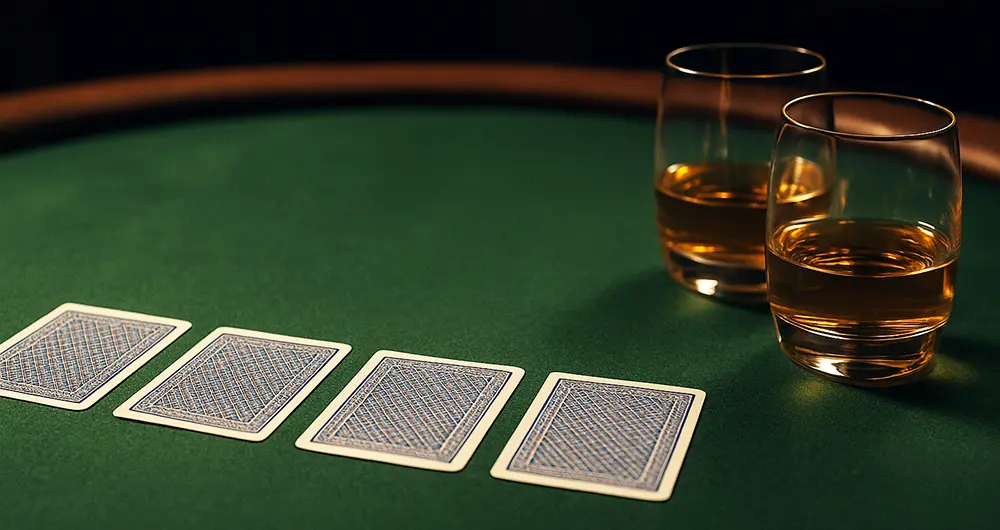
Our reservations about cultural stereotypes aside there is also a popular drinking game called Irish Poker which plays nothing like what you read above. The Irish Poker drinking game has a lot of similarities to Ride the Bus, another popular drinking game, but this online poker game has its own clear rules and variations.
Irish Poker Drinking Game Setup
Get up to 13 players ready and start by giving everyone 4 face-down cards.
Choose a dealer (it can be any player, and they can still join the game). The dealer hands out 4 cards to each player, placing them face down in a row. Make sure no one looks at their cards yet!
Each player should also have their drink of choice nearby—whether it’s beer, liquor, or a non-alcoholic option.
How to Play Irish Poker Drinking Game
Players take turns guessing the characteristics of the cards in front of them, with drinks being “given” or “taken” based on whether their guesses are correct or not.
Starting with the player to the left of the dealer, each person guesses about their face-down cards one by one. First, they guess the card’s color (red or black). If they’re correct, they “give” 2 drinks to other players. These drinks can be given all to one person or split among multiple players. If they’re wrong, they “take” 2 drinks themselves.
After everyone finishes the first round, the game moves to the second round where players now guess whether their next card is higher or lower than the first card. The cards, often placed in the center of the table, make it easy for everyone to keep track of the action. Drinks are increased in this round: now worth 4 drinks.
Each round introduces a new type of guess, such as whether the card falls between two others or guessing the card’s suit, and the value of drinks escalates with each round (6 drinks, then 8 in later rounds).
Play continues this way, with alternating guesses, giving or taking drinks, and increasing stakes, making it a fun and interactive game for everyone at the table.
Irish Poker Drinking Game – Final Round
After everyone has made their four guesses for their own cards, the game moves to the board, which has two rows of cards. The top row is called the “give” row, and the bottom row is the “take” row. The first card in the top row is flipped over, and if it matches one of your cards, you give out 2 drinks. If the second card is higher and matches one of your cards, you give out 4 drinks; the third card means giving out 6 drinks, and the fourth card means you give out 8 drinks. The bottom row works the same way, but instead of giving drinks, you take drinks if the card flipped matches one of yours.
For those who want a more intense version of the game, you can increase the drink values in the first round by using the card’s face value instead. For example, if a 2 is flipped, it counts as 2 drinks. Face cards (Jack, Queen, King) remain 10 drinks, and an Ace can be counted as 1 or 14, depending on your preference.
Best Strategies for Irish Poker
In Irish Poker, it’s best to think like an Omaha player before the flop. This means you should focus on starting hands that give you plenty of options to build a strong hand. Based on our experience, here are the types of hands you should aim for:
- Double Big Pairs: Hands like AAKK, KKQQ, or QQJJ give you strong pair combinations.
- Double Suited Cards: Look for hands like AH8H, KD10D, or QH9H to increase your chances of hitting a flush.
- Wraps: Hands like KQJT, QJT9, or J1098 give you multiple ways to make straights.
- High Pairs with Connectors: Hands like KKJT, QQ109, or KKJ9 combine strong pairs with potential straight possibilities.
If your four cards don’t work well together before the flop, it’s better to wait for a stronger hand.
Want to dive deeper into strong Omaha starting hands? Check out our guide: Pot-Limit Omaha: Best Starting Hands.
Tips for Winning at Irish Poker
Through extensive analysis of numerous poker strategies, we’ve compiled a list of invaluable tips to help you excel at Irish Poker. By following these suggestions, you’ll be well on your way to improving your gameplay and increasing your chances of winning:
Learn Texas Hold’em and Omaha hand rankings to guide your decisions during the discard phase.
Watch for patterns in your opponents’ play to gain a strategic advantage.
Be adaptable and ready to adjust your strategy as your hand evolves through the discard phase.
Sharpen your skills through practice—play online or organise casual games to become more confident.
Things You Should Know About Irish Poker
Irish poker is fun variant of the two most played poker games and there are many other poker variations out there. By learning all the poker rules of different poker forms you become better player, but can also start playing in the multi-game poker tournaments like H.O.R.S.E and 8-game. Winning the multi-game pokers is a true sign of a real poker master and that is why these are also present at the most entertaining live poker extravaganza. So, are you ready to play different poker styles? Check out our complete list of different poker rules.
Best Sites to Try Irish Poker Online
Now that you have familiarised yourself with all the nuances of Irish Poker, it’s time to put your knowledge into practice. We encourage you to explore the best sites where you can try your hand at this exciting game and enhance your skills further. Take the next step and experience the thrill of Irish Poker online!
Irish Poker FAQs
What is Irish Poker?
Irish Poker is a fun mix of Texas Hold’em and Omaha, perfect for players looking to try something new. It’s played with a standard 52-card deck and uses the same hand rankings as regular poker. The game starts with each player being dealt 4 hole cards. After the flop (the first three community cards), players must choose 2 of their hole cards to discard. Using the 2 remaining hole cards and the community cards, players aim to create the best hand possible.
What are the best starting hands in Irish Poker?
The best starting hands in Irish Poker are high pairs like AA, KK, or QQ. Suited hands are also strong choices. However, the flop can completely change the game, so the best hand is usually the one with the most potential combinations. To keep your options open, high cards with suited connectors are always a solid choice.
Where can I play Irish Poker online?
You can play Irish Poker online on the popular PokerStars website. PokerStars offers many different poker games, including Irish Poker. Whether you want to play for real money or just for fun, all you need is an active poker account to get started!
How many people can play Irish poker at the same time?
Irish Poker can be played by anywhere from 2 to 13 players at the same time. This range makes it a versatile game suitable for both small gatherings and larger groups.
What strategies work best in Irish Poker?
The key to playing Irish poker well is choosing the right cards and knowing your position at the table. For beginners, it’s best to start with four cards that work well together, like A-K-Q-J, as this increases your chances of making a strong hand after the flop. Also, try to play more hands when you’re in a late position (closer to the dealer) and fewer hands when you’re in an early position.
How does Irish Poker differ from Hold’em and Omaha?
Irish Poker differs from Hold’em and Omaha primarily in the number of hole cards and the decision-making process. Players start with four hole cards, similar to Omaha, but must discard two after the flop, creating a unique strategic element.
What are the best starting hands in Irish Poker?
The best starting hands in Irish Poker are high pocket pairs like Aces, Kings, and Queens, as well as strong suited connectors like Ace-King suited. These hands offer the best potential before the flop and flexibility after discarding two cards.
What is an Irish Poker drinking game?
The Irish Poker drinking game isn’t the same as traditional Irish Poker—they’re completely different. This game is perfect if you’re in the mood for some drinks and a bit of fun. Irish Poker is similar to the “Ride the Bus” game, where players guess card characteristics and either drink or make others drink based on the outcome.
How to determine who rides the bus in Irish poker?
In Irish Poker, the player who answers the most questions incorrectly or loses the most rounds during the question phase typically “rides the bus.” This final phase involves a challenging sequence of card guesses as a form of penalty.
 PokerListings




Log in to join the discussion
Share your thoughts and see what others have to say.
User Comments
Yoo