
How to Play 7 Card Stud

Before community-card games such as Hold’em and Omaha became popular the most widely played poker variation in the world was 7 Card Stud. Even now Stud is regarded as a more “pure” poker variation, as much for its historic past as for its increased difficulty of play. 7-Card Stud requires more attention and card-playing prowess, along the lines of Bridge or Gin, than a community-card game.
That’s not to say seven card stud is a “better” poker game than any other variation but it is a game worth knowing how to play – especially if you’re interested in playing 8-Game or any other mixed games. Every poker player should have the ability to play multiple variations of poker and 7-Card is one of the most popular and important.
Basic Play 7 Card Stud Gameplay
The game of 7 Card Stud can be played with 2-8 players at a table. The goal in Stud is the same as any other poker variation: win as many chips as you can, one pot at a time. Stud has a lot of little rules and a few quirks but it’s a simple game at its core. 7-Card Stud rules can be broken up into four sections:
- Setup
- The Bring
- Betting Rounds
- Showdown
If you’ve just read the Texas Hold’em Poker Rules article, you’ll notice that Stud has one more section. For players familiar to the rules and game play of a community-card game, the only completely new concept you’ll learn in this article will be “the bring.” Watch our introductory 7-Card Stud video below for a quick run through the basics of 7 Card Stud rules.
Watch and Learn How to Play 7 Card Stud
Key Skills for 7-Card Stud
- Strict hand selection
- Discipline to wait for good hands
- Ability to read opponents
- Memory of players’ up cards
Beginner players should learn to play seven card stud game in a solid, tight and aggressive style. Meaning balancing bluffs and semi-bluffs with mostly solid play and focusing on third-street play because this betting round is the most important. If you play correctly on third street you will face fewer difficult situations in subsequent betting rounds because the game quickly becomes very complex as it progresses.
As in all forms of poker there are exceptions to the rules and the concepts addressed in this article should be understood as general guidelines only. To be a truly successful player you must be able to make exceptions and use your judgment in order to determine the best possible play. It is virtually impossible to give clear-cut advice that applies to all situations.
The best general advice, as mentioned in this brief introduction to stud, is a line that you’re probably very familiar with.
“You only play premium hands. You only start with jacks or better split, nines or better wired, three high cards to a flush. If it’s good enough to call, you got to be in there raising, all right?”
– Mike McD from Rounders
Tips on How to Play Limit Seven Card Stud
- Be very selective with your starting hands: Nothing is more important than choosing the correct starting hand for a certain situation.
- Play the players: Assess quickly who plays inferior hands, who folds at aggression, who bets with draws, who calls bets with weak hands and long-shot draws, who can be bluffed, who bluffs.
- Fold or raise: You should avoid calling unless you have a good reason (like trapping an opponent).
- Remember the up cards: It is very important to know if the hands are “live” (none or few of the key cards are gone). The only way to get good at this is practice. The more hands you play, the stronger you will get.
- Raise with your strong draws: More valuable in Stud than in Hold’em, depending on which parts of your draw are “up” and which are in the hole, or “down”. If you’re on sixth street with a four-flush (meaning you have four cards to a suit, only needing one more to make a flush), and three of your suited cards are down, betting on the come is less likely to get a fold than if you have three suited up cards.
Common Mistakes in Limit Seven Card Stud
- Playing too many starting hands.
- Not paying attention to which cards are out.
- Not folding with modest holdings and weak draws.
- Not raising with premium holdings, thus letting too many drawing hands in.
- Drawing for cards that are likely to give you a second-best hand. For example, calling an opponent who raised showing three to a flush with a straight draw is likely to land you with a losing, second-best hand.
- Paying exclusive attention to your own game and not that of your opponents. How many players are in on fourth street? Did someone raise on third street? What types of players are left in the pot? These are all questions to consider during play.
- Not being aggressive enough on third street (taking initiative) and fourth and fifth streets (following through/protecting hand).
- Calling all the way to the river without proper pot odds.
- Calling too often, instead of raising, when you have the best hand.

Seven Card Stud vs Texas Hold’em
Here’s a list of difference between the two games, some of which are glaringly obvious:
- There are no community cards.
- An ante and a bring-in bet are used instead of blinds.
- There are five betting rounds as compared to four in Hold’em.
- The player who has the best starting hand starts the action on every betting round, except for the first round of betting, when the lowest up card begins.
- You must remember the folded up cards.
- The number of players is limited to a maximum of eight.
- There is no positional advantage before the cards are dealt. The cards determine who acts first and last on every betting round.
- There is no dealer button, as every hand is dealt in the same order starting at the dealer’s immediate left.

7-Card Stud – Game Setup
The first thing you need to do (if you’re playing 7 Card Stud for your home game) is get everyone at your table some chips. You’ll need a combination of chips that will allow for a big bet, small bet and an ante. The size of the bets will dictate how large your game will play. A big bet is typically twice the size of the small bet with the ante around 10% of the big bet. Here’s a chart of buy-ins and bets to give you some ideas.
Note: The buy-in amounts are the minimum amounts you would want to buy in for the stakes. If you want to be sure to have lots of chips, play with smaller stakes for the buy in – for example, use the bets for a $10 game and buy in for $20:
| Recommended Buy-in | Big Bet | Small Bet | Ante |
| $100+ | $4 | $2 | 50¢ |
| $20+ | $1 | 50¢ | 10¢ |
| $10+ | 50¢ | 25¢ | 5¢ |
Once you all have chips one player needs to grab the deck and shuffle up. It doesn’t matter who starts as the dealer in a Stud game.
Structure and Antes
- All players receive two cards dealt face down (hole cards) and one card dealt face up (up card). The cards are dealt one at a time.
- The player with the lowest up card has to make a bring-in bet.
- The betting continues clockwise with the player to the left of the bring-in bet.
- A fourth card is dealt face up. The action begins with the player holding the best up cards and continues clockwise.
- A fifth card is dealt face up. The action begins with the player holding the best up cards and continues clockwise.
- A sixth card is dealt face up. The action begins with the player holding the best up cards and continues clockwise.
- A seventh card is dealt face down. The action begins with the player holding the best up cards and continues clockwise.
- All remaining players make out the best possible five-card poker hand.
The following table shows the most common betting structure in 7 Card Stud:
| Limit | Ante | Bring | Opening Bet |
| $1-$2 | $0.25 | $0.50 | $1 |
| $2-$4 | $0.50 | $0.75 | $2 |
| $3-$6 | $0.75 | $1.25 | $3 |
| $4-$8 | $1 | $2 | $4 |
| $5-$10 | $1 | $2 | $5 |
| $6-$12 | $1 | $2 | $6 |
| $8-$16 | $2 | $3 | $8 |
| $10-$20 | $2 | $4 | $10 |
| $15-$30 | $3 | $6 | $15 |
| $20-$40 | $5 | $10 | $20 |
| $30-$60 | $5 | $15 | $30 |
| $50-$100 | $10 | $20 | $50 |
| $75-$150 | $25 | $50 | $75 |
| $100-$200 | $25 | $50 | $100 |
7-Card Stud Betting Rules and Dealing
In Limit Stud the betting limits are fixed at set amounts. The size of the game is determined by the bet size. For example, in a $4/$8 game the small bet is $4 and the big bet is $8.
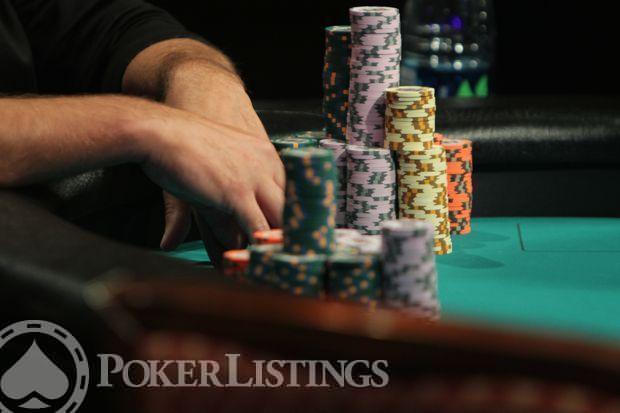
The ante is typically 10% of the big bet. A minimum “bring in” is equal to the ante.
Betting and raising is done in increments of the big or small bet (depending on what street the betting is taking place.)
For the first two betting rounds betting is done in increments of the small bet. So in our example a bet would be $4, and a raise would be an additional $4 making a total bet of $8.
In the last three betting rounds betting is done in increments of the big bet. A bet would be $8 while a raise would be to $16.
The limit betting structure puts a cap on the number of raises. In most venues there is a maximum of a bet and three raises although some rooms have a cap of four raises.
7-Card Stud: Ante and Bring
Once the cards are shuffled all players must ante. Antes are dead money, meaning they go immediately into the pot. Any bets you make will be in addition to the antes.
Starting with the player on the dealer’s left and moving around the table clockwise, the dealer deals every player two cards face down (all cards face down are known as “down” cards or hole cards), followed by one card face up (this card is known as the door card, or window card. All cards face up are collectively known as “up” cards or show cards).
In every form of poker there is some determining factor as to how and where the action starts in the hand. In Hold’em or Omaha the action starts to the left of the big blind; in Stud it starts with the bring.
The player with the lowest-value up card is the one required to “bring it in.”
Here’s what you need to discern the player for the bring:
- All cards are worth face value and face cards are valued from worst to best: Jack, Queen, King.
- Aces are high for the bring, which means they rank higher than a king.
- If two players have the same value low card, suits are used to determine the loser.
- Stud uses poker-suit ordering alphabetic from worst to best: clubs, diamonds, hearts, spades.
The player required to bring has two choices. They can either bring by making a bet equal to the size of the ante or they can complete the bet to the full amount of the small bet.
Stealing Antes in 7 Card Stud
A good way to increase your profits in 7 Card Stud is by stealing the antes. In a regular game you generally get enough pot odds to show a profit if your steal success is around 40%. However, your chances do not actually have to be that good because there are times when you will win the pot even though someone called you down.
An example of this would be catching a scare card (usually an ace or a king, or a card that might not help your true hand but connects your show cards, making a straight or a flush possible in your hand) on fourth street. Doing so enables you to win the pot by betting and representing a big hand. Oftentimes your opponent will fold a small pair on fourth street if you have been the aggressor and if you have higher board cards than his pair.
Another reason to steal the antes is because it adds deception to your overall game. If you only raise with legitimate raising hands, you will never get any action and thus will not win as much as you could. Anytime you are on a steal, it is important that you consider your opponents’ up cards. In general, consider stealing when you hold the highest or second-highest up card.
A good time to steal is when you have the second-highest up card and the highest up card has yet to act. This creates the illusion that you have a legitimate hand since you raised into a higher card. When trying this move you must always consider what type of player is holding the highest up card. If that player is a good, aggressive player, be more cautious about stealing.
Occasionally, if you suspect another player might be stealing, you should attempt to resteal. A good time to do this is when you hold a bigger up-card than your opponent and your hand has some additional value, like a three-straight or a flush. Since you were planning to call regardless, you may as well try for a reraise if it seems likely that your opponent is on a steal.
If you are playing in a tight game, you can steal when you are sitting up front holding an ace or king as your up card. This is usually a mistake in a loose game because the chance for a successful steal is much smaller. In general, you should not try to steal when your up card is duplicated in any of your opponents’ hands. Your opponents will know you are less likely to hold the hand you are trying to represent and that you will most likely not improve to that hand if you get played with.

7 Card Stud – Best Starting Hands
It is very important to look around and see whether or not your hand is live. Most weak pairs, straight draws, flush draws, etc., are playable when your cards are completely live. For example, you start with ( 10 9 ) 8 . This hand is much stronger if all sevens are live, as compared to two of them being out. If all sevens and a jack are out, your hand is almost dead.
The only exception to this concept is when you hold a pair of aces or kings (when no ace is showing), which can be played in most situations even if the hand is almost completely dead.
In order to make it easier when deciding what to look for in your starting hand, here’s a list of the best starting hands.
- Three of a kind (also called rolled-up trips). Starting with (A-A) A and on down.
- The big pairs AA-JJ. The hand is stronger when the pair is hidden, thus making the hand more deceptive to play against. Also, your kicker is important; a (J-J) A is stronger than a (J-J) 2.
- The big suited connectors, such as (A♠ K♠) Q♠, (K♠ Q♠) J♠ or (J♠ T♠) Q♠.
- The medium pairs TT-88 and medium suited connectors, such as (J♠ T♠) 9♠, (T♠ 9♠) 8♠ and (9♠ 8♠) 7♠.
- The big suited semi-connectors, such as (A♠ Q♠) J♠, (K♠ J♠) T♠ or (A♠ K♠) T♠.
Mike McD, in the much-quoted Rounders line, talks about having “nines or better wired, jacks or better split.” This means having pocket nines or better for your two down cards, and pairs of jacks or better with one of them your show card. He also mentions “three high cards to a flush.” All the aforementioned hands are valuable Stud holdings if played properly. This is a very tight system for starting hands. If you find yourself playing too many hands, it’s a great default to revert to.
Playing Rolled-Up Trips
On average, you will be dealt rolled-up trips once in every 425 times. This is the strongest holding you can start with, though it does not necessarily mean you should always slow-play the hand. In a loose game, where lots of players give action with a wide variety of hands, slow-playing is almost always incorrect. A good time to slow-play the hand is when you do not want to give your hand away.
For example, a king raises and then an ace re-raises. If you then re-raise with something like rolled-up deuces you announce to the table what your holding is. In this case it is better to just smooth-call and reveal your true strength in later betting rounds.
An exception would be if you have been making many advertising plays or have frequently re-raised with hands like three-flushes. In these cases, your hand can be played fast from third street onward. When slow-playing your trips, it is usually best to wait until fifth or sixth street before putting in your first raise. Such a decision should be based on what your opponents’ likely holdings are, how many players are in the pot and how big the pot is.
Playing Big Pairs
The big pairs are AA-JJ. These hands should almost always be played. The only times to fold them are when you are fairly certain that you are up against a bigger pair, or when your cards are dead (both of the other cards are already out).
A pair of jacks can also be folded when you have a bad kicker to your pair and there are many big cards left to act behind you. Another occasion when it is correct to muck your big pair is when the pot has been raised and re-raised by players with bigger up cards than your pair.
For example, you hold a pair of jacks and a king raises only to be re-raised by an ace before it is your turn to act. Remember that a two-flush and/or a two-straight to go with your pair give additional value to the hand.
Before folding your big pairs, always consider the action and the opponents giving the action. If one of your opponents pairs their door card, and you don’t have a four-flush or a four-straight, it is usually correct to fold your big pair.
Playing Small and Medium Pairs
When deciding whether or not to play the medium pairs, always consider the following factors (the first two are the most important):
- If you are not in a steal position make sure all your cards are live before you decide to play.
- Do you have a strong kicker?
- What are the other up cards?
- Is the game tight or loose?
- Your hand is stronger when your pair is concealed.
- Holding a two-flush and/or two-straight gives your pair additional value.
You should generally fold your medium pairs in raised pots, unless you have a bigger kicker than the pair the raiser is representing. When you hold a medium pair and there are no up cards higher than your pair on the board, you should almost always raise with them. If you have a strong kicker to your pair, it holds certain advantages.
For example, it allows you to represent a higher pair than what you hold and it increases your chances of ending up with the best two-pair. If the pot is raised and you have a strong kicker, you should call. If the pot has been raised and re-raised, you should generally fold no matter what additional value you hold.
Playing Three-Flushes
The way you play three-flushes very much depends on four factors:
- How high are your cards?
- How many of your cards are live?
- What is your up card?
- What is your position?
These factors greatly affect the way this type of hand should be played. Some three-flushes play better heads-up and some play better in multi-way pots. If all your flush cards are live but none of your pair cards are, then the hand will be played better in multi-way pots.
This is because you will most likely need to hit your flush in order to win the pot. This will not happen as often as winning by pairing, so you want to ensure the pot is big enough for those times you hit your flush.
Remember, if all your flush cards are live the hand is almost always playable. If you have high up cards, you should almost always raise when you are first in. This strategy also works well with the ante-stealing strategy, as it adds deception to your play.
Playing Three-Straights
Three-straights are generally not as powerful as three-flushes. Nonetheless, they can still be profitable hands. You must consider the following factors when deciding whether or not to play three-straights:
- How high are your cards?
- How many of your cards are live?
- What is your up card?
- Do you also have a two-flush?
- What are the other cards on the board?
- Who and how many players are already involved in the pot?
- How much will it cost you to play?
- How well do your opponents play?
Obviously, the more factors working in your favor, the more advisable it is to play the hand.
When the pot has been raised and re-raised, only play three-straights if your cards are live, if you have high cards and/or a two-flush. When you hold smaller unsuited three-straights, such as (7♣8♦) 9♥, the most important factor to consider is how live the sixes and tens are.
In general, do not play gut-shot three-straights unless you have high cards and/or a two-flush, and your gap card is live. For example, a hand like (Q♠J♣) 9♦ can be played if no tens are out and it appears that you could win the pot if you paired one of your hole cards.
Betting Round One (Third Street)
The player to the left of the bring is next to act. That player has three options:
- Fold: They pay nothing to the pot and throw away their hand, waiting for the next deal to play again.
- Call: They match the amount of the bring.
- Raise: If the first player made a minimum bring (only brought the amount of the ante) a raise will be completing the bet to the amount of the small bet limit. If the first player completed their bring to the full small bet a raise would be doubling the small bet amount.
For example in a $20 game:
Minimum Bring
- Player 1 brings 10¢
- Player 2 can call 10¢ or complete to 50¢.
Maximum Bring (Completion)
- Player 1 brings (completes) 50¢
- Player 2 can call 50¢ or raise to $1
Play moves clockwise around the table one player at a time. A betting round ends when two conditions are met:
- All players have had a chance to act.
- All players who haven’t folded have bet the same amount of money for the round.
Strategy Advice for 3rd Street in 7 Card Stud
The most important decisions in Seven-Card Stud are made on third street. You must be able to decide whether or not to play a hand and how to play it. Some hands play better in multiway pots and some in short-handed pots. The hands that play well in multiway pots are drawing hands, like three-flushes, three-straights and combinations of the two. The hands that play well in short-handed pots are big pairs.
One of the most valuable skills in 7-Card Stud is the ability to be very selective about the hands you begin with. The problem with playing too many starting hands is that these mistakes are usually compounded in later betting rounds. For instance, you might start with nothing and end up drawing to something with a hand you should not have been involved with in the first place. Mistakes like this can prove very costly in the long run. There are a number of issues that should be taken into account when deciding which hands to play.
They are as follows:
- Which cards are out?
- How many players are in the pot when it is your turn to act?
- Is the table tight or loose?
- How many players are sitting at the table?
- Has the pot been raised? If so, from what player and position?
- What is your position in relation to the raiser (if any)?
The most important factors to consider are what cards are out and how many players are in the pot. The combination of these two may sometimes make it correct to throw away the best hand on third street. For example, in a multiway pot where you hold (J-J)7 and both of the other jacks and one seven are out, you should fold, even though no one has represented a bigger pair or has bigger up cards than a jack.
The chances of you still holding the best hand when all the cards are out are simply too small to justify calling or raising. You can play this hand when you are in an ante-steal position (it is already short-handed), or in a multiway pot when all your cards are live. And, while it is imperative that you remember which cards are out on third street, you must not stop there, as it’s also crucial that you watch the other cards as they are turned up.
Betting Round Two (Fourth Street)
Once the first betting round has completed the dealer deals every player (always starting at the first live player to his or her left and moving clockwise around the table) one card face up, next to the first face-up card. In this betting round (and every betting round to follow) the first player to act is decided by the value of the show cards. The player with the highest value show cards acts first.
The value of show cards are ranked in the same order as poker hands.
On fourth street, with only two cards showing, the best possible hand would be two aces showing A A to be exact. The worst possible hand would be 2 3 . Any pair is better than any two non-paired cards; for example 2 2 is better than A K .
Suit ranks are used in the event of a tie for the highest-ranked show cards. When evaluating rank by suit the value of the hand is determined by the suit of the highest-ranking card.
Example 1:
Player 1:
A A
K
A
K
 K
K
Player 2:
A A
K
K
A
K
K
Player 1 has the better hand since the Ace of spades is of higher rank than the Ace of hearts.
Example 2:
Player 1:
3
3
3
3
Player 2:
3
3
3
 3
3
Player 1 wins, since they have the Three of Spades, which is a higher ranked card than Player 2’s Three of Hearts.
Once you have discerned the highest hand, that person acts first. They have the option to check (wager no money, and move the action to the player on their left) or bet the small betting limit.
The action moves from that player clockwise around the table one player at a time. Each player has the option to:
- Check (if no bet has been made).
- Call (match any bet made).
- Bet/Raise (If no bet is made, they can bet the small limit; if a bet has been made they can raise it by adding an additional amount to the bet, equal to the small limit).
- fold (throw away their hand).
Once every player has acted, and every player that has not folded has put the same amount of money into the pot, the betting round ends.
Betting Round Three (Fifth Street)
At the completion of fourth street, the dealer deals every remaining player another card face up, starting with the first live player to his or her left, moving clockwise around the table. Once all the cards have been dealt, the betting round starts the same way fourth street started. The player with the best show cards bets first. Three of a kind is the best combination, followed by a pair, followed by the highest cards. In this betting round, players bet using the big betting limit. Other than the size of the bets, this betting round is identical to fourth street.
Betting Round Four (Sixth Street)
Sixth street is identical to fifth street. Every player is dealt one card face up, and the highest valued show cards bets first. On sixth street, with four show cards for each player, the best possible show card value is four of a kind. Sixth street betting uses the big betting limit.
The Final Betting Round (Seventh Street)
When the sixth street betting round is complete, the dealer deals one final card FACE DOWN to every player. Again, the dealer starts at the first player with cards to their left, and moves on clockwise around the table. The player with the highest-ranked show cards in the previous betting round is the first to act in this betting round as well. The final card having been dealt face down does not affect the value of the four show cards. The final betting round uses the big betting limit.
Showdown
Once the final betting round has been completed, the players still in the hand enter into the showdown. In the showdown, each player makes the best five card hand possible out of their own seven cards. The remaining two cards are “dead” and have no value towards the hand at all. They are never used to evaluate the strength of a hand.
Seven-Card Stud Hand Odds
| Hand A | Hand B | Dead Cards | Win Percentage |
| ( A A ) 7 | ( Q Q ) 7 | None | Hand A wins 66.6% |
| ( A A ) 7 | ( Q Q ) 7 | None | Hand A wins 63.9% |
| ( A A ) 6 | ( 9 9 ) J | None | Hand A wins 61.4% |
| ( K K ) 8 | ( Q Q ) A | None | Hand A wins 55.8% |
| ( A A ) 7 | ( J 6 ) 2 | 5 Q | Hand A wins 72.7% |
The Effects of Dead Cards
Below are a number of tables displaying how your chances of making a certain hand change depending on the number of dead cards.
| Hand: Three-Flush | Chances of a Flush (%) |
| 0 Dead Cards | 23.6% |
| 1 Dead Cards | 19.6% |
| 2 Dead Cards | 15.8% |
| 3 Dead Cards | 12.3% |
| 4 Dead Cards | 9.1% |
| Hand: ( 5 5 ) A | Chances of Aces Up or Trips (%) |
| Number of aces and fives out: 0 | 41.0% |
| Number of aces and fives out: 1 | 34.1% |
| Number of aces and fives out: 2 | 26.5% |
| Number of aces and fives out: 3 | 18.3% |
| Number of aces and fives out: 4 | 10.5% |
| Hand: ( 6 7 ) 8 9 | Chances of a straight (%) |
| Number of fives and tens out: 0 | 49.8% |
| Number of fives and tens out: 1 | 44.8% |
| Number of fives and tens out: 2 | 39.4% |
| Number of fives and tens out: 3 | 33.8% |
| Number of fives and tens out: 4 | 27.8% |
Stud is one of the oldest forms of poker and still a favorite game to many. Next time you’re spreading a poker home game, add some stud into your rotation; you’ll be glad you did!
7-Card Stud – Which Hand Wins
Here are the rules for evaluating a winning hand in 7 Card Stud:
- The poker hand ranking order can be found here. (there will be another link at the bottom of this page) There are no exceptions to this ordering, a flush always beats a straight, and three of a kind always beats two pair.
- There are no other hands used in Stud than the hands listed in this chart. For example, having three pairs is actually only “two pair” with the highest valued two pairs making your hand.
- Poker hands must be exactly five cards and only those five cards are used to evaluate the winning hand. For example:
If the player holds:
2
2
J
J
Q
Q
K
K
A
A
10
10
9
9
The player’s best hand is a straight:
10
10
J
J
Q
Q
K
K
A
A
- If all remaining players have nothing, no pair or anything stronger, the winning hand is the hand with the highest valued single card. meaning:
#1:
A
A
3
3
4
4
6
6
7
7
Hand #1 with A high is a better hand than K high.
#2:
K
K
Q
Q
J
J
9
9
8
8
#1:
A
A
J
J
9
9
8
8
6
6
#1 Is better because of 5th card – 6 > 2
#2:
A
A
J
J
9
9
8
8
2
2
- Suits are never used to evaluate the strength of a hand. If two players have the exact same hand (disregarding the suits of the cards), the pot is split between the players.
Once you have discerned the winning hand, that player is awarded the pot. After the pot has been shipped, all players ante and are dealt their next hand. Unless you have a professional dealer, typically the role of dealer will rotate around the table, although it is not necessary for Stud.
Having one player as the dealer for the entire duration of the game will give no player an advantage or disadvantage during the game.
Stud Eight-or-Better (Stud Hi-Lo)
Also known as Stud EB and Stud Hi-Lo, Stud Eights-or-Better plays the same as Stud. Everyone antes, the low card brings and you get three cards off the deal.
The difference in Stud EB is the same as between Omaha and O8, where the qualifying low hand wins half the pot.
As in O8 the low is made up of the lowest five-card hand, all cards being below eight in value, with no pairs. Straights and flushes do not count against you, making the nut low A-2-3-4-5.
Stud Hi-Lo Starting Hands
Starting hands for Stud EB are the same as both Stud and Razz. A monster Stud starting hand can be good for the high, while a monster Razz starting hand is good for the low. The best are hands with the option for scooping, making A 3 2 the best possible Stud EB starting hand.
7 Card Stud Hi-Lo Showdown Rules
The High
The high hand in a 7 Card Stud Hi-Lo game is identical to the winning hand of a standard 7 Card Stud game. Half the pot is awarded to the player who holds this hand.
The Low
Low hands must qualify to be eligible for winning the low half of the pot.
- The cards a player uses for her best high hand have no effect on the low. A player can use any five cards from her hand, regardless of the cards used in her high hand.
- A qualifying low hand is defined as: five unpaired cards, all with ranks at or below eight.
- Aces are considered low for the low hand.
- Flushes and straights do not count for the low, meaning the best low possible is A-2-3-4-5.
- Low hands are counted from the top down, meaning the hand is only as good as its highest card. For example:
#1:
2
2
3
3
5
5
6
6
7
7
Hand #1 is lower than #2 because of 5th card 7 < 8
#2:
A
A
2
2
3
3
4
4
8
8
- Any hand with a pair, or a card higher than eight, does not qualify, even if the rank of the pair is below eight.
- Suits do not count toward a low; any players sharing the exact same low must equally split the low half of the pot. (Winning half of the low pot and nothing from the high pot is known as being quartered.)
Example:
#1:
A
A
2
2
K
K
K
K
3
3
4
4
5
5
#2:
A
A
3
3
Q
Q
Q
Q
Q
Q
3
3
High Winner: Hand #2 wins with a full house, queens over threes: Q Q Q 3 3 .
Low Winner: Hand #1 wins with a five-four low: 5 4 3 2 A (Hand #2 doesn’t have a qualifying low).
General Rules
- If there is an extra odd chip that cannot be split in half, this chip is always added to the pot awarded to the winning high hand.
- If there is no qualifying low hand the entire pot is awarded to player with the winning high hand.
- Players can win one or both halves of the pot with the same or different cards from their hand.
- A player does not have to announce what half of the pot they’re playing for at the beginning of the hand. This is only required in other variations of poker, known as “declare” games.
Basic 7-Card Stud Hi-Lo Strategy
In Omaha 8 or Better you always want to be playing for the high with a redraw to the low.
Stud Hi-Lo is the opposite: You want to play for the low with a redraw to the high. It’s easy to get quartered for half the low pot by playing exclusively low.
In Stud EB it’s much easier to discern if you have the winning low than the high. You use the same technique as you would in Razz, and read the other players’ board cards.
Also, the low card is forced to bring in Stud. If you’re dealt three to a bike you have the chance to complete, adding money to the pot with well on the way to half the pot.
You have to correctly gauge your own hand and pit it against your opponents’ hands. Who’s chasing what? Who’s on the high and who’s on the low? Whom can you beat?
You want to play the low and hopefully pick up a high along the way. The beauty of hitting the wheel is it can be good for both the high and the low if no one can beat the baby straight.
Spread-Limit 7-Card Stud
Another popular betting structure, known as Spread-Limit, is typically exclusive to Stud (occasionally players will play other games as Spread-Limit, but it’s extremely rare).
This betting structure is the rarest and as such the least standardized of all Stud structures. The rules you will encounter in one room may change to the next. Even with the variation in specific rules, the standard concepts stay the same:
- There is a set minimum bet and a set maximum bet.
- All bets made on any street must be at or between the limits.
- For example, in a $1 to $5 Spread-Limit game, a player can bet as little as $1 or as much as $5 at any time.
- In a variation of Spread-Limit, the limit doubles on the later streets. For example “$1 to $5 with a $10 on the end” would allow bets from $1 to $10 on the later betting streets.
- A minimum raise is double the previous bet.
- A maximum raise is raising by the top end of the spread limit. For example:
- If a player bets $2 in our $1 to $5 game, a minimum raise would be a bet of $4, a maximum raise would be a bet of $7.
- If a player bets $5 the only allowable raise would be raising by $5 for a total bet of $10.
- Typically there is a cap on raises, just as in a Limit game. The number of allowable raises changes depending on the house rules, but most often you’re allowed one bet and three raises.
- Many low-limit Spread-Limit games have no ante, but the ones that do have one typically set it around 25% of the minimum bet.
- The minimum bring is equal to the ante (or in some places without an ante, the minimum bring is equal to the bottom end of the spread).
- A player wishing to complete the bring can bet any amount within the spread.
Pot-Limit Stud
For high-limit Stud players looking for lots of action Pot-Limit is the only way to go. Because there are five betting rounds in Stud as compared to four in Hold’em or Omaha, a Pot-Limit Stud game can play much larger than a Pot-Limit game of another form.
The size of the game depends on the size of the buy-in and ante amount. Typically the ante is around 1/200th of the buy-in, making a $1 ante for a $200 buy-in game. The bring minimum is equal to the size of the ante.
How you determine the maximum bet is by counting all the money in the pot and all the bets on the table, including any call you would make before raising. (It sounds more complicated than it really is). Two examples for you:
You’re first to act on third street (you need to bring) with a pot of $5. You have the option to bet as little as the amount of the ante ($1) or as much as the pot ($5). Any bet in between is a “legal bet.”
You’re second to act on fourth street. With a pot of $15, the first player bets $10. You now have the option to fold, call ($10) or raise.
Your minimum raise is equal to the amount of the previous bet. In this hand your minimum raise is $10 ($10 + $10 for a total bet of $20).
Your maximum raise is the amount of the pot. To do this, add up the pot + the bet + your call ($15 + $10 + $10 = $35). You are allowed to bet that total amount in addition to your call, meaning your total bet is $45 ($10 for the call + $35 for the size of the pot).
You can raise any amount in between the minimum and the maximum raise amount.
More 7-Card Stud Rules
Fourth Street Open Pair: If a player pairs up their door card on fourth street (giving them a pair as the winning high hand for fourth street), the player has the option of checking, betting the small limit or betting the big limit.
If the player chooses to check, the next player to act inherits the same options (meaning they can check, or bet either the small or big limit).
If a player chooses to bet the larger betting limit, all bets and raises in that betting round must be in the big betting limit unit. For example in a $10-$20 limit game, if a player is dealt a pair on fourth street, they can bet $10 or $20.
If they choose to bet $20, the next player must fold, call $20 or raise to $40.
Capping the Bet: In any one betting round while there are three or more players still in the hand, there can only be one bet and three raises. Once the third raise has been made, the betting is “capped,” meaning all future action in that betting round is restricted to calling or folding.
Running Out of Cards: If you are playing with eight people it’s not possible for every player to be dealt a full 7 cards since there are only 52 cards in the deck.
If you ever get to the point where all eight players are in the hand until seventh street, instead of dealing every player one card you must deal a single card face up in the middle of the table.
This card is used as a community card (like in Hold’em or Omaha). Every player shares that card as the seventh card of their hand.
Related Articles
- Poker Hand Ranking PDF
- Best 7-Card Stud Poker Sites
- How to Play Razz Poker | Razz Poker Rules
- See More Online Poker Sites
7 Card Stud Poker FAQs
WHAT IS 7 CARD STUD POKER?
The game of 7 Card Stud is a poker game that can be played with 2-8 players at a table. The goal in Stud is the same as any other poker variation: win as many chips as you can, one pot at a time. Stud has a lot of little rules and a few quirks but it’s a simple game at its core.
WHAT ARE THE DIFFERENCES BETWEEN HOLD’EM AND 7 CARD STUD POKER?
There are no community cards and there are five betting round (four in hold’em). An ante and a bring-in bet are used instead of blinds. The player who has the best starting hand starts the action on every betting round, except for the first round of betting, when the lowest up card begins. There is no positional advantage before the cards are dealt. The cards determine who acts first and last on every betting round. There is no dealer button, as every hand is dealt in the same order starting at the dealer’s immediate left.
HOW TO PLAY 7 CARD STUD POKER?
Beginner players should learn to play seven card stud game in a solid, tight and aggressive style. Meaning balancing bluffs and semi-bluffs with mostly solid play and focusing on third-street play because this betting round is the most important. If you play correctly on third street you will face fewer difficult situations in subsequent betting rounds because the game quickly becomes very complex as it progresses.
WHERE TO PLAY 7 CARD STUD POKER ONLINE?
You are able to play 7 Card Stud Poker online at the poker sites featured on this page. Including: Partypoker, PokerStars, Bet365 Poker and Betfair Poker. Access through the links on this page for an exclusive sign up bonus.
WHAT ARE THE HAND RANKINGS FOR 7 CARD STUD POKER?
The poker hand ranking is the same as usual hold’dem hand ranking. There are no exceptions to this ordering, a flush always beats a straight, and three of a kind always beats two pair. Poker hands must be exactly five cards and only those five cards are used to evaluate the winning hand (the remaining two “dead” cards have no value towards the hand at all.

-
- Rakeback 5%
- $55 Stake Cash + 260K Gold Coins
T&Cs Apply | Play Responsibly | GambleAware
18+ | Play Responsibly | T&C Apply
-
- 1,000 Chips Daily
- FREE 5,000 Chips
T&Cs Apply | Play Responsibly | GambleAware
T&Cs Apply | Play Responsibly | GambleAware
-
- 2,500 Gold Coins + 0.50 Sweeps Coins
T&Cs Apply | Play Responsibly | GambleAware
18+ | Play Responsibly | T&C Apply
-
- Up to 70%
- 100% up to $1000
T&Cs Apply | Play Responsibly | GambleAware
T&Cs Apply | Play Responsibly | GambleAware
-
- 100,000 CC & 2 FREE SC
T&Cs Apply | Play Responsibly | GambleAware
18+ | Play Responsibly | T&C Apply



User Comments
I’m a bit confused. The 7 card stud is played with two decks of cards? Or how coud your starting hand be like the third and fifth example in “Seven-Card Stud Hand Odds” section, with two Ace of Hearts in it?
In 7 card poker if all players check but one player folds even without a bet is the player that folded still dealt a card???
In seven Stud if there are two winning hands that are identical straights do you go to the 6th and 7th(if need be) cards to determine the winner or is it based only on the 5 cards?
You always only consider the best 5-card-hand, never the 6th or 7th card. In case the two players have the same best 5-card-hand, it’s a split pot.
Running out of cards with 8 players in 7 card stud before last round is dealt.
How come it does not say if you do or do not burn a card before turning up community card?
@David: There will no burn card in this case.
what happens when one person has an extra card—mix deal and then what ????
Not necessarily a misdeal Joan, if the dealer realizes right away and no players have seen their cards, just take the last card dealt to the player with three cards and move it to the next player, then carry on dealing as normal.
With 8 players in 7 card stud and no one folds what do you do for the final down cards?
@Jamie: In this case the final card will be dealt face up in the middle and is used as a community card for all players.
@mike: Agree, given the stats and other combos included in the list, AQ and AT make sense. I suppose that’s what the author had in mind as well and changed the part in the article accordingly.
If a player prematurely shows his hole cards can he continue to participate in that hand or does he forfeit that hand?
Hey Doug,
It’s worth noting that cash games may be a bit more lenient – but in general, you’re not allowed to expose your cards.
Especially if it’s a situation where there are multiple players still left to act and the reveal influences their action.
If it’s a genuine accident, the player may be allowed to carry out the hand while only performing passive actions like checking or calling.
But if exposing the cards is intentional, like to try to intimidate an opponent, gauge their hand strength, or something of the sort – it’s still frowned upon.
In this case, the floor manager may be called to give the player a warning and that player may have to sit out the hand.
We’ve seen house rules vary on this one, so you should clarify this as a rule wherever you’re playing.
We don’t recommend any player does this anyway, because if you think about it, they’re giving themselves a disadvantage when they do so.
Good luck!
Ideally, you should set a finish time at the start
I think the jist of the game is face down ,correct me if i am wrong.
thank you!!
Players can look at their cards that are face down. The 1st 2 are hidden then 3rd 4th 5th and 6th are open. 7th street card is dealt face down.
Can the players look at the cards that are face down? Or are they a surprize after betting?
in 7 card stud can the house that the game is held can the house person stop the game when he or she is ready to stop, even if players still want to keep playing
What is the rule if you play a7 card game everyon has 7 cards and one has 8 what the rule?