
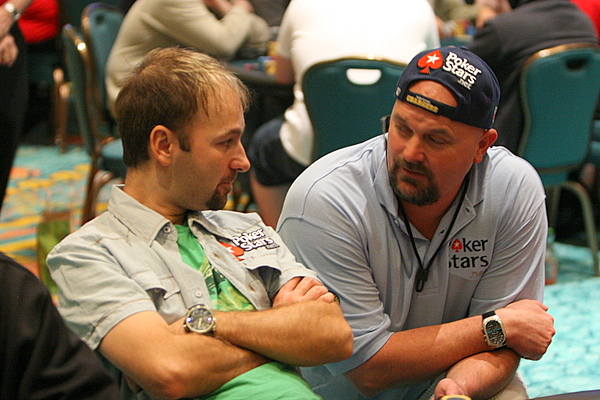

Anyone who has spent time playing sports will tell you this:
They almost always perform best when playing against or with someone much better than themselves.
Unfortunately, it's hard to raise your own poker game simply by playing against better players.
Who to Look To in Poker
Most of the decisions players make at the table are done privately. You can't emulate another player when you have no idea what they're doing and how they got to that decision.
The only way to get a glimpse into the mind of a better poker player is for that player to willingly share their thoughts and thought processes. And a solid discussion with a better player about specific parts of the game can be more useful than any book or article.
The reason is simple: the exact questions you have are answered and there are no holes left lingering after the lesson.

Although talking poker with anyone can be beneficial, certain people can offer much more insight and advice than others.
First, you want to be talking to someone who is stronger at the game or knows more than you. The discussion may be fun but it's rare for you to pick up any useful advice from someone who knows far less than you.
Second, you need to consider the person's ability to communicate their thought process. Doing something really well and being able to describe how you do it are two very different things.
It's better to have a discussion with a strong $5/$10 NL player who can clearly explain his thoughts than with a tight-lipped Phil Ivey.
Related Reading:
What to Talk About
The way the majority of humans learn best is through practice - trial and error, learning from our mistakes. To learn from a mistake, you have to:
- Make a mistake
- Understand and admit it was a mistake
- Figure out what the correct choice would have been
- Figure out why that is the correct choice
- Apply it to your game.
This mistake formula is crucial to becoming a great poker player. Technically you can use it with great results by yourself but discussing with a friend, peer or coach can greatly expedite the process and make it even more successful.
Here's the key to discussing the game: The best discussions come from you bringing up a legitimate situation where you think you made a mistake.
Hypothetical situations and abstract poker theory can be good but nailing down a specific situation you've encountered will, for most people, be much more helpful.
Take the situation with your mistake, describe it with as much detail as possible and then discuss.
You'll be using everything you learned in the first nine steps of How Not to Suck at Poker as the building blocks of your discussion, from evaluating your hand selection to counting outs to paying attention when you're not involved in a hand.
The more mistakes you can fix using the above formula, the fewer holes you'll have in your game. And every mistake you eliminate will be one more step towards not sucking at poker.
Related Reading:
Don't Be Afraid to Branch Out
Having friends that can beat the stakes and games you're playing is great. But hearing a different perspective on a hand or a concept can help you make the mental leap necessary to take your game to the next level.
If you're already starting to take poker a little more seriously you've likely begun hanging around with a few more people who also enjoy the game more than the average Joe.
If you don't have a network of poker friends like that in real life, don't feel disheartened. There are lots of other ways you can reach out and find the right network for you.
First, start online. Make an account and start posting on one of the big poker forums like TwoPlusTwo.
The forums are broken down into tons of subcategories based on everything from the games and stakes to specific hand situations and deeper strategy lessons.
If your fellow forum posters don't have the answers, they more than likely can direct you to someone who can. The poker sub-forum of Reddit is also a good place to start.
If you do play at a live casino, simply start asking around. Dealers, floor staff and players in bigger games will likely be happy to direct you to some of the more open and communicative players in your area.
Whatever you do, don't give up! It may take a while to find the right network you - and it may never be in your local area - but great poker friends are out there. You just have to find them.
Related Reading:
Watch our short video below to see how it's done!
More on How Not to Suck at Poker:
- How Not to Suck at Poker: Play Fewer Hands
- How Not to Suck at Poker: Play in Position
- How Not to Suck at Poker: Count Your Outs
- How Not to Suck at Poker: Learn Basic Odds
- How Not to Suck at Poker: Pay Attention
- How Not to Suck at Poker: Have a Bankroll
- How Not to Suck at Poker: Stop Bluffing
- How Not to Suck at Poker: Stop Talking So Much
- How Not to Suck at Poker: Track Your Results





I’ve been playing poker for a long time, more than a decade, but my skill is getting nowhere once it hits certain level where I’m at right now. After reading this article I found out certain things I did wrong but mostly right(thanks goodness). In my opinion, books/advices are valuable but they go hand-in-hand with practices. You have to apply these tips in the right place and right time. Right place refers to the type of players you’re playing with. The right time refers to knowing when to or not to depends on what you think about your opponents’ have. But of course there is no guarantee! The bottom line is you need a combination of math, discipline, and guts in order win and move to that next level! The more you play, then when you read a book the more it’s making sense. Playing and learning from books, and esp. other better players would help improve your game tremendously, stay alert to recognize your weaknesses, learn from them THEN apply your solution(this to me is the hardest part like the phrase said “it’s hard to teach an old dog a new trick”. Keep-on learning to trust yourself too, go with your educated guesses once in a while you’ll be wrong and get caught but it’s the only way to improve your game and totally committed and trusted in your skill! Poker is not a card game but rather is a people game that requires mostly skill + some percentage of luck depends on who you ask. You can know yourself, know your opponent, know the game, but you never know what people have since poker is a game is collecting missing information and that, my friends, made this game so much fun and challenging! You got to love it!!!!
JR, if that’s the case then widen up your range, especially in position, and just value bet them to death. Also, continue to increase your PF raise size until you are getting the hand HU or 3-way at most. If they are calling 5x BB raise, try 6. If they call 6, try 7. Rinse and repeat till you find a number that thins the field. Getting players to call with a dominated range is how you make money. You just have to be smart enough to know when TPTK or an overpair is no good – and generally, by the river, TPTK is going to be an average hand at best.
I find that obviously the top 15 hands should be respected at all times, but like flying twin engine airplanes that are superior to single engine planes, things can go wrong if both engines don’t function normally. These tips are meant for bigger stakes and more serious players that respect a quality bet. In a typical home game thats on the cheap everyone it seams calls to the river. For me anyway its more about relationships and knowing the other players. I love to play suited connectors when I have been raised by a player that only plays the top five on the list. If the bet isn’t to high, I will call knowing that if he doesn’t hit I can raise him out of the pot without hitting anything myself. It all depends on the people and knowing them. If you play strangers then stick to the basic principles outlined here.
Here’s my question….i am a low limit (10NL) player/casual. I have read a bit before similar to whats discussed on this site. I agree with / understand the strict calling policies (AA KK AKsuit etc through the listed 15 hands) but how do you beat people who call and call and call? I try to play only my best hands, and push them preflop, but when 3 or 4 people are calling bs cards (2-5, 8-3 etc) i mean garbage hands, they seem to hit more two pairs and straights and unnutted flushes. Even with decent preflop raises most will call and call flop and turn and river bets. Playing fewer hands well and more strongly is not new advice to me–it makes a hell of a lot of sense. However it doesnt seem to hold up against a table that doesnt know when to fold. when a whole table calls on gutshot draws or low pocket pairs seeking trips it seems that usually someone connects on the river to trump your A with K kicker. AA and AK lose more than they win at home games against people that you know chase it to the end. Do i need to move up against people that know to count their outs and fold to decent bet? I keep getting f’d by chumps with chump cards = im the chump. i can pick up blind money and stay afloat but eventually ill lose on KKK or QQQ to low 3-7 straight. I agree with triqui “all these hands should be folded by everyone, everywhere, all the time” but i have a similar experience to what TerryZ is talking about. I try to play fewer/better cards, play from position more, raise limps, but seem to consistently lose to people playing more hands with worse starting hands, that are willing to chase it to the riv every time. WTF, Over?
play tight.. this is every poker strategists advice.. but when you play online with many maniacs you cannot figure out which hands they are playing.. you may advice to fold JJ against a preflop all in when all that guy have is Ax , JQ , KT, etc.. or even the suited connectors.. i dont think this ABC poker is viable online with those guys playing like having dealt AA, KK, QQ all the time..
Although I consider myself a skilled advanced player, I read this just to refresh myself and found most of the tips will be very usefull for beginers. Especialy the mistakes part, making mistakes is a big part in becoming a good player, learning from them is key. If you are just starting out, play lower limit cash games as much as you can, as often as you can, so that the mistakes you make wont cost you too much. There are still mistakes I make in my play that after a session I think back and recognize and address a way to fix that perticular weakness.
I want to add that although these are great tips for starting out, if you dont evolve your game and move into advanced techniques you will NOT win in the long term. So always look for new ways to play, after a while in low limits, MOVE UP! Dont be afraid!
ps. Live poker vs online is a huge difference, these tips in my opp will work best live, as you will be more timid and following a stern set of starting hands at first will help your confidence.
TerryZ, you can’t be wronger. All the hands you have named should be fold every time, everywhere, by everyone. And that includes most of the most aggresive pros. A Jack and Seven means Jack. Pun intended. Sure, more than 15 hands should be played. That’s why there is also an article about position, and semibluff, etc. For example, you could play 44 in position, rasing to steal the Blinds, becouse even if you are called, you still have a hand. You could also try to steal “sometimes” with 89s when in position if everybody folds up to you. This article only try to tell you that if you play stupid hands such as Seven and Jack, or 62s, or if you raise in early position with KJ and call a reraise, you will find yourself broke faster you can say “sharks eat fish”
Now I will say that many of the tips do work. I learned so much from this site after only one day. Now I will try to play a while but at first glance I suck, and I mean bad. But after reading this web site I learned how not to suck soo bad. It is a trip to me how many duces and fours make it around the table compaired to Ace King or Ace Queen hands.
Some tips work some don’t. Like trying the top 15 hands rule for beginners. I have lost countless games online waiting for those top 15 hands. If you read it, found under hands to play, it reads that beginners should only play the top 15 hands, period. I follow that rule as a beginner but then I get dealt 6 hearts and a 2 of clubs, or seven and a jack or 9 of spades and a 3 of hearts. This goes on and on while waiting for a top hand. This game is a game of chance. So most hands either have to be bluffed, and I read here not to bluff, or you have to fold 100 times to get one good hand. Why bother?
Do you know how many hands you have to play to build up a pot just to stay in the game? So if you don’t bluff at least a couple times you will always fold or over bet. I just won a hand with a six and a duce. Go figure.
This game is not so much skill as much as luck and not so much as luck but more skill. So get something that is lucky and rub it and then try to play low ball a few times. Then play this game then play pool then play darts and if you win at all of those games save up a bank roll and play poker. I just bluffed with a five and a duce. This game is too much meaning, too much like fun and weird at the same time.
Rupert,
The answer is both yes and no. The closer you are to the button, the more hands you can play, but you’re still wanting to only stick to your legitimate starting hands. The button just allows you to make calls, or raises with hands you may have had to fold OOP.
As a beginner, article one was immensley helpful, but i was under the impression that there was something of a gradutated system, so-as the closer one is to the button the more hands one bets. Is this untrue? The article on counting outs was very helpful as well.
a set of articales to inspire and assist the new player thankyou
tony c
Rray, I like that idea. I’ll see what I can do. Keep your eyes peeled for it.
FYI, if it happens it won’t be for a couple of weeks, lots on the go during WSOP time.
Hi Sean
Thanks for an excellent series of articles.
Following on from your last post, I would like to request that you write an article on playing A-x.
I’ve graduated from being like a deer in head lights upon seeing an ace in my hand some time ago, to almost dreading the little fellas. They seem to be overvalued a great deal online but do win their fair share of pots.
Your insight on playing A-x (2 to Q), suited and none, would be appreciated.
Hey Sean, great series! Thank you very much!
YT,TT